
Everything You Need to Know About ISO 14001 Certification Before Applying
Environmental sustainability is no longer just a corporate responsibility — it has become a business necessity. Governments, customers, and stakeholders increasingly expect organizations to minimize environmental impact and operate responsibly. One of the most effective ways to demonstrate this commitment is through iso 14001 certification india, a globally recognized standard for Environmental Management Systems (EMS).
ISO 14001 provides a structured framework that helps organizations identify environmental risks, comply with regulations, and implement sustainable practices. Before applying for certification, businesses must understand the requirements, process, and benefits associated with the standard.
This comprehensive guide explains ISO 14001 certification essentials, common questions, and key considerations to help organizations prepare effectively.
Understanding ISO 14001 Certification
ISO 14001 is an international standard that outlines requirements for establishing and maintaining an Environmental Management System. It focuses on identifying environmental aspects, managing risks, and promoting continual improvement.
Organizations pursuing iso 14001 certification india aim to:
- Reduce environmental impact
- Improve resource efficiency
- Ensure regulatory compliance
- Enhance sustainability performance
- Strengthen brand reputation
Certification demonstrates that an organization has implemented effective environmental management processes aligned with global best practices.
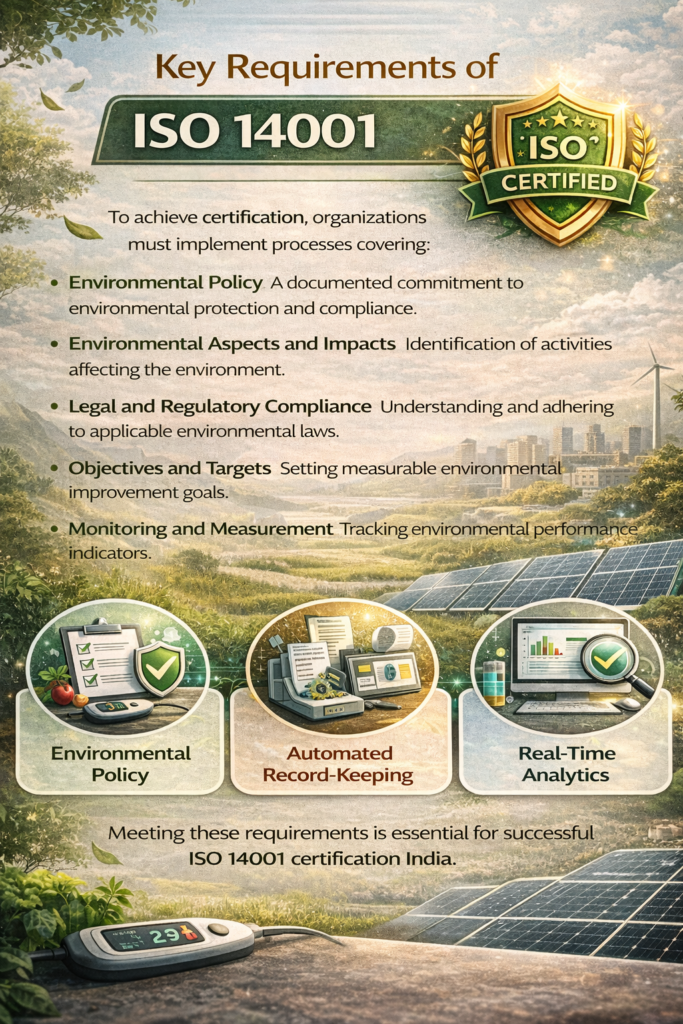
Key Requirements of ISO 14001
To achieve certification, organizations must implement processes covering:
Environmental Policy
A documented commitment to environmental protection and compliance.
Environmental Aspects and Impacts
Identification of activities affecting the environment.
Legal and Regulatory Compliance
Understanding and adhering to applicable environmental laws.
Objectives and Targets
Setting measurable environmental improvement goals.
Operational Controls
Implementing procedures to manage environmental risks.
Monitoring and Measurement
Tracking environmental performance indicators.
Internal Audits and Management Review
Evaluating system effectiveness and driving continuous improvement.
Meeting these requirements is essential for successful iso 14001 certification india.
Benefits of ISO 14001 Certification
Regulatory Compliance
ISO 14001 helps organizations systematically monitor environmental regulations and avoid penalties.
Cost Savings
Efficient resource utilization and waste reduction lead to operational cost savings.
Enhanced Reputation
Certification demonstrates commitment to sustainability, improving stakeholder trust.
Risk Management
Structured risk assessment reduces environmental incidents and liabilities.
Competitive Advantage
Certified organizations often gain preference in procurement and partnership opportunities.
Can you self-certify ISO 14001?
Organizations cannot officially self-certify ISO 14001. While they can implement an Environmental Management System internally, formal certification requires an independent audit to verify compliance with ISO standards.
Self-assessment can be valuable for readiness evaluation, but official iso 14001 certification india must be obtained through accredited certification processes to ensure credibility and recognition.
Is ISO 14001 certification worth it?
ISO 14001 certification offers long-term value beyond compliance. It enhances operational efficiency, strengthens corporate image, and supports sustainability goals.
For organizations operating in environmentally sensitive industries, certification may be essential for regulatory compliance and market access. Even for smaller businesses, iso 14001 certification india provides a structured approach to environmental responsibility and risk reduction.
How long is an ISO 14001 certificate valid?
ISO 14001 certification usually lasts for three years. During this period, organizations undergo periodic surveillance audits to ensure ongoing compliance.
At the end of the certification cycle, recertification audits are conducted to maintain validity. Continuous improvement and system maintenance are essential for sustaining iso 14001 certification india.
How to get ISO certification cost?
The price of ISO certification depends on a few factors, such as:
- Organizational size and complexity
- Scope of certification
- Implementation effort required
- Audit duration and frequency
While cost considerations are important, organizations should view certification as a strategic investment that delivers long-term environmental and operational benefits.
How long does it take to become ISO 14001 certified?
The certification timeline varies based on organizational readiness and complexity.
Small Organizations
May achieve certification within a few months if processes are already structured.
Medium and Large Organizations
May require additional time for system development, training, and documentation.
Preparation, gap analysis, and implementation significantly influence the overall timeline for iso 14001 certification india.
How much does ISO accreditation cost?
ISO accreditation costs vary depending on certification scope and implementation requirements. Factors influencing cost include documentation development, employee training, and audit preparation.
Organizations should focus on value creation rather than cost alone, as iso 14001 certification india delivers measurable benefits through improved environmental performance and compliance.
Can a person get ISO 14001 certification?
ISO 14001 certification applies to organizations rather than individuals. However, individuals can receive training and qualifications related to environmental management, auditing, or implementation.
Such training enhances professional competency and supports organizational certification efforts.
How to apply for ISO certification?
Applying for ISO 14001 certification involves several structured steps.
Step 1: Conduct a Gap Analysis
Evaluate existing environmental practices against ISO requirements.
Step 2: Develop an Environmental Management System
Develop policies, procedures, and documents that follow ISO 14001.
Step 3: Employee Training and Awareness
Educate employees on environmental responsibilities and system processes.
Step 4: Internal Audits
Assess system effectiveness and address nonconformities.
Step 5: Certification Audit
Undergo external audits to verify compliance.
Successful completion of these steps leads to iso 14001 certification india.
Documentation Requirements for ISO 14001
Key documentation includes:
- Environmental policy
- Aspect and impact assessments
- Legal compliance records
- Objectives and targets
- Operational procedures
- Monitoring and measurement data
- Audit and review records
Accurate documentation supports transparency and audit readiness.
Challenges in ISO 14001 Implementation
Organizations may face challenges such as:
- Limited awareness of environmental risks
- Resource constraints
- Resistance to change
- Documentation complexity
Addressing these challenges requires leadership commitment and employee engagement.
Best Practices for Successful Certification
- Engage top management in environmental initiatives
- Establish measurable environmental objectives
- Maintain clear documentation
- Conduct regular internal audits
- Promote continuous improvement
These practices enhance the effectiveness of iso 14001 certification india.
Integration with Other ISO Standards
Integrating iso 14001 certification india with other ISO standards such as ISO 9001 and ISO 45001 helps organizations create a unified and efficient management system. When businesses align quality, environmental, and occupational health processes, they reduce duplication and streamline operations.
Through integrated implementation, iso 14001 certification india supports shared documentation, combined internal audits, and coordinated risk management activities. This approach ensures that environmental objectives are aligned with quality goals and workplace safety initiatives.
Organizations pursuing iso 14001 certification india often benefit from the Annex SL structure, which allows multiple standards to follow similar clauses and management principles. As a result, policies, procedures, and performance indicators can be harmonized across systems. Integrated management also enhances decision-making by providing a comprehensive view of organizational risks and opportunities.
Businesses implementing iso 14001 certification india alongside other standards can improve resource utilization, strengthen compliance, and foster a culture of continuous improvement. Ultimately, integration simplifies certification maintenance and maximizes the overall value of management system investments.
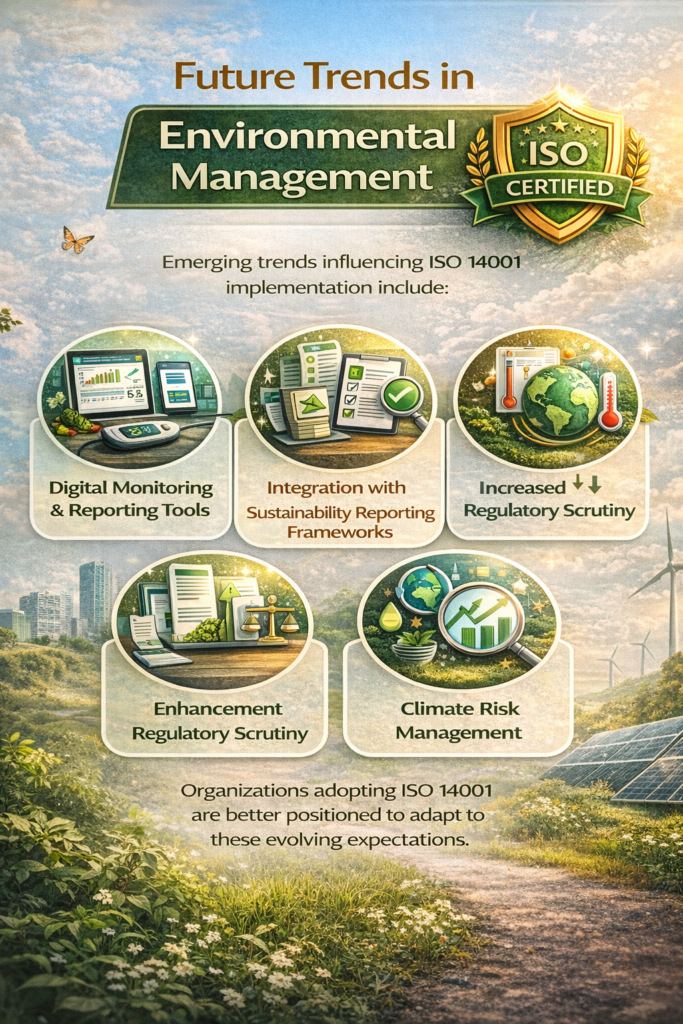
Future Trends in Environmental Management
Emerging trends influencing ISO 14001 implementation include:
- Digital monitoring and reporting tools
- Integration with sustainability reporting frameworks
- Increased regulatory scrutiny
- Greater emphasis on climate risk management
Organizations adopting ISO 14001 are better positioned to adapt to these evolving expectations.
Final Thoughts
Achieving iso 14001 certification india is a strategic step toward building environmentally responsible and sustainable business operations. By implementing a structured Environmental Management System, organizations pursuing iso 14001 certification india can systematically identify environmental aspects, control impacts, and ensure compliance with regulatory requirements. This proactive approach enhances operational efficiency and strengthens stakeholder confidence.
Although obtaining iso 14001 certification india requires careful planning, documentation, and employee engagement, the long-term benefits significantly outweigh the initial effort. Certification helps organizations reduce waste, optimize energy use, and improve environmental performance while demonstrating accountability to customers and regulators. Businesses that invest in iso 14001 certification india also gain improved market credibility and competitive advantage in sustainability-focused industries.
Organizations that prepare effectively, train employees, and conduct regular performance reviews can maintain iso 14001 certification india successfully. Continuous improvement remains a core principle, enabling businesses to adapt to evolving environmental expectations. Ultimately, adopting iso 14001 certification india supports resilience, responsible growth, and a stronger commitment to environmental stewardship in an increasingly sustainability-driven global marketplace.