
What Does Third Party ISO Certification India Actually Validate in Your Business?
ISO certification is often viewed as a certificate that demonstrates an organization follows a particular standard. However, the real value of certification goes beyond displaying a document on a website or office wall. A proper third-party audit provides independent evidence that an organization’s management system has been assessed against the requirements of a specific ISO standard.
For businesses considering third party ISO certification India, it is important to understand what the certification actually validates. It does not simply confirm that a company has prepared policies or completed paperwork. It examines whether relevant processes have been established, implemented, monitored, and maintained within the defined certification scope.
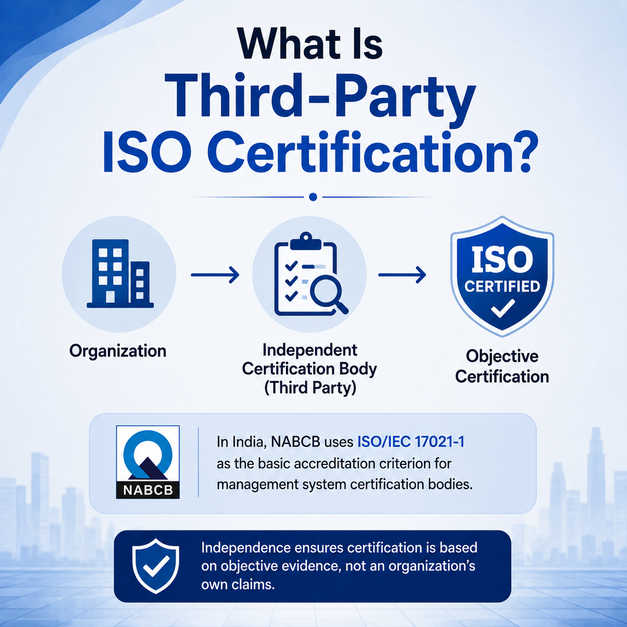
What Is Third-Party ISO Certification?
Third-party certification means that an independent certification body assesses an organization’s management system. The organization being certified and the certification body should have an appropriate independent relationship so that the assessment can be conducted objectively.
For management system certification, certification bodies operate according to requirements established for bodies that audit and certify management systems. In India, NABCB uses ISO/IEC 17021-1 as a basic accreditation criterion for management system certification bodies.
This independence is important because the certification should be based on objective evidence rather than an organization’s own claims.
It Validates Your Management System
One of the main things a third-party audit evaluates is whether your management system meets the requirements of the selected ISO standard.
For example, depending on the standard, an organization may need to demonstrate how it manages processes, responsibilities, risks, objectives, resources, records, performance, and improvement.
The auditor does not simply ask whether a procedure exists. The auditor may look for evidence that employees actually follow the defined process and that the process produces the intended results.
This distinction is important. A company can have impressive-looking documents but still have an ineffective management system if employees do not follow them consistently.
It Validates That Processes Are Actually Implemented
Implementation is one of the most important aspects of certification.
During an audit, evidence may come from interviews, records, observations, reports, process monitoring, and other relevant information. Auditors can compare documented procedures with what employees actually do.
For example, if an organization has a process for handling customer complaints, the audit may examine whether complaints are recorded, investigated, addressed, and reviewed for recurring problems.
This means third party ISO certification India can provide an external assessment of whether the management system is functioning in practice rather than existing only on paper.
It Validates Defined Responsibilities
An effective management system requires people to understand their responsibilities.
Third-party assessment can examine whether relevant responsibilities and authorities have been established and whether employees understand the activities they are expected to perform.
When responsibilities are unclear, tasks can be missed, duplicated, or handled inconsistently.
Clear accountability can help organizations manage processes more effectively and identify who is responsible for monitoring performance, addressing problems, and implementing improvements.
It Validates Evidence-Based Practices
ISO certification relies heavily on objective evidence.
An auditor generally needs evidence to determine whether applicable requirements are being met. Depending on the standard, this evidence could include records, measurements, reports, monitoring results, internal audit findings, customer feedback, training records, corrective actions, or other documented information.
This creates an important difference between saying that a process works and demonstrating that it works.
A well-maintained record can show what happened, when it happened, who was responsible, and what action was taken when necessary.
It Validates Monitoring and Performance Evaluation
A management system should not remain unchanged after implementation. Organizations need to monitor relevant processes and evaluate whether objectives are being achieved.
Third-party audits can therefore examine how an organization measures and reviews its performance.
For example, an organization may monitor customer complaints, delivery performance, process errors, product conformity, service results, or other indicators relevant to its objectives.
The exact measures depend on the organization and the ISO standard. The important point is that performance should be evaluated using information that supports informed decisions.
It Validates Corrective Action
Problems can occur in every organization. ISO certification does not mean that an organization will never experience a mistake, complaint, nonconformity, or operational issue.
Instead, a mature management system should have a method for identifying problems, understanding their causes, taking corrective action, and checking whether the action was effective.
During an audit, evidence of previous problems and the actions taken to address them may be reviewed.
This helps demonstrate whether the organization is learning from problems rather than repeatedly treating the same issue without addressing its underlying cause.
It Validates Internal Auditing and Management Review
Internal audits and management reviews are important parts of many ISO management systems.
An internal audit gives an organization an opportunity to evaluate its own processes before an external assessment. Management review allows leadership to examine the performance and continuing suitability of the management system.
A third-party auditor may review evidence showing that these activities have been conducted appropriately and that findings or decisions have been addressed.
This demonstrates that the management system is being actively managed rather than left unattended between certification audits.
It Validates the Agreed Certification Scope
Certification does not automatically include every activity an organization carries out.
The certification has a defined scope describing the activities, locations, and processes covered by the assessment. This scope is important because it explains exactly what the certification applies to.
Organizations should therefore avoid making broad claims that go beyond their certified scope.
A properly defined scope provides clarity to customers, business partners, and other interested parties about which activities have been assessed.
It Does Not Validate Everything About Your Business
There is an important limitation to understand.
ISO certification does not mean that every product, service, employee, financial decision, or business activity is perfect. It does not automatically guarantee customer satisfaction or eliminate every operational risk.
Instead, certification confirms that the relevant management system has been assessed against the requirements of the applicable standard within the agreed scope.
Understanding this distinction prevents organizations from making exaggerated claims about what their certificate represents.
Why Accreditation Matters
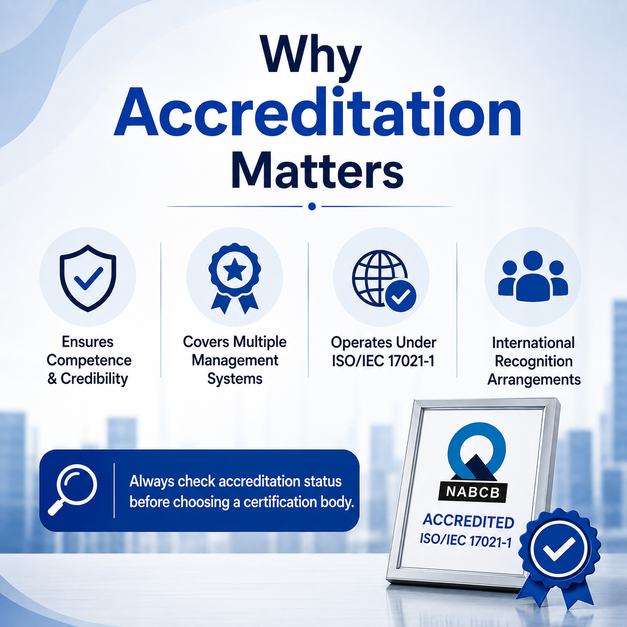
When choosing a certification provider, businesses should consider whether the certification body has appropriate competence and accreditation for the relevant standard and scope.
NABCB maintains accreditation programmes for various management systems, including quality management systems, environmental management systems, information security management systems, food safety management systems, and others.
NABCB also states that its management system accreditation operates under ISO/IEC 17021-1 requirements and that it has international recognition arrangements through relevant accreditation cooperation frameworks.
This makes checking accreditation status an important part of selecting a certification arrangement.
How Businesses Can Prepare for Third-Party Certification
Organizations preparing for third party ISO certification India should focus on implementation rather than simply preparing for an audit.
Start by understanding the selected standard and identifying gaps in existing processes. Establish appropriate procedures, responsibilities, objectives, controls, and records. Train relevant employees and make sure processes are followed consistently.
Conduct internal audits to identify weaknesses and complete management reviews to evaluate overall performance. Correct identified issues before the external assessment where possible.
Most importantly, employees should understand why processes exist and how their work contributes to the organization’s objectives.
Conclusion
Third-party ISO certification provides more than a certificate. It offers an independent assessment of whether an organization’s management system meets applicable requirements within a defined scope.
It can validate that processes are established and implemented, responsibilities are defined, performance is monitored, evidence is maintained, problems are addressed, internal audits are conducted, and management remains involved in continual improvement.
For organizations considering third party ISO certification India, the focus should therefore be on building a management system that genuinely supports the business. Certification should be viewed as an opportunity to strengthen consistency, accountability, process control, and continual improvement rather than simply as a compliance document.