ISO Certification in Singapore: Requirements, Process & Cost
ISO certification helps organizations demonstrate that their management systems follow recognized international requirements. In Singapore, businesses across manufacturing, construction, healthcare, food, technology, logistics, and professional services may pursue certification to improve processes, meet customer expectations, strengthen supplier relationships, or support business growth.
For organizations researching ISO certification Singapore, understanding the requirements, process, and factors affecting cost can make preparation easier. Certification is more than just getting a certificate. It involves establishing a management system, implementing it in daily operations, monitoring its performance, and improving it when necessary.
What Is ISO Certification?
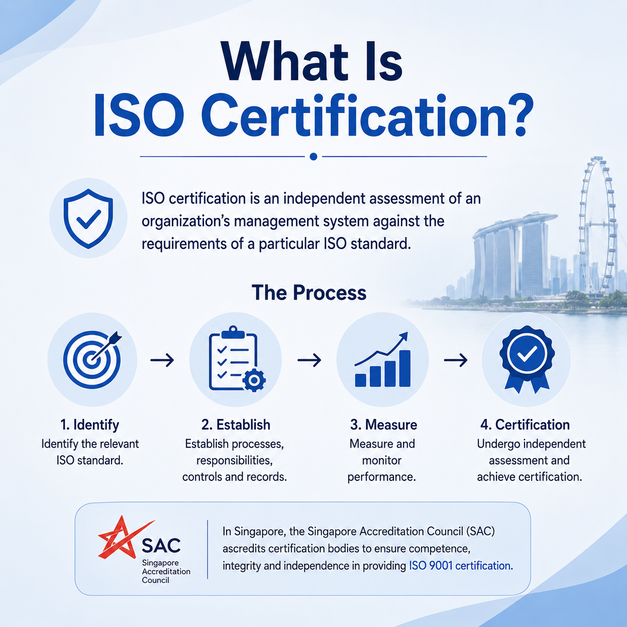
ISO certification is an independent assessment of an organization’s management system against the requirements of a particular ISO standard. Different standards address different areas, including quality management, environmental management, information security, occupational health and safety, food safety, and business continuity.
An organization first identifies the standard relevant to its objectives. It then establishes appropriate processes, responsibilities, controls, records, and performance measures.
In Singapore, the Singapore Accreditation Council (SAC) operates accreditation programmes for management system certification bodies. Its quality management system certification scheme evaluates certification bodies for competence, integrity, and independence when providing ISO 9001 certification.
Why Do Businesses in Singapore Seek ISO Certification?
Businesses may pursue certification because customers, contracts, supply chains, or internal objectives require a structured approach to management.
A properly implemented management system can help organizations standardize processes, clarify responsibilities, monitor performance, manage complaints, identify risks, and take corrective action.
Certification can also provide additional confidence to customers and business partners when it is issued through an appropriate independent certification process. However, the value does not come from the certificate alone. The management system should be useful and actively maintained.
For companies considering ISO certification Singapore, it is important to first identify what business objective the certification should support.
What Are the Main ISO Requirements?
The exact requirements depend on the selected standard. Management system standards commonly require organizations to understand their context, define responsibilities, establish objectives, provide resources, control operations, monitor performance, and improve their systems.
Documentation may be required, but certification does not mean creating unnecessary paperwork. Documents and records should support effective processes and provide evidence that requirements are being followed.
The system should also consider relevant customers, interested parties, legal requirements, operational risks, and opportunities for improvement. It should reflect the organization’s actual activities rather than relying on generic templates.
Step 1: Select the Right ISO Standard
The first step is identifying the standard that matches the organization’s needs.
For example, an organization focused on quality may consider ISO 9001, while a business concerned with information security may require ISO 27001. Other standards address environmental management, occupational health and safety, food safety, energy management, and business continuity.
The certification scope should also be clearly defined. It should identify the activities, locations, and functions covered by the management system.
A clear scope helps prevent confusion and ensures that the assessment focuses on the organization’s actual requirements.
Step 2: Review Existing Processes
Before creating new procedures, understand how the organization currently operates.
Review customer requirements, purchasing, operations, employee responsibilities, supplier controls, complaints, records, performance monitoring, and corrective actions.
A gap assessment can then compare current practices with the requirements of the selected standard. The findings should become an action plan with responsibilities and realistic deadlines.
This approach is more effective than creating documents first and trying to make the business fit them later.
Step 3: Develop and Implement the Management System
After identifying gaps, the organization can establish or improve its management system.
This may involve policies, procedures, work instructions, forms, records, objectives, risk controls, and monitoring methods. Documentation should support actual work rather than create unnecessary administrative work.
Employees should understand their responsibilities and how their work contributes to organizational objectives.
Management involvement is equally important. A management system should not depend entirely on one employee or department. It needs support from leadership and participation across relevant areas of the organization.
Step 4: Maintain Records and Measure Performance
A management system needs evidence that important processes are being followed.
Depending on the standard, records may include customer feedback, training records, supplier evaluations, complaints, corrective actions, process measurements, meeting records, and internal audit results.
The organization should establish useful performance indicators and regularly review results.
When performance does not meet expectations, the organization should investigate the cause and take appropriate corrective action. This helps prevent the same problem from repeatedly occurring.
Step 5: Conduct an Internal Audit
An internal audit allows the organization to evaluate its management system before the independent certification assessment.
Auditors review relevant processes and records to determine whether requirements are being met and whether established processes are being followed.
Findings should be documented and addressed.
A good internal audit is not simply a checklist exercise. It can identify weaknesses, confirm effective practices, and provide management with information for improvement.
Step 6: Conduct a Management Review
Top management should periodically review whether the management system remains suitable and effective.
The review can consider audit results, customer feedback, objectives, process performance, nonconformities, corrective actions, risks, opportunities, and resource requirements.
Management review demonstrates that certification is not merely an administrative responsibility. Leadership needs to remain involved in evaluating performance and deciding where improvements are necessary.
Step 7: Choose an Appropriate Certification Body
After implementation, the organization can select an independent certification body.
When considering ISO certification Singapore, businesses should review the certification body’s competence, certification scope, independence, and relevant accreditation status.
SAC’s management system certification programme is based on requirements for certification bodies, including ISO/IEC 17021-1. Accredited certification can provide greater confidence in the competence and independence of the certification process.
Step 8: Complete the Certification Audit
The certification body assesses the management system against the selected standard and agreed scope.
Relevant employees and records should be available during the assessment. Employees do not need to memorize prepared answers; they should understand their actual responsibilities and be able to explain how they perform their work.
If nonconformities are identified, the organization may need to investigate their causes, implement corrective action, and provide appropriate evidence according to the certification process.
What Determines ISO Certification Cost in Singapore?
There is no single fixed cost for ISO certification Singapore. The overall cost depends on the organization and its certification scope.
Important factors include:
- Selected ISO standard
- Number of employees
- Number of locations
- Complexity of operations
- Certification scope
- Audit duration
- Management system readiness
- Internal resources
- Consultancy or training requirements
- Ongoing surveillance arrangements
A larger organization with several locations and complex processes will generally require more audit effort than a smaller organization with a limited scope.
Businesses should therefore request a quotation based on their specific requirements rather than relying on a general price shown online.
How Long Does ISO Certification Take?
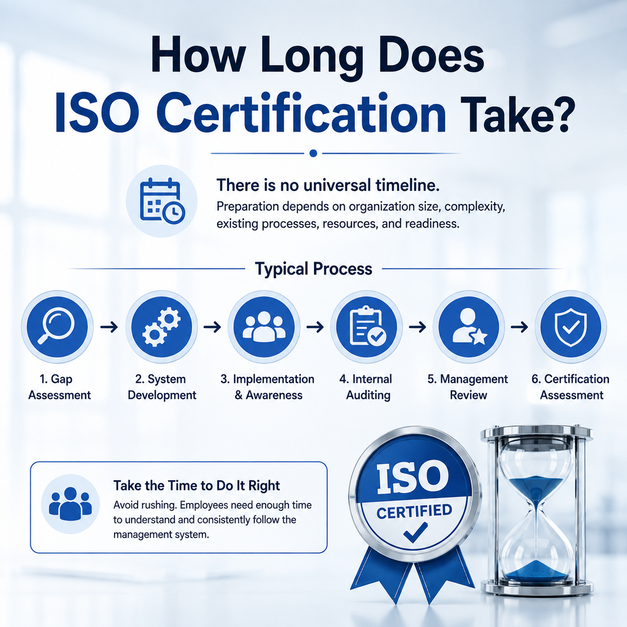
There is no universal timeline. Preparation depends on organization size, complexity, existing processes, resources, and readiness.
The process may include gap assessment, system development, implementation, employee awareness, internal auditing, management review, corrective actions, and certification assessment.
Organizations should avoid rushing implementation simply to obtain a certificate. Employees need enough time to understand and consistently follow the management system.
What Happens After Certification?
Certification is not the end of the process. Organizations need to continue operating and improving their management systems.
Processes should be reviewed, performance should be monitored, internal audits should continue, and corrective actions should be completed when problems occur. Surveillance or follow-up assessments may also form part of the certification arrangement.
Continual improvement is important because customer expectations, business risks, technology, and regulatory requirements can change over time.
Conclusion
Obtaining ISO certification Singapore is best approached as a structured business improvement project rather than a paperwork exercise. Organizations should select the appropriate standard, define the scope, review existing processes, identify gaps, implement the management system, involve employees, monitor performance, conduct internal audits, and complete management review before certification.
Cost depends on factors such as the selected standard, organization size, number of locations, operational complexity, audit requirements, and preparation level. Therefore, a scope-specific quotation is more useful than a general price estimate.