
How to Get ISO 9001 Certification in the UAE: A Simple Guide
Quality has become an important part of doing business in the UAE. Customers, business partners, government entities, and supply chains increasingly expect organizations to maintain reliable processes and consistent results. ISO 9001 provides a structured framework for developing and improving a quality management system (QMS). It can be applied to organizations of different sizes and sectors. ISO explains that the standard helps organizations consistently meet customer and applicable requirements while improving customer satisfaction.
For businesses planning ISO 9001 certification UAE, understanding the process before starting can make the journey more organized. Certification is not simply about preparing documents and receiving a certificate. It involves establishing a working management system, reviewing how the organization operates, identifying areas for improvement, and demonstrating that the system is effective.
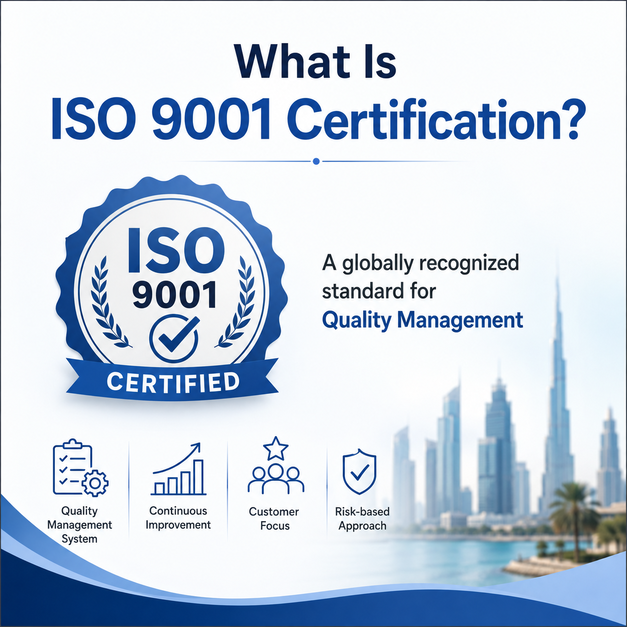
What Is ISO 9001 Certification?
ISO 9001 is a globally recognized standard for managing quality. It provides requirements for establishing, implementing, maintaining, and continually improving a QMS. The framework can apply to manufacturing companies, service providers, construction businesses, healthcare organizations, technology companies, trading firms, and many other organizations.
The purpose is not to make every organization operate in exactly the same way. Instead, each organization develops a system that fits its activities while considering customer needs, applicable requirements, risks, responsibilities, performance, and improvement.
For businesses considering ISO 9001 certification UAE, this flexibility makes the standard suitable for both growing companies and established organizations.
Why Do UAE Businesses Consider ISO 9001?
Organizations may pursue certification for different reasons. Some want to improve internal processes, while others need to demonstrate their quality practices to customers, partners, or supply chains.
A well-implemented QMS can help an organization create consistent processes, clarify responsibilities, monitor performance, manage risks, address customer complaints, and identify opportunities for improvement. ISO highlights customer focus, leadership, process management, evidence-based decision-making, and continual improvement as important elements of quality management.
Certification can also provide external confidence when a certificate is issued by an appropriate independent certification body. ISO distinguishes certification from accreditation, with accreditation providing formal recognition of a certification body’s competence.
Step 1: Understand Your Current Processes
Before beginning implementation, understand how your organization currently works. Map important activities from receiving customer requirements through delivery, service, feedback, and follow-up.
Look at where errors occur, where responsibilities are unclear, how complaints are handled, and how performance is measured. This gives management a practical starting point.
Do not create a system only to satisfy an audit. The objective should be to build processes that genuinely help the organization operate more consistently.
Step 2: Identify the Gaps
Once current processes are understood, compare them with the applicable ISO 9001 requirements. This is commonly called a gap assessment.
The review may identify missing documented information, unclear responsibilities, weak monitoring methods, inconsistent processes, or areas where corrective action is not properly followed.
The results can be organized into an action plan with responsibilities and target dates. This makes implementation easier to manage and helps the organization focus on important improvements.
Step 3: Establish the Quality Management System
The organization can then develop or improve its QMS. The system should reflect actual business activities rather than simply copying generic documents.
ISO 9001 covers areas such as organizational context, leadership, planning, support, operations, performance evaluation, and improvement. The organization should determine what applies to its activities and establish appropriate processes and controls.
Employees should understand their responsibilities and how their work affects quality and customer satisfaction.
Step 4: Maintain Appropriate Documentation
Documentation is an important part of a QMS, but having more documents does not automatically mean better quality.
Organizations should maintain the documented information needed to support effective processes and demonstrate that requirements are being met. Records may include policies, objectives, process information, monitoring results, complaints, corrective actions, and evidence of performance.
Documentation should be practical, understandable, controlled, and easy for employees to use.
Step 5: Monitor and Improve Performance
After the QMS is implemented, the organization needs to check whether it is actually working.
Set suitable quality objectives and monitor relevant indicators. Review customer feedback, complaints, process results, nonconformities, and other useful information.
When problems occur, investigate their causes and take appropriate corrective action. The objective is not simply to fix an individual mistake but to reduce the possibility of the same problem happening again.
This continual improvement approach is one of the central ideas behind ISO 9001.
Step 6: Conduct an Internal Audit
An internal audit provides an opportunity to check the QMS before an external certification audit.
Internal auditors review whether processes are being followed and whether the management system meets applicable requirements. Findings should be recorded and handled properly.
Internal auditing can also give management a clearer view of what is working well and where improvements are needed.
Step 7: Conduct a Management Review
Top management should periodically review the QMS and its performance. The review can consider objectives, audit results, customer feedback, process performance, nonconformities, corrective actions, risks, opportunities, and resource requirements.
This demonstrates that quality management is not simply an administrative responsibility. Leadership involvement is an important part of an effective quality management system.
Step 8: Select an Independent Certification Body
When the organization is ready for certification, it can select an independent certification body to audit the management system.
ISO recommends evaluating certification bodies and checking that the relevant certification approach is being used. Organizations may also consider whether the certification body is appropriately accredited for the required scope.
The certification body evaluates the organization’s management system against the applicable requirements and determines whether certification conditions have been met.
Step 9: Prepare for the Certification Audit
Before the audit, make sure employees understand the processes relevant to their responsibilities. Review important records and confirm that identified corrective actions have been completed where necessary.
Employees should not simply memorize answers for an audit. They should understand what they do, why they do it, and how their work supports quality.
During the audit, provide accurate information and evidence. If nonconformities are identified, they should be addressed according to the certification body’s established process.
What Happens After Certification?
Getting certified is not the end of quality management. The QMS should remain effective and keep improving over time.
Organizations should continue monitoring performance, conducting internal audits, reviewing the system, addressing problems, and maintaining relevant records.
Follow-up or surveillance activities may also form part of the certification arrangement. Continued attention is important because a quality system should support everyday business performance rather than exist only for an audit.
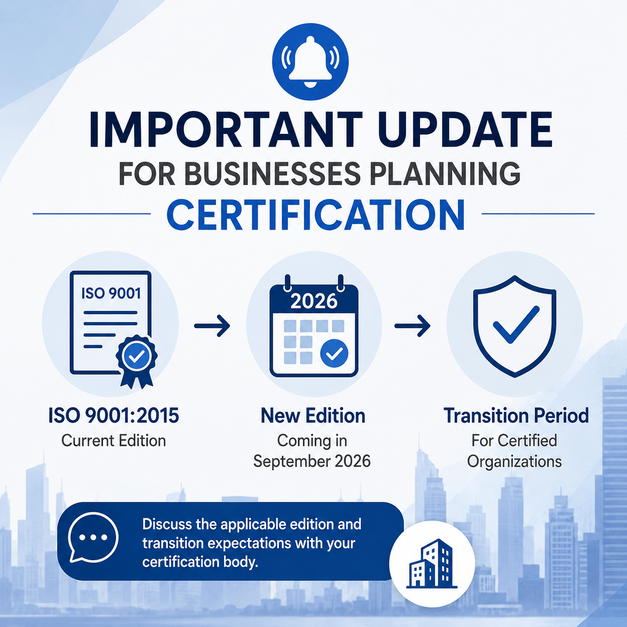
Important Update for Businesses Planning Certification
Businesses planning ISO 9001 certification UAE should be aware that the standard is being revised in 2026. ISO currently identifies ISO 9001:2015 as the published edition, while the sixth edition is under publication and is expected to replace the 2015 edition in September 2026. ISO states that organizations certified to the current edition will receive a transition period to move to the revised edition.
Organizations beginning their QMS journey should therefore discuss the applicable edition and transition expectations with their chosen certification body before finalizing their certification plans.
Conclusion
Getting ISO 9001 certification in the UAE is best approached as a business improvement project rather than a paperwork exercise. Start by understanding current processes, identify gaps, establish a practical QMS, involve employees, monitor performance, conduct internal audits, review results, and prepare for independent certification.
For organizations planning ISO 9001 certification UAE, early preparation can make the process clearer and help ensure that the management system becomes part of everyday operations.
The real benefit of ISO 9001 is using it to improve consistency, customer satisfaction, decision-making, and ongoing improvement. A certificate may demonstrate conformity, but a well-used quality management system can contribute to stronger and more sustainable business performance.