
Why Does a Business Need an IAF Accredited Certification Body?
When a business decides to obtain ISO certification, choosing the right certification body is as important as preparing the management system itself. Many organizations focus on policies, procedures, internal audits, and employee awareness but overlook who will conduct the certification audit.
An independent and appropriately accredited certification body provides confidence that the management system has been assessed against recognized requirements. This is especially important when certification needs to be accepted by customers, suppliers, regulators, or international business partners.
For companies searching for an IAF accredited certification body India, it is important to understand what accreditation means, why it matters, and what should be checked before selecting a certification body.
What Is an IAF Accredited Certification Body?
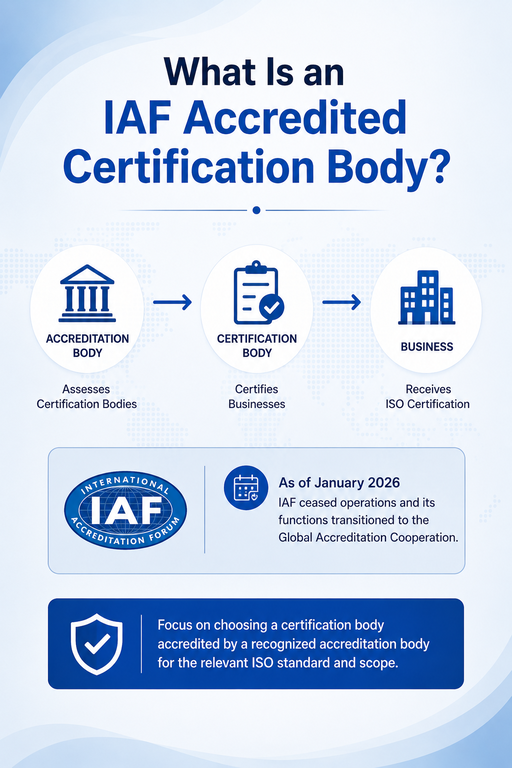
The term “IAF accredited certification body” is commonly used in the ISO industry. Technically, IAF was not the organization that directly certified businesses. Accreditation bodies assessed certification bodies, while international recognition arrangements helped establish confidence in accredited conformity assessment results.
As of January 2026, IAF ceased operations and its functions transitioned to the Global Accreditation Cooperation. Businesses should therefore focus on whether a certification body is accredited by a recognized accreditation body for the particular ISO standard and scope required.
Why Does Accreditation Matter?
Accreditation provides an additional level of confidence in the certification process. A certification body needs to demonstrate competence, impartiality, and suitable procedures for auditing and certifying management systems.
This creates a structured chain of confidence: ISO standard, certification body, accreditation body, and international recognition.
The purpose is to make certification results more reliable and comparable. An appropriately accredited certification body is therefore different from a provider that simply issues certificates without a recognized accreditation framework.
Independent Assessment Builds Trust
One major benefit of choosing an IAF accredited certification body India is independent evaluation. A certification audit should not be treated as a simple document-checking exercise. Auditors assess whether the management system meets the applicable requirements and whether it has actually been implemented.
An organization may have policies, procedures, and audit reports, but the auditor should also determine whether employees follow the processes and whether there is evidence that the system is functioning effectively.
Independence supports objective assessment and makes the certification more meaningful to external stakeholders.
International Recognition Can Matter
Businesses increasingly work with customers and suppliers across borders. In such situations, certification may need to be recognized outside the organization’s local market.
International accreditation arrangements support recognition of accredited conformity assessment results between participating accreditation systems.
For businesses with international customers, checking the accreditation arrangement behind a certificate can therefore be an important part of selecting a certification body.
Accreditation Must Cover the Relevant Standard
Not every certification body is accredited for every ISO standard. Businesses sometimes overlook this important point.
For example, a certification body may have accreditation for quality management certification but not necessarily for another specialized management system. Accreditation is granted for defined scopes.
When evaluating an IAF accredited certification body India, businesses should verify that the certification body’s accreditation covers the required ISO standard and, where applicable, the relevant technical or industry sector.
Simply seeing an accreditation logo is not enough. The actual accreditation scope should be checked.
Accreditation Supports Auditor Competence
Management system audits require appropriate technical knowledge and auditing competence. Depending on the standard and industry, auditors may need knowledge of particular processes, technologies, risks, or regulatory requirements.
Accreditation requirements establish controls around the competence and operation of certification bodies. This supports confidence that audits are conducted by people with appropriate knowledge and skills.
For a business, this means the assessment is more likely to consider relevant requirements rather than becoming a superficial review of documents.
It Helps Reduce Certification Risks
The ISO certification market includes many different providers. Some may offer certificates quickly with limited assessment or focus mainly on paperwork.
Businesses should be cautious about certification that appears unusually easy or comes with unrealistic promises. A credible certification process involves independent assessment, objective evidence, defined audit activities, and appropriate certification decisions.
Choosing an IAF accredited certification body India, or a certification body operating under an equivalent recognized accreditation arrangement, can reduce the risk of relying on a certificate that may not be accepted by important customers or stakeholders.
What Should a Business Check?
Before selecting a certification body, businesses should check several points.
First, confirm the certification body’s current accreditation status. Second, verify that the accreditation covers the required ISO standard. Third, check whether the organization’s industry or technical sector falls within the relevant accreditation scope where applicable.
It is also useful to understand the certification body’s audit process, certification scope, and decision-making process. Finally, confirm that the certificate will clearly describe the activities covered.
These checks can prevent problems later, especially when certification is required for a customer contract, supplier qualification, or tender.
Accreditation Is Different From Consultancy
Another important distinction is between certification and consultancy.
A certification body evaluates whether a management system meets applicable requirements. Consultancy involves helping an organization develop or improve its management system.
Maintaining impartiality is important in certification. Businesses should understand who is providing implementation assistance and who is conducting the independent certification assessment. These roles should not be confused.
Accreditation Does Not Guarantee a Perfect Business
Certification does not mean that a business will never experience a customer complaint, product defect, operational problem, or business risk.
Instead, certification provides evidence that the organization’s management system has been independently assessed against the applicable standard within a defined scope.
The organization remains responsible for maintaining and improving its management system after certification. Accreditation supports confidence in the certification process, but it does not replace good management practices.
Certification Should Reflect Real Implementation
The value of certification depends on how seriously an organization implements its management system.
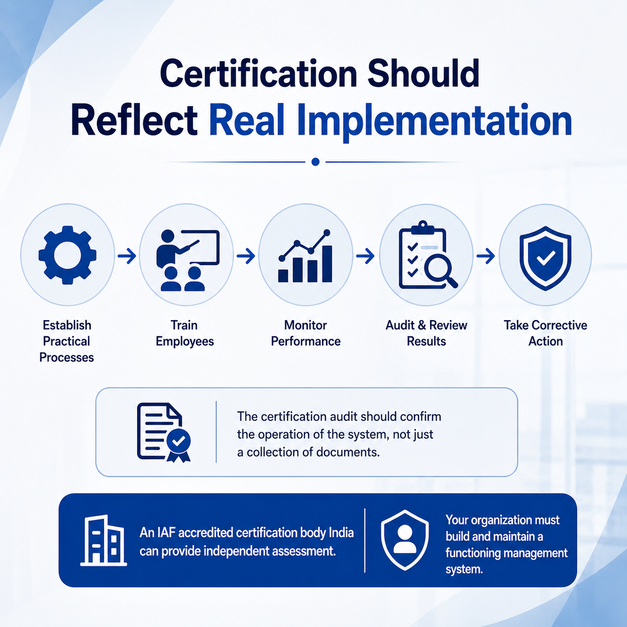
Businesses should establish practical processes, train relevant employees, monitor performance, conduct internal audits, review results, and take corrective action when problems occur.
The certification audit should confirm the operation of this system rather than simply validate a collection of documents.
An IAF accredited certification body India can provide independent assessment, but the organization itself must build and maintain a functioning management system.
Why the Choice Matters for Business Goals
ISO certification may be required for customer expectations, supplier qualification, tenders, international business, risk management, or internal improvement.
If a certificate is not accepted by the intended stakeholder, the organization may have to repeat the certification process. Selecting an appropriately accredited certification body from the beginning can therefore prevent unnecessary complications.
Businesses should consider not only their immediate certification requirement but also where the certificate may be used in the future.
Conclusion
Choosing an IAF accredited certification body India is an important decision for businesses seeking credible ISO certification. Accreditation provides confidence that a certification body operates within a recognized framework for competence and impartiality and that its accreditation covers the relevant certification activity.
Businesses should verify accreditation status, applicable standards, certification scope, sector coverage, and independence before making a decision.
It is also important to understand the current terminology. IAF ceased operations in January 2026 as the international accreditation system transitioned to the Global Accreditation Cooperation. Businesses should therefore verify the current accreditation and recognition arrangements applicable to their certification.
Ultimately, the objective should not be to obtain a certificate as quickly as possible. The better approach is to establish a management system that genuinely improves business processes and then have it independently assessed by an appropriately accredited certification body.