

Can You Switch Your ISO Certification Agency Without Losing Your Existing Certification?
Yes, businesses can switch ISO certification agencies without losing their existing certification, provided the transfer meets applicable accreditation requirements. When comparing iso certification agencies in india, organisations should verify their certificate status, accreditation eligibility and outstanding audit findings. A properly managed transfer can maintain certification continuity without restarting the entire certification process.
What Is an ISO Certificate Transfer?
An ISO certificate transfer allows an eligible organisation to move its existing management system certification from one certification body to another without undergoing the entire initial certification process again.
Businesses may consider transferring certification because of communication difficulties, audit scheduling concerns, industry expertise requirements or changing operational needs.
The transfer involves recognising an existing certification rather than simply replacing the certificate with another document.
International transfer requirements established under IAF MD 2:2023 provide a framework for maintaining certification integrity when businesses change certification bodies.
Which ISO Certificates Can Be Transferred?
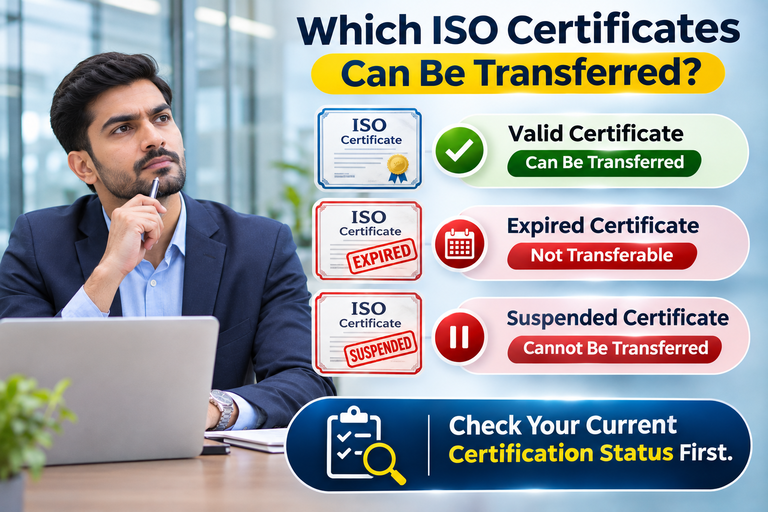
Not every certificate qualifies for transfer. The existing certification must be valid and covered by appropriate recognised accreditation.
Can You Transfer an Expired Certificate?
An expired certificate generally does not qualify for a standard transfer. Businesses may need to undergo a new certification assessment instead.
Can You Transfer a Suspended Certificate?
No. Suspended certification cannot be accepted through the standard transfer process.
Before approaching iso certification agencies in india, businesses should confirm their current certification status and determine whether any unresolved issues could affect transfer eligibility.
Do You Need Another ISO Audit?
A successful transfer does not automatically require another full certification audit. However, the receiving certification body must conduct a pre-transfer review.
This review helps determine whether sufficient evidence exists to recognise previous certification decisions.
Depending on the findings, the receiving body may arrange a site visit to clarify outstanding concerns. Such a visit is intended to support verification and is not itself a certification audit.
Maintaining accredited ISO certification requires reliable evidence that existing management system arrangements remain suitable for continued certification.
Businesses should therefore avoid assuming that transferring certification is purely administrative.
What Documents Are Required for Transfer?
The receiving certification body needs sufficient information to understand the existing certification arrangements and previous assessment outcomes.
Businesses should prepare relevant documents, including:
- Current ISO certificate and approved certification scope.
- Initial certification or latest recertification audit report.
- Most recent surveillance audit report.
- Outstanding nonconformity and corrective action records.
- Information concerning relevant complaints and regulatory matters.
- Existing audit programme and upcoming assessment dates.
Complete documentation supports an efficient ISO certificate transfer and allows reviewers to identify potential concerns before making a certification decision.
Missing records may prevent the receiving body from recognising the previous assessment.
What Happens to Outstanding Audit Findings?
Changing certification bodies does not remove existing nonconformities or corrective action responsibilities.
Before issuing certification, the receiving body must verify that outstanding major nonconformities have been corrected and appropriate corrective actions implemented. Plans addressing outstanding minor nonconformities must also be accepted.
Businesses should not use a transfer to avoid resolving problems identified during previous assessments.
Effective ISO certification continuity depends on demonstrating that management system weaknesses are being addressed responsibly.
Maintaining clear corrective action records can prevent unnecessary delays during the transfer review.
Will Your Certificate Expiry Date Change?
A successful transfer normally continues the existing certification cycle rather than beginning a new one.
For example, if your certificate has fourteen months of validity remaining, transferring to another certification body does not automatically provide three additional years of certification.
Your upcoming surveillance and recertification assessments must remain aligned with the applicable certification programme.
Businesses comparing iso certification agencies in india should request clarification about their next audit date before completing the transfer.
This helps prevent missed assessments caused by misunderstandings between the outgoing and incoming certification bodies.
Can Your Current Agency Refuse the Transfer?
The existing certification body should cooperate with legitimate transfer arrangements and provide relevant information when properly authorised.
It should not suspend or withdraw certification solely because a compliant organisation intends to transfer elsewhere.
If cooperation becomes difficult, the receiving certification body or certified organisation can raise the matter with the relevant accreditation body.
Businesses should nevertheless review contractual obligations and outstanding administrative responsibilities before initiating the transition.
Maintaining written communication throughout the process helps establish accountability and prevents unnecessary disagreements.
What If Your Certification Agency Loses Accreditation?
Losing accreditation creates circumstances that require particularly careful attention.
Under established international transfer requirements, affected organisations generally have six months to complete an eligible transfer, or until their certification expires, whichever occurs first.
The receiving certification body must also notify its accreditation body before completing such a transfer.
Businesses should act promptly rather than assume their existing certificates will remain acceptable indefinitely.
Protecting ISO certification continuity becomes especially important when customers require recognised accreditation for ongoing supplier approval.
What Would This Look Like in a Real Business?
Consider an engineering manufacturer in Ahmedabad holding valid ISO 9001 certification.
Management experiences repeated communication difficulties when arranging surveillance assessments and decides to explore another certification body.
The manufacturer submits its certificate, previous audit reports and corrective action records for review.
The receiving body confirms accreditation eligibility, examines the documentation and establishes suitable arrangements for continued assessment.
Following an independent certification decision, the manufacturer receives revised certification documents while retaining its existing certification cycle.
This hypothetical example demonstrates how an organised ISO certificate transfer can support business continuity without unnecessarily repeating the initial certification process.
How Can You Avoid a Certification Gap?
Begin planning well before your next scheduled assessment or certificate expiry date. Confirm transfer eligibility before terminating existing arrangements.
Businesses should compare accreditation coverage, technical expertise, communication practices and audit availability when evaluating iso certification agencies in india.
Exploring relevant ISO certification services can help organisations identify suitable assessment arrangements.
Once the transfer is approved, update supplier registration documents, customer records and certification references. Remove outdated certification marks wherever necessary and confirm that employees understand which certificate should be shared externally.

Conclusion
Switching certification bodies does not necessarily mean starting your certification journey again. Valid accreditation, reliable audit records and appropriate corrective actions remain essential for a successful transition.
Businesses evaluating iso certification agencies in india should prioritise recognised accreditation, transparent communication and careful transfer planning.
Maintaining ISO certification continuity requires coordination between both certification bodies and the certified organisation. By confirming eligibility and completing the necessary verification before ending existing arrangements, businesses can change certification providers while protecting their operational commitments and customer relationships.
Frequently Asked Questions
1. Can I Change My ISO Certification Agency Midway Through Certification?
Yes, an ISO certificate transfer may take place during an existing certification cycle, provided the organisation satisfies applicable eligibility and verification requirements.
2. Can I Transfer Non-Accredited ISO Certification?
Certificates without the required recognised accreditation do not qualify for standard accredited transfers. Businesses seeking accredited ISO certification may need to undergo initial certification assessments.
3. Will Changing Agencies Affect My Customers?
Not necessarily. Maintaining ISO certification continuity and satisfying specific customer accreditation requirements can help prevent disruptions. However, customers should receive updated certification information.
4. Can I Transfer Multiple ISO Certificates Together?
Potentially, provided each certification satisfies applicable transfer requirements. Businesses comparing iso certification agencies in india should verify accreditation coverage for every relevant management system standard.
5. Will My Previous Audit Findings Disappear After Transfer?
No. An ISO certificate transfer does not eliminate outstanding nonconformities. Appropriate corrective actions remain necessary before the receiving body can approve certification.