
The Audit-to-Audit Gap: What Is Your QMS Doing When Nobody Is Checking?
An audit can tell you whether a process meets requirements on a particular day. It cannot tell you what happens on every ordinary day between audits. That gap is where many quality management systems lose effectiveness. A procedure may exist, records may be complete, and employees may know what an auditor expects, yet the system can become reactive rather than useful.
A strong quality management system (QMS) should work when nobody is checking. ISO 9001 is designed around establishing, maintaining, and continually improving a QMS, with attention to customer needs, process performance, evaluation, and improvement. The current ISO 9001:2026 edition continues this focus while emphasizing leadership, quality culture, risks, opportunities, and business relevance.
For organizations considering iso 9001 certification india, this distinction matters. Certification should not become an exercise in preparing documents for an external visit. The real value comes when quality controls become part of everyday decisions, operations, and problem-solving.
What Is the Audit-to-Audit Gap?
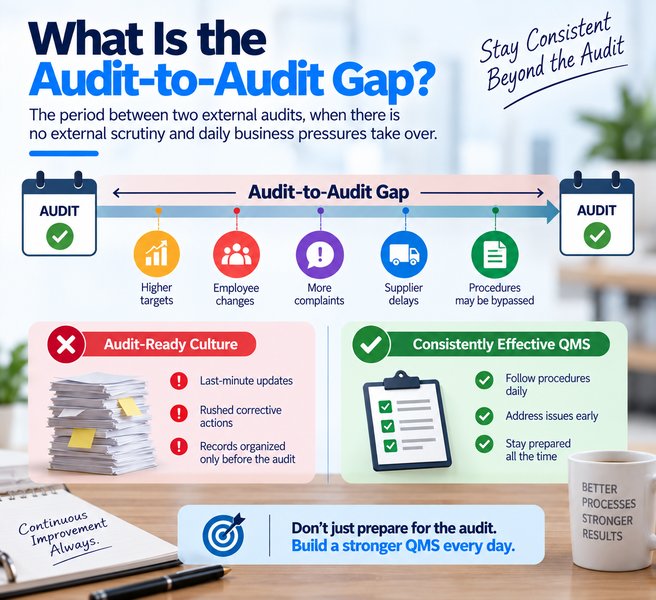
The audit-to-audit gap is the period when external scrutiny is absent. During that time, normal business pressures take over. Targets increase, employees change roles, complaints compete for attention, suppliers face delays, and procedures may be bypassed.
These situations do not automatically mean a QMS is failing. The concern arises when weaknesses are discovered only shortly before an audit. Teams may rush to update records, close corrective actions, organize evidence, or remind employees about procedures. The system then becomes audit-ready instead of consistently effective.
Why a QMS Must Work Without an Auditor
ISO 9001 includes monitoring, measurement, analysis, evaluation, and improvement as important parts of quality management. Internal audits are one way to check whether the system is working, but they should not be the only source of discipline.
Imagine a process that performs correctly only because employees know an auditor is coming. Once the audit ends, shortcuts can return. This creates a repeating cycle: prepare, pass, relax, discover problems, and prepare again.
A practical QMS works differently. Employees understand why controls exist. Managers review meaningful performance information. Problems are investigated rather than hidden. Corrective actions address causes instead of symptoms. Changes are evaluated before they create new quality risks.
The goal is not more paperwork. It is making the system useful during normal work.
Signs Your QMS May Be Audit-Dependent
Several warning signs can reveal an audit-to-audit gap.
One sign is a sudden improvement in documentation shortly before an audit. If records that should be maintained continuously are created or reconstructed at the last minute, the process may not be embedded.
Another sign is repeated nonconformity. A finding that returns after corrective action suggests the organization may be treating the visible problem rather than understanding its root cause.
A third sign is weak employee awareness. If staff can explain a procedure only when coached by the quality team, the QMS may not be integrated into daily responsibilities.
Finally, consider customer complaints. If complaints are logged but trends are not reviewed, valuable information is being collected without being converted into improvement.
Internal Audits Should Reveal Reality
An effective ISO 9001 internal audit is not a rehearsal for an external auditor. It is an opportunity to examine whether processes are actually delivering intended results.
Internal auditors should look beyond documents and ask practical questions. Are employees following the current process? Are records reliable? Are controls effective? What happens when a requirement is missed? Are corrective actions preventing recurrence? Are process risks changing?
Audits should be planned according to process importance, changes, and previous results rather than treated as routine paperwork. Independence and competence matter because an audit is more useful when evidence can be evaluated objectively. ISO explains that internal audits help organizations check how their QMS is working.
For organizations working toward or maintaining iso 9001 certification india, internal audits can provide an early warning system. Instead of discovering weaknesses during a certification or surveillance audit, management can identify them while there is still time to respond calmly.
Turn Findings Into Everyday Improvement
Finding a problem is only the beginning. The stronger question is what the organization does afterward.
Suppose a customer receives an incorrect product. Replacing it may correct the immediate issue, but it does not necessarily prevent recurrence. A deeper review might examine order entry, specifications, approval steps, communication, training, or system controls.
This is where continual improvement becomes practical. Corrective actions should be proportionate to the problem and supported by evidence. Once an action is implemented, its effectiveness should be checked. If the problem returns, the organization has evidence that the response was insufficient.
A mature QMS also learns from near misses, trends, supplier performance, process deviations, and customer feedback—not only from formal nonconformities. This turns quality management into an ongoing learning process.
Make Quality Visible Between Audits
One way to close the gap is to create regular visibility. Organizations can monitor a small set of meaningful indicators rather than collecting excessive data.
Depending on the business, useful measures may include defect rates, rework, delivery performance, complaint trends, supplier issues, process delays, corrective-action closure, and customer satisfaction. The purpose is not to produce attractive dashboards. It is to identify changing performance and decide what action is needed.
The Role of Employees in a Living QMS
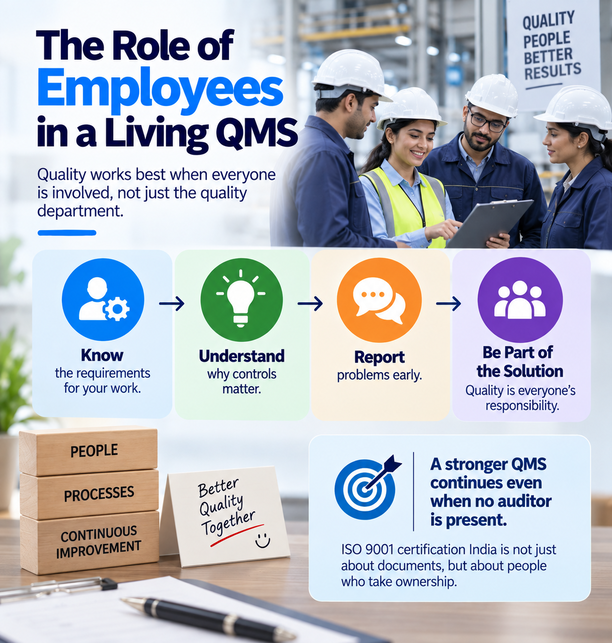
A QMS cannot remain effective if quality belongs only to the quality department. Employees who perform processes every day often notice problems before they appear in reports.
They should know the requirements relevant to their work, understand why controls matter, and have a clear route for reporting problems. Training should therefore connect to actual responsibilities rather than become a certificate-collection exercise.
Preparing for ISO 9001 certification India should therefore include more than document preparation. It should involve building ownership across the organization so that quality continues even when no auditor is present.
Use the Gap as a Management Question
Don’t just focus on being ready for the next audit. Ask yourself, “Would our processes still run smoothly if we had no audits for an entire year?”
That question can expose weaknesses quickly. Would records still be maintained? Would corrective actions still be reviewed? Would employees follow the approved process? Would customer feedback influence decisions? Would management know where quality performance was deteriorating?
If the answers are uncertain, the solution is not necessarily more documentation. It may be clearer responsibilities, better monitoring, stronger internal audits, improved training, better root-cause analysis, or more consistent management involvement.
A QMS should create control without creating dependence on inspection. When the system becomes part of everyday work, external audits become opportunities to validate an operating management system rather than events that temporarily change behavior.
Conclusion
The real test of quality management happens between audits. A certificate can demonstrate conformity at a defined point in time, but sustained performance depends on what happens afterward.
Organizations pursuing iso 9001 certification india can use the audit-to-audit gap as a practical diagnostic. Look at everyday records, employee behavior, customer feedback, corrective actions, process indicators, and management decisions. Ask whether the QMS is helping people prevent problems and improve performance—or simply helping them prepare for the next audit.
A dependable quality management system does not disappear when the auditor leaves. It remains visible in decisions, processes, evidence, customer outcomes, and continuous learning. That is how quality moves from an audit requirement to an everyday business discipline.