
Your HACCP Plan Passed the Audit—but Will It Work on a Bad Production Day?
Passing a HACCP audit is an important milestone for a food business. It shows that a food safety system has been reviewed against applicable requirements. But an audit captures conditions during a defined assessment period. Production does not always happen under comfortable or predictable circumstances.
The real test can come when something goes wrong.
A sudden equipment failure, staff shortage, delayed raw materials, temperature fluctuation, rushed production schedule, or maintenance problem can place pressure on established controls. A HACCP plan that looks complete on paper must also help employees make correct decisions when the production environment becomes difficult.
For organizations pursuing haccp certification in india, this distinction matters. HACCP is a preventive approach to identifying and controlling significant food safety hazards. Its effectiveness depends on how well the plan reflects actual operations and how consistently employees follow the controls when conditions change.
A Normal Production Day Can Hide Weaknesses
During routine production, processes may appear easy to control. Equipment works properly, trained employees are available, raw materials arrive as expected, and monitoring records are completed on schedule.
A difficult production day can expose weaknesses that remain invisible during normal operations.
Imagine a process where temperature must remain within a defined limit. What happens when equipment begins fluctuating during a busy shift? Does the employee recognize the deviation? Is the affected product identified? Is the process controlled? Does a responsible person know what decision to make?
These questions reveal whether the HACCP system is practical or simply documented. A strong system should remain useful when production becomes unpredictable.
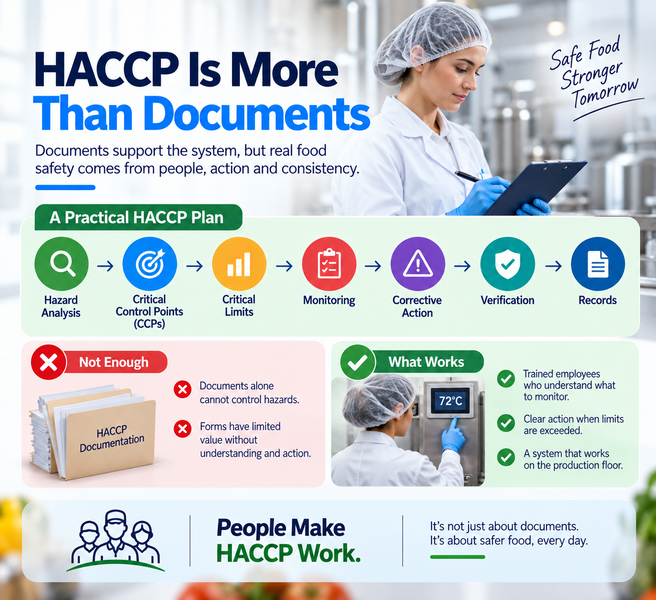
HACCP Is More Than Documents
Documentation is important, but documents alone cannot control food safety hazards. A practical HACCP plan connects hazard analysis with critical control points, critical limits, monitoring, corrective action, verification, and records.
Employees need to understand what they must monitor and what action is required when results fall outside acceptable limits.
For example, a monitoring form may instruct an employee to record a temperature. That form has limited value if the employee does not know what to do when the reading exceeds the established limit. The system becomes stronger when the employee understands the significance of the result and knows how to escalate the issue.
Businesses should therefore judge their HACCP system by what happens on the production floor, not only by how organized the documentation looks.
What Happens When Production Speeds Up?
High demand can create pressure to process more products within less time. Employees may handle additional tasks, while routine checks become vulnerable to delays or shortcuts.
A well-designed HACCP system should anticipate operational pressure. Monitoring responsibilities should be clearly assigned, and employees should know how frequently checks occur, how results are recorded, and who must be informed when a deviation occurs.
A food safety control should remain understandable when workloads increase.
Equipment Failure Is a Real Test
Equipment problems can quickly challenge food safety controls. Refrigeration units, heating systems, sensors, or other process controls may stop working correctly.
The HACCP system should provide a clear response when equipment affects a food safety control. This may include identifying the affected process, controlling the operation, determining which product could be affected, assessing the deviation, recording the event, and restoring control.
Preventive maintenance and calibration, where applicable, can reduce the likelihood that equipment problems compromise a control.
Staff Shortages Can Expose Weak Controls
A HACCP system may appear effective when experienced employees are present. But what happens when a key employee is absent?
Food businesses should consider whether more than one trained person can perform essential monitoring and response activities. If one individual alone understands a critical control, the system becomes vulnerable.
Training should cover relevant hazards, monitoring responsibilities, limits, deviation reporting, and corrective-action procedures. For businesses working toward haccp certification in india, employee competence should be part of operational readiness.
Corrective Action Must Work Under Pressure
A deviation is only useful as a warning if the organization knows what to do next.
Corrective-action procedures should be clear enough for employees and supervisors to use during an active production problem. Depending on the situation, actions may include restoring the process to control, identifying affected products, placing product on hold, investigating the cause, documenting the event, and preventing recurrence.
The response should be based on the hazard and established procedures. Management should also review repeated deviations. If the same problem appears again and again, correcting each individual event may not address the underlying cause.
Can Employees Recognize a Deviation?
An effective HACCP food safety system depends on employees recognizing when a control is not operating as intended.
People responsible for monitoring should understand relevant limits, measurement methods, frequency, recording requirements, and escalation steps. They should also know who has authority to make decisions when results are outside the acceptable range.
Clear instructions reduce hesitation during unexpected situations.
If a critical measurement is outside its limit, an employee should not have to guess whether the result is serious or wait until the end of a shift to report it. The system should make the expected response clear.
Verification Should Test Reality
Verification should not be limited to checking whether forms contain signatures. It should help determine whether the HACCP system is actually functioning.
Management can review monitoring records, corrective actions, audit findings, recurring deviations, equipment performance, and training effectiveness. Observing processes directly can also reveal differences between written procedures and actual practice.
A useful HACCP certification process involves more than preparing documents for an external audit. Internal verification can identify weaknesses before they become serious problems, especially when products, equipment, processes, or operating conditions change.
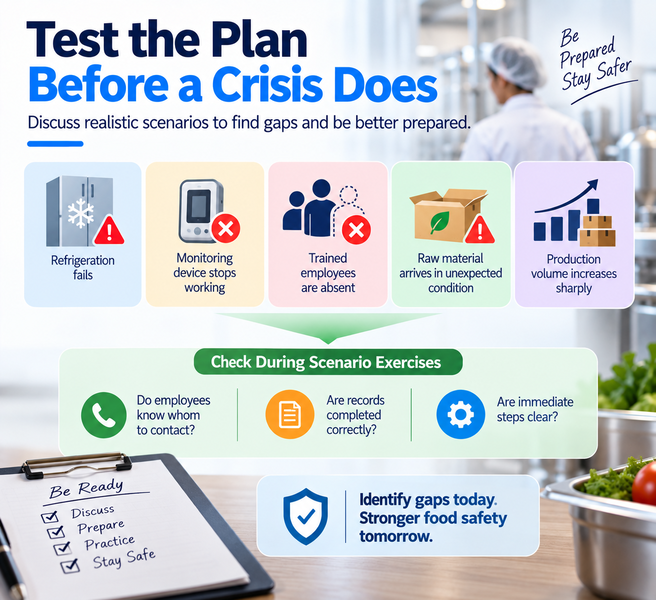
Test the Plan Before a Crisis Does
One practical way to strengthen a HACCP system is to discuss realistic disruption scenarios.
What would happen if refrigeration failed during peak production? What if a monitoring device stopped working? What if trained employees were absent? What if a raw material arrived in an unexpected condition? What if production volume increased sharply?
The purpose is to identify unclear responsibilities and unrealistic assumptions before an actual incident occurs.
Scenario exercises can show whether employees know whom to contact, what records to complete, and what immediate steps are expected.
Build HACCP Around Actual Operations
Businesses preparing for haccp certification in india should develop their HACCP system around the process that actually happens, not an idealized version of production.
Hazard analysis should reflect real conditions. Critical control points should be appropriately determined. Monitoring methods should be practical. Corrective actions should be usable. Verification should provide meaningful evidence.
When a process changes, the HACCP system should be reviewed accordingly. New equipment, ingredients, production methods, layouts, or operating conditions can introduce different risks or change existing controls.
Conclusion
A HACCP plan should not only look convincing during an audit. It should help employees control food safety risks when production becomes rushed, disrupted, or unpredictable.
For organizations pursuing haccp certification in india, preparation should focus on real operational performance. Employees need clear responsibilities, monitoring must be practical, corrective actions must be usable, and verification should test whether controls work as intended.
A bad production day provides a practical test of whether the system was designed for real conditions. When hazard analysis, monitoring, corrective action, training, verification, and management involvement work together, HACCP becomes more than an audit requirement. It becomes a working food safety tool.