
The Registration Fee Myth: ISO Certification Is More Than an Application
When businesses begin exploring ISO certification, one of the first things they often search for is iso registration fees india. The search itself is understandable. Organizations want to plan budgets, compare options, and understand what is involved before beginning the certification journey.
However, treating ISO certification as nothing more than a registration payment can create the wrong expectations. ISO certification is not simply a form submission followed by the delivery of a certificate. It involves defining the management system, reviewing requirements, preparing documented information where needed, implementing processes, undergoing an audit, addressing findings, and maintaining conformity over time.
ISO itself does not perform certification or issue management-system certificates. Independent certification bodies issue the certification. Therefore, organizations should understand what they are actually paying for and what responsibilities remain with them.
Why the Registration Fee Myth Exists
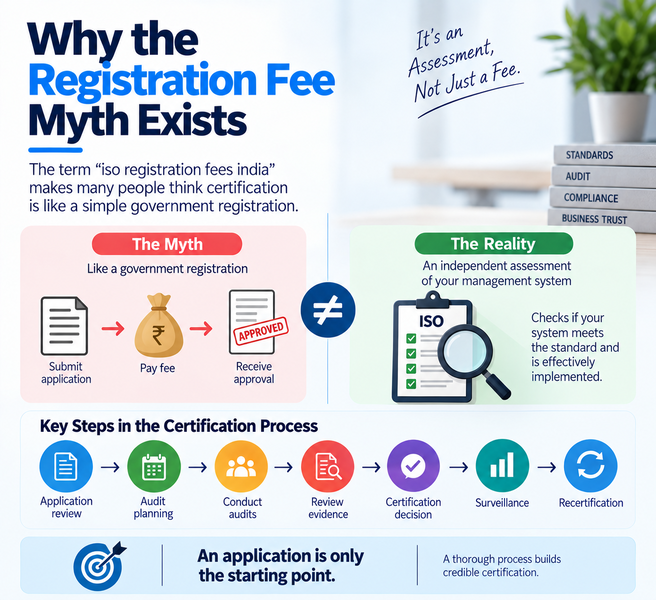
The phrase iso registration fees india can make certification sound like a government-style registration process where an organization submits an application, pays a fee, and receives approval.
Management-system certification works differently. Certification involves an independent assessment of whether an organization’s management system meets the requirements of the relevant standard and whether the system is effectively implemented within its defined scope.
The certification process includes activities such as application review, audit planning, determining audit time, conducting audits, reviewing evidence, recording findings, making a certification decision, surveillance, and recertification. These stages are part of the broader conformity-assessment process.
This means an application is only the starting point.
What the Application Actually Does
An application gives the certification body important information about the organization. Depending on the standard and certification arrangement, this can include the organization’s activities, locations, scope, number of employees, processes, and other factors relevant to planning the certification audit.
This information matters because certification cannot be assessed accurately without understanding what the organization actually does.
For example, a small office performing administrative activities may have a different certification scope from an organization operating manufacturing facilities, warehouses, field services, or multiple locations. The complexity of activities and the size and structure of the organization can affect how the certification process is planned.
Therefore, asking only about iso registration fees india without discussing the organization’s scope can provide an incomplete picture of the certification process.
Certification Is Based on Evidence
A management-system audit is fundamentally an evidence-based activity. Auditors evaluate whether relevant requirements are addressed and whether the organization’s system is implemented as intended.
Evidence can include documented procedures, records, process results, employee interviews, operational controls, monitoring activities, internal audits, corrective actions, and management review outputs, depending on the standard being assessed.
The organization therefore has an important responsibility before the external audit begins. It must establish and operate the management system rather than simply prepare paperwork for an auditor.
A certificate has meaning because an independent certification process evaluates conformity against specified requirements. ISO describes certification as independent written assurance that a product, service, or system meets specified requirements.
Documentation Is Only One Part
Another common misunderstanding is that ISO certification is mainly about creating documents.
Documentation can be important, but documents alone do not demonstrate an effective management system. An organization may have well-written procedures while employees follow completely different practices in daily operations.
Effective implementation connects documented requirements with actual activities.
For instance, if an organization has a documented corrective-action procedure, it should also be able to demonstrate how problems are identified, causes are evaluated, actions are assigned, and effectiveness is reviewed. Similarly, a documented internal-audit process should be supported by evidence that audits actually take place and findings are addressed.
This is why organizations should look beyond the initial iso registration fees india when calculating the effort involved.
Audit Preparation Requires Real Work
Preparation for certification usually involves understanding the applicable standard, identifying relevant processes, determining responsibilities, evaluating risks where required, maintaining appropriate records, and checking whether processes operate consistently.
Internal review can help identify gaps before the certification audit. Employees should understand their responsibilities rather than seeing ISO as a paperwork exercise handled by one person.
Leadership involvement is also important. Management-system requirements often connect with organizational objectives, resources, performance evaluation, improvement, and decision-making.
A realistic preparation process therefore considers people, processes, records, controls, and actual operational practices.
What Happens When an Auditor Finds a Nonconformity?
Finding a nonconformity does not simply mean that the organization has failed its entire certification effort. Audit findings need to be understood, addressed appropriately, and evaluated according to the applicable certification process.
The organization may need to determine the cause, implement corrections or corrective actions, and provide evidence demonstrating how the issue has been addressed. Certification decisions are made using the information generated through the applicable audit and review process.
This is another reason why a simple registration-fee mindset can be misleading. Certification involves evaluation and, where necessary, follow-up activity rather than a one-time administrative transaction.
Certification Does Not End With the Certificate
Even after certification is granted, the process does not necessarily end. Certified management systems are subject to ongoing maintenance and surveillance activities within the certification cycle. IAF guidance for management-system certification describes surveillance and recertification arrangements as part of maintaining certification.
Organizations must therefore continue operating their management system and maintaining relevant evidence.
Changes to processes, locations, organizational structure, products, services, or other circumstances may also require management to review the system and communicate relevant changes through the certification process.
This makes certification an ongoing management responsibility rather than a single registration event.
What Should Businesses Ask Before Starting?
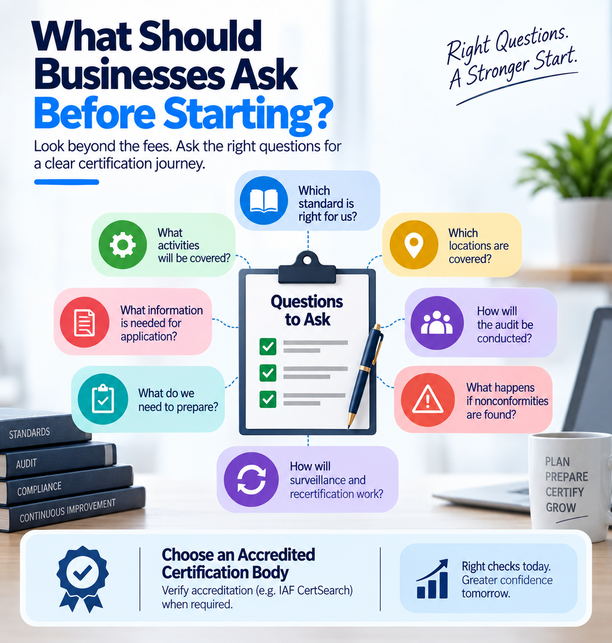
Instead of asking only, “What are the iso registration fees india?” organizations should ask several practical questions.
What standard is appropriate for the business? Which activities will be covered by the certification? Which locations are covered? What information is needed for application review? How will the audit be conducted? What does the organization need to prepare? What happens if nonconformities are identified? How will surveillance and recertification work?
These questions create a much clearer understanding of the complete certification journey.
Organizations should also check if the certification body is accredited for the required scope when accredited certification is needed or preferred. ISO recommends checking accreditation arrangements and notes that IAF CertSearch can be used to verify certifications and accreditation information.
Think Beyond the Application
The real value of ISO certification comes from implementing a management system that supports consistent processes, accountability, monitoring, risk awareness, customer confidence, and continual improvement.
The application begins the formal conversation, but it does not replace implementation. The certificate represents the outcome of a structured assessment process, not simply proof that a registration form was submitted.
Businesses researching iso registration fees india should therefore look at the complete certification journey. Understanding scope, audit requirements, preparation, implementation, surveillance, and ongoing responsibilities makes it easier to plan realistically and avoid confusion later.
Conclusion
The idea that ISO certification is simply a registration fee is an oversimplification. An application may start the process, but certification involves much more: defining scope, preparing the management system, implementing processes, generating evidence, undergoing independent assessment, responding to findings, and maintaining conformity.
A business that understands these stages can approach certification with clearer expectations. Instead of focusing exclusively on iso registration fees india, decision-makers should consider the complete process and the internal commitment required to maintain an effective management system.