
Your Head Office Is Certified—but What About Your Other Locations?
A head office may hold a valid ISO certificate, but that does not automatically mean every branch, warehouse, plant, service centre, or regional office operates under the same certified management system. As organizations expand, maintaining consistent processes across locations becomes more difficult. Different teams may interpret procedures differently, keep records in different ways, or develop local practices that are not aligned with central requirements.
This is why multi-location certification deserves careful attention. A business looking for an iso certification agency in mumbai may be focused on obtaining or maintaining certification at one principal location, while overlooking what happens at other sites. The real question is not simply whether the head office has a certificate. It is whether the management system is consistently implemented, controlled, monitored, and improved wherever the organization operates.
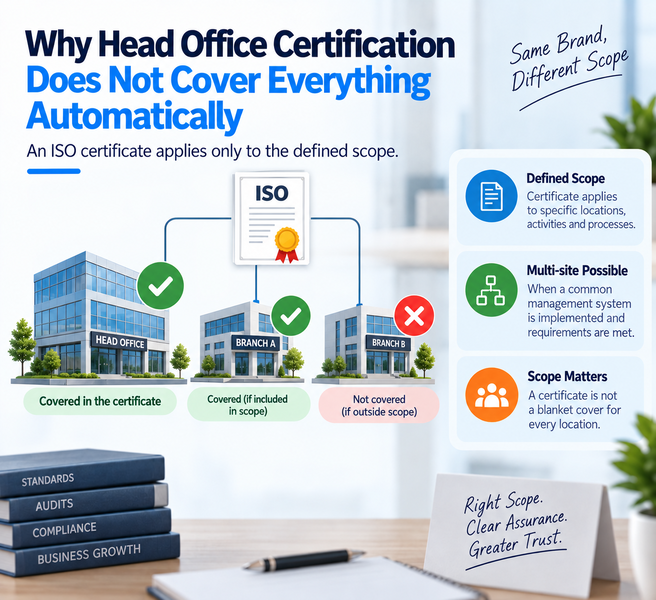
Why Head Office Certification Does Not Cover Everything Automatically
An ISO certificate applies to a defined scope. The scope identifies the organization, activities, processes, and locations covered by the certification. If a branch or facility is outside that defined scope, its activities should not automatically be presented as certified.
For organizations with several locations, certification arrangements can be more complex. Multi-site certification is possible when the organization operates a common management system across relevant sites and meets applicable certification requirements. Guidance for auditing multi-site organizations specifically addresses situations in which several sites operate under a single management system. It also distinguishes organizations with one shared system from organizations using separate management systems at different locations.
This distinction matters because a certificate is not a blanket statement that every part of a business follows the same controls. The certification scope and audit arrangements determine what has actually been assessed.
The Hidden Risk of Inconsistent Branch Practices
Imagine a company with a well-controlled head office and several regional locations. The central team may maintain documented procedures, monitor performance, conduct internal reviews, and manage corrective actions. However, a branch may use outdated forms, skip required checks, store records incorrectly, or handle customer complaints through an informal process.
These differences can create operational gaps even when the main office remains compliant. They may also make it harder for management to demonstrate that the organization follows a consistent system.
Common warning signs include different versions of procedures, inconsistent training records, missing operational records, different supplier-evaluation practices, locally handled corrective actions, and internal audits that exclude smaller or remote sites.
Such gaps do not necessarily mean certification is invalid. They indicate that management should understand the certification scope and evaluate whether every relevant location is adequately controlled.
Start With the Certification Scope
Before reviewing individual branches, management should examine the existing certificate and its scope. Identify which legal entity, activities, departments, and locations are included.
This is one of the most important steps when working with an iso certification agency in mumbai, because certification planning should be based on the organization’s actual structure rather than assumptions about what the certificate covers.
Ask which locations are included, whether they perform activities covered by the system, whether branches use separate procedures, whether new sites have opened, whether responsibilities have changed, and whether temporary or remote operations are relevant.
Clear answers help determine whether the existing certification arrangement still reflects the organization accurately.
How Multi-Site Certification Can Work
For organizations operating several locations under a common management system, multi-site certification may provide a structured approach. Applicable rules can allow sampling of sites when eligibility conditions are satisfied. However, sampling does not mean that unvisited locations can ignore the management system. The organization remains responsible for implementing the system across the applicable sites, while the certification process determines how locations are audited.
The relevant guidance explains that multi-site certification concerns organizations with multiple sites operating a single management system. Where multiple management systems are independently deployed, the sites may need to be treated differently for certification purposes.
Therefore, businesses should discuss their actual structure, processes, risks, and locations with an appropriately competent certification body before deciding how certification should be arranged.
Build One System, Not Several Versions
Consistency does not mean every location must operate in exactly the same way. Local differences may be necessary because of customer requirements, legal conditions, staffing, equipment, or operational characteristics.
The important point is that core controls should remain consistent. Document control, training, records, risk assessment, internal audits, corrective action, performance monitoring, and management review should have clear ownership.
A useful approach is to establish central requirements while allowing controlled local procedures where justified. This creates flexibility without turning every branch into an independent system.
Internal Audits Should Reach Beyond Headquarters
A common weakness in multi-location organizations is treating the head office as the main source of evidence. Internal auditing should provide visibility into how processes actually work at different sites.
Auditors can examine whether employees understand relevant procedures, records are maintained correctly, risks are being addressed, customer requirements are followed, and corrective actions are effective.
Remote or smaller locations should not be ignored simply because they have fewer employees. Their processes may still affect customers, information, product quality, environmental performance, workplace safety, or other management-system objectives.
Training and Communication Matter
Even a well-designed system can fail when employees at different locations receive inconsistent information. Central policies should be communicated clearly, while local teams should understand how those policies apply to their daily responsibilities.
Training records should be controlled, responsibilities should be clear, and significant changes should reach affected employees promptly. Regular communication between headquarters and branches can also help identify recurring problems before they become larger issues.
Choosing Certification Support for Multiple Locations
Organizations searching for an iso certification agency in mumbai should look beyond basic certification assistance. For a multi-location business, the certification process should account for organizational structure, locations, activities, applicable standards, and audit requirements.
ISO/IEC 17021-1 sets requirements for the competence, consistency, and impartiality of bodies that audit and certify management systems. This provides an important framework for understanding what competent third-party certification involves.
Organizations should also verify what accreditation and certification arrangements apply to their chosen certification body. ISO itself does not issue management-system certificates; certification is performed by independent certification bodies.
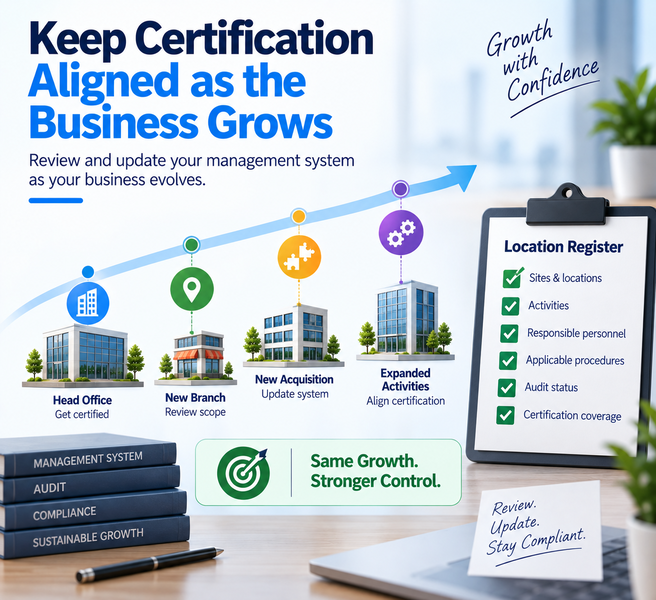
Keep Certification Aligned as the Business Grows
Certification should be treated as an ongoing management responsibility rather than a one-time head-office achievement. When a business opens a new branch, acquires another operation, changes its processes, or expands into new activities, the management system and certification scope may need to be reviewed.
A simple location register can help management track every site, its activities, responsible personnel, applicable procedures, audit status, and certification coverage. Reviewing this information before surveillance or recertification audits can reduce surprises and improve organizational control.
Conclusion
A certificate at headquarters is valuable, but its relevance depends on what the certificate actually covers and how the management system operates across the organization. Other locations should not be assumed to be covered simply because they share the same brand, ownership, or corporate structure.
For multi-location businesses, the goal should be clear: define the scope accurately, maintain consistent core controls, audit relevant locations, train employees effectively, and review certification coverage whenever the organization changes. Working with an iso certification agency in mumbai can be part of that process, but the organization itself remains responsible for ensuring that its management system works across the locations within its scope.