
Your Company Is Small—but Is Your Information Security Scope Small Too?
A small business may have a small team, a limited office, and fewer processes than a large enterprise. That does not automatically mean it has a small information security responsibility. Even a lean organization may handle customer records, employee information, financial documents, intellectual property, credentials, cloud applications, and confidential communications. The main question is not how many employees you have. It is what information you create, receive, store, process, and share.
ISO/IEC 27001:2022 is designed for organizations of every size and sector. It provides requirements for establishing, implementing, maintaining, and continually improving an information security management system (ISMS). This makes information security relevant even when an organization has a lean structure.
Small Does Not Mean Low Risk
Company size is only one factor in understanding information security risk. A small organization may depend heavily on a few critical systems or individuals. If one employee has access to sensitive records, a compromised account can affect an important part of the business. If customer information is stored in a cloud platform, that platform becomes part of the security picture.
This is why a small organization should think about scope in terms of information and business activities rather than headcount. A useful starting point is to identify what information matters most and how it moves through the organization.
What Does Information Security Scope Mean?
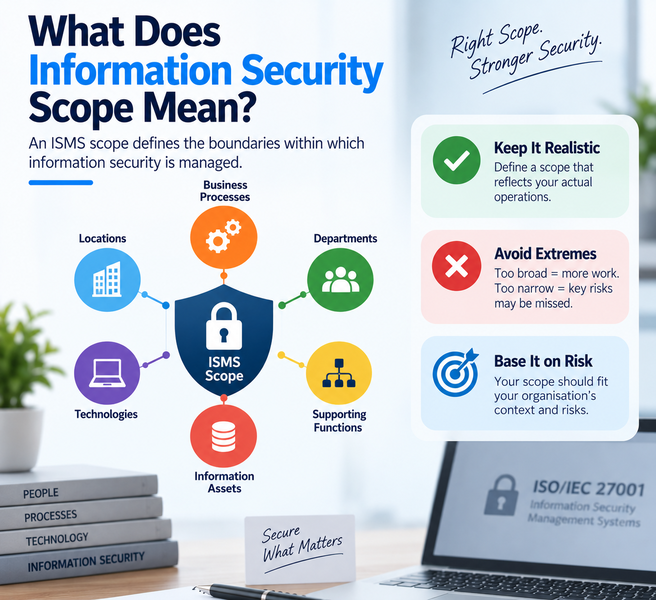
An ISMS scope defines the organizational and operational boundaries within which information security is managed. It can include particular business processes, locations, departments, technologies, supporting functions, and information assets.
The scope should be realistic, clearly defined, and connected to actual operations. Making it unnecessarily broad can create additional management work. Making it artificially narrow can leave important information flows outside the intended system.
The appropriate scope depends on the organization’s context and risks. This is consistent with the risk-based approach behind ISO/IEC 27001, which requires organizations to establish and continually improve an ISMS suited to their circumstances.
Why Scope Should Follow Information Flow
Information rarely stays inside one department. A customer inquiry may enter through a website, move into an email account, be recorded in a customer management system, and later be accessed by an employee working remotely. Documents may be stored in cloud services and shared with external providers.
Because of these connections, deciding scope by department alone can miss important dependencies. Organizations should map significant information flows and identify the systems, people, locations, and external relationships involved.
This approach also shows why information security management system planning is more than creating cybersecurity policies. An effective ISMS connects security objectives with business processes, responsibilities, risk assessment, controls, monitoring, and continual improvement.
Small Teams Can Have Complex Dependencies
A small workforce can create concentrated risk. One person may perform several functions, while a limited number of administrators may have broad system access. A business may also rely on external hosting, payroll, accounting, communication, backup, or software services.
These relationships should be considered when determining scope and assessing risk. External providers do not disappear from the information security conversation simply because they are outside the office. Their services may affect confidentiality, integrity, availability, or business continuity.
The organization should understand which external dependencies affect information security and establish appropriate controls, responsibilities, and monitoring.
The Connection Between Scope and Certification
Organizations researching certification often begin with questions such as iso 27000 certification cost in india. Cost may matter during planning, but it should not be the starting point for defining information security scope. The scope determines what the management system covers, which affects implementation and assessment activities.
It is also important to distinguish ISO/IEC 27000 from ISO/IEC 27001. ISO/IEC 27000 provides an overview of the information security management systems family, while ISO/IEC 27001 specifies requirements for an ISMS. ISO currently lists ISO/IEC 27000:2026 as its latest overview standard, while ISO/IEC 27001:2022 is the published requirements standard.
Therefore, businesses searching for iso 27000 certification cost in india should first understand which standard or certification they need and which activities are intended to be included within the ISMS scope. A clear scope helps you plan better.
How a Small Business Can Define Its Scope
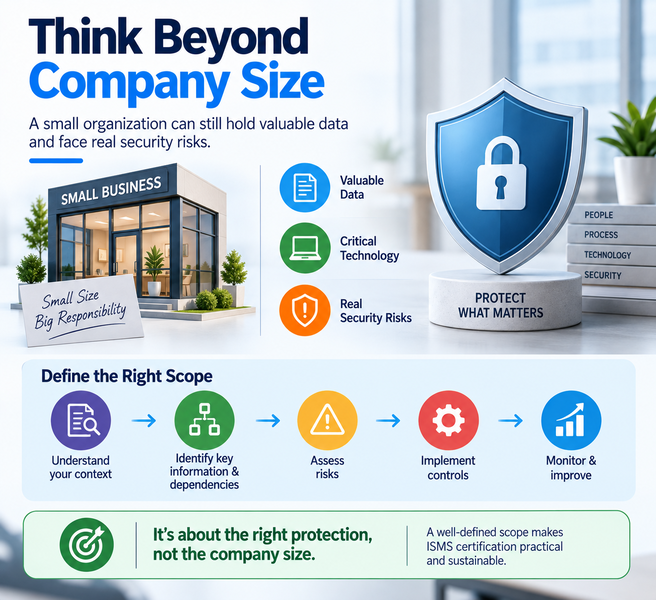
Start with the business purpose. Identify services or products that depend on information and technology. Then list the information assets supporting those activities. Consider customer data, employee records, contracts, financial information, intellectual property, credentials, operational records, and other sensitive information.
Finally, document the boundaries. State which business activities, locations, technologies, and supporting functions are included. Explain relevant interfaces and dependencies. A clear scope makes responsibilities easier to understand and provides a practical basis for risk assessment.
Avoid the “Smallest Possible Scope” Trap
A narrow scope can appear attractive because it may seem easier to manage. However, excluding an activity does not eliminate risks created by its connection to the business.
The better question is: “What scope accurately represents the information security risks and business activities we need to manage?” rather than “What is the smallest scope we can certify?”
A certification scope should represent meaningful business activities and information security responsibilities rather than being reduced simply to make implementation appear easier.
Building a Practical ISMS
A small organization does not need to imitate a multinational corporation’s management structure. Its ISMS should be proportionate to its context while meeting applicable requirements.
Responsibilities can be assigned clearly even when teams are small. Risk assessments can focus on meaningful business scenarios. Access reviews, incident management, backups, supplier controls, awareness activities, and internal reviews can be integrated into existing workflows.
ISO guidance specifically recognizes that SMEs have different resource constraints and provides practical guidance for applying ISO/IEC 27001 in smaller organizations. The standard itself remains applicable across organization sizes and sectors.
What a Well-Defined Scope Can Achieve
A well-defined scope gives employees a clearer understanding of what information and activities are protected. It helps management connect security decisions with business priorities. It can also make internal reviews and external assessments more structured because boundaries and responsibilities are documented.
More importantly, scope encourages a risk-based mindset. Instead of selecting controls simply because they appear on a generic checklist, the organization can ask which risks matter, what information is exposed, which processes depend on it, and what controls are appropriate.
This is also where ISO 27001 certification India planning becomes more meaningful. Certification should reflect a functioning management system rather than a document collection prepared only for an assessment.
Think Beyond Company Size
Information security responsibility does not shrink simply because the employee count is small. A small organization can hold valuable data, depend on critical technology, and face serious consequences from unauthorized access, loss, alteration, or unavailability.
The practical answer is not to create the largest possible ISMS. It is to define a scope that accurately represents the organization’s context, information flows, dependencies, and risks. Once that foundation is clear, policies, controls, responsibilities, monitoring, and improvement activities can be aligned around it.
For organizations exploring ISMS certification, the first useful question is not how large the company is. It is which information and business activities genuinely need to be managed and protected. A carefully designed scope can help a small business build an information security system that is understandable, relevant, and sustainable.
Conclusion
Being small does not automatically make an organization’s information security scope small. What matters is the information handled, the processes supporting it, the technology involved, and the dependencies connecting the business to customers and external providers.
Understanding these boundaries before discussing iso 27000 certification cost in india can support better planning and clearer expectations. A proportionate scope can help a small organization manage security without unnecessary complexity while keeping attention on the risks that matter to its operations.