
Who Really Issues Your ISO Certificate? The Answer May Surprise You
When a business decides to pursue ISO certification, it is natural to assume that the organisation behind the ISO standard also issues the certificate. That assumption is common, but it is not how the certification system works.
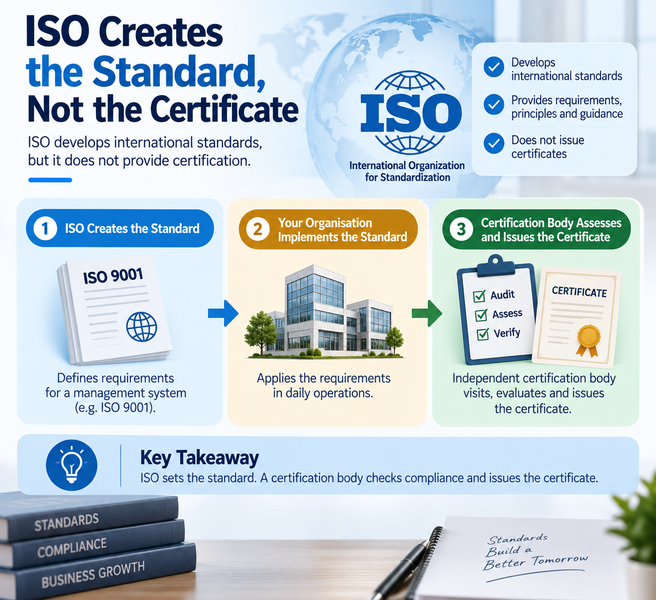
ISO develops and publishes international standards, but ISO itself does not audit businesses or issue ISO certificates. Certification is carried out by independent certification bodies that assess whether an organisation’s management system meets the requirements of the relevant standard.
This distinction is important for businesses searching for iso certification companies in india because the organisation helping with preparation may not be the organisation that actually conducts the independent certification audit.
Understanding who does what can make the certification process easier to evaluate and can help businesses ask better questions before selecting a certification arrangement.
ISO Creates the Standard, Not the Certificate
The International Organization for Standardization develops international standards through its technical committees and member bodies. These standards provide requirements, principles, or guidance for different areas of business and management.
However, ISO clearly states that it does not provide certification or conformity assessment and does not issue certificates.
For example, ISO 9001 specifies requirements for a quality management system, but ISO does not visit an organisation to determine whether that organisation conforms to ISO 9001.
The actual conformity assessment is performed by a certification body.
This is one of the most important facts businesses should understand before beginning their certification journey.
So, Who Actually Issues the Certificate?
A certification body conducts the relevant audit and, when the certification requirements have been met, issues the certificate under its own certification authority.
The certification body is responsible for evaluating the management system against the applicable standard and making the certification decision according to its established processes.
In India, the National Accreditation Board for Certification Bodies, or NABCB, provides accreditation to certification bodies for management-system certification under ISO/IEC 17021-1:2015.
This creates an important distinction between three different roles: the standards organisation develops the standard, the accreditation body evaluates the competence and conformity of certification bodies, and the certification body performs the audit and certification activity.
What Does an Accreditation Body Do?
An accreditation body does not normally certify your business directly.
Instead, it assesses certification bodies to determine whether they meet applicable competence and impartiality requirements. NABCB states that it grants accreditation to management-system certification bodies according to ISO/IEC 17021-1:2015.
Accreditation therefore provides a mechanism for recognising the competence of certification bodies within defined scopes.
This matters because not every organisation offering “ISO certification” services necessarily performs the same role. Businesses should understand whether they are dealing with a certification body, a consultancy, or another service provider.
Certification Body and Consultant Are Not the Same
One of the most confusing parts of ISO certification is the difference between consultancy and certification.
A consultant may help a business understand the standard, develop documentation, establish procedures, train employees, conduct internal audits, or prepare for an external assessment.
The certification body has a different responsibility. It independently evaluates the management system against the relevant requirements.
Keeping these roles separate is important because certification requires an impartial assessment. A business should therefore understand exactly which organisation is providing preparation assistance and which organisation will conduct the certification audit.
When researching ISO certification bodies in India, this distinction should be one of the first things to check.
What Happens During Certification?
The certification process generally begins with an application or review of information about the organisation.
The certification body needs to understand factors such as the management system standard, business activities, scope, locations, number of employees, and other relevant characteristics.
For an initial management-system certification, the audit may involve Stage 1 and Stage 2 activities. Stage 1 focuses on areas such as readiness, documentation, organisational context, processes, and planning for the next stage. Stage 2 checks whether the management system is properly implemented and working effectively.
The exact process depends on the applicable standard and certification scheme.
The important point is that receiving a certificate is the result of an assessment process rather than simply purchasing a document.
Why Accreditation Matters
Accreditation can provide additional confidence about the competence and recognition of a certification body.
NABCB explains that its management-system accreditation operates against ISO/IEC 17021-1:2015 and that it has recognition arrangements through the International Accreditation Forum and Asia Pacific Accreditation Cooperation.
Its current management-system information covers areas including quality, environmental, occupational health and safety, food safety, information security, energy, and other management-system schemes.
This means businesses should look beyond a certificate’s visual appearance. They should understand who issued it, under what certification scope, and whether the certification body has appropriate accreditation for the relevant standard and sector where accreditation is required or expected.
Does Every ISO Certificate Need Accreditation?
Accreditation and certification are related but different concepts.
A certification body can perform conformity assessment, while accreditation is the independent recognition of the certification body’s competence against specified requirements.
The relevance of accreditation can depend on the standard, sector, customer requirements, tender conditions, regulatory expectations, and intended use of the certificate.
Therefore, businesses should not assume that every certificate carries the same type of recognition simply because the word “ISO” appears on it.
Before selecting a certification arrangement, ask whether accredited certification is required for the intended purpose and, if so, whether the proposed certification body is accredited for the relevant standard and scope.
How Can You Check Who Issued Your Certificate?
The certificate itself should provide useful information about the certification body, the organisation being certified, the applicable standard, certification scope, certificate number, and validity information.
Businesses can then verify the certification body through the relevant accreditation body’s directory when applicable.
NABCB maintains lists of accredited certification bodies across management-system schemes, including quality, environmental, food safety, information security, and other areas.
This verification step can be particularly useful when a business receives an offer from an unfamiliar provider.
Why Businesses Should Not Focus Only on the Certificate
An ISO certificate represents the outcome of an assessment, but the underlying management system is what creates practical value.
A business should focus on implementing processes that actually support consistent operations, monitoring performance, addressing risks, maintaining records, and continually improving where applicable.
The certificate should therefore be viewed as evidence connected to a defined scope and management system, not simply as a decorative document.
This perspective also helps businesses understand why certification involves audits, evidence, corrective actions, surveillance, and periodic reassessment.
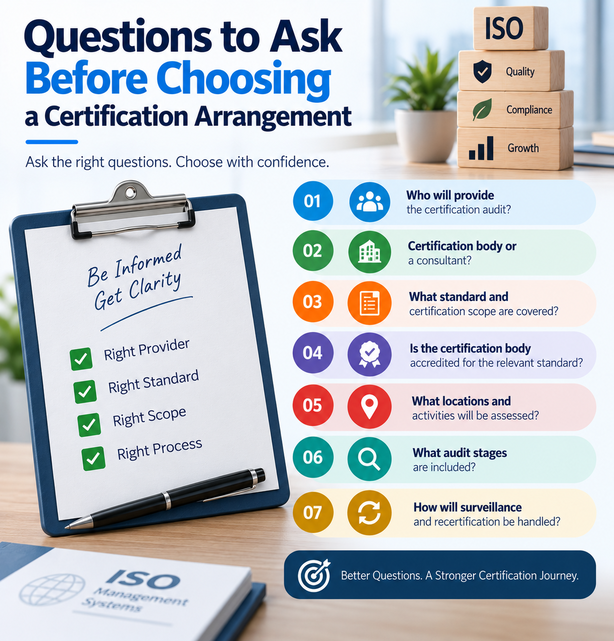
Questions to Ask Before Choosing a Certification Arrangement
Businesses researching ISO certification companies in India can ask several straightforward questions before proceeding.
Who will provide the certification audit? Is the organisation a certification body or a consultant? What standard and certification scope are covered? Is the certification body accredited for the relevant standard and scope? What locations and activities will be assessed? What audit stages are included? How will surveillance and recertification be handled?
These questions can reveal important differences between service providers and help businesses understand what they are actually receiving.
The Simple Answer
So, who really issues your ISO certificate?
Not ISO itself.
ISO develops the standard. An accreditation body may assess and accredit competent certification bodies. A certification body conducts the conformity assessment and, when the applicable requirements are satisfied, issues the certification.
Consultants may help organisations prepare, but their role is different from that of the independent certification body.
For businesses searching for iso certification companies in india, understanding this structure is essential. It helps separate standard development, accreditation, consultancy, auditing, and certification into their proper roles.
Conclusion
The answer may be surprising because the phrase “ISO certificate” can make it sound as though ISO directly certifies businesses. In reality, ISO explicitly states that it does not issue certificates or perform conformity assessment.
Certification is performed by certification bodies, while accreditation bodies assess the competence of certification bodies within defined scopes. In India, NABCB provides accreditation for management-system certification bodies under applicable requirements.
Understanding these roles allows businesses to make more informed certification decisions and verify who is actually responsible for the certificate they receive.