
Why Audit Days Matter More Than Most Businesses Realize
When businesses discuss ISO certification, they often focus on the certificate, documentation, preparation, and overall iso certification cost india. One factor that receives less attention is audit time. Yet the number of audit days can have a direct connection with how thoroughly a management system is assessed and how a certification quotation is structured.
An audit day is not simply a number added to a quotation. It represents time required for auditors to plan, conduct, document, and conclude an assessment. ISO guidance specifically addresses how the duration of management-system certification audits is determined, while applicable accreditation guidance provides factors that certification bodies must consider when establishing audit time.
Understanding audit days can therefore help businesses read certification proposals more intelligently and avoid comparing quotations based only on the final amount.
What Does an Audit Day Actually Mean?
An audit day represents time allocated for certification activities. It is connected with the work an audit team needs to perform to obtain sufficient evidence about the organisation’s management system.
The audit itself involves activities such as opening discussions, examining information, interviewing relevant personnel, collecting evidence, recording findings, and preparing conclusions. ISO terminology distinguishes overall audit time from the portion spent conducting audit activities.
For certain management-system certifications, applicable IAF guidance uses an audit-day framework to determine appropriate time for initial, surveillance, and recertification audits. The purpose is to provide enough time for a complete and effective assessment rather than simply assigning the same duration to every organisation.
Why Audit Days Affect Certification Quotations
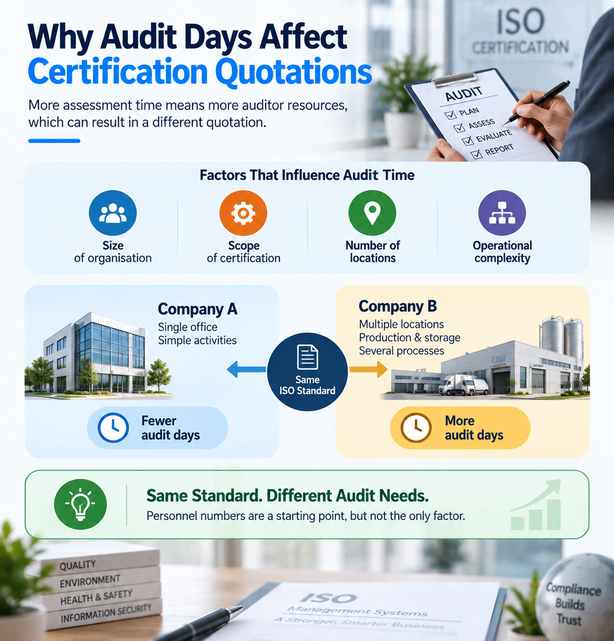
Audit time represents professional work performed by the certification body. If an organisation requires more assessment time because of its size, scope, locations, or operational complexity, the certification process can involve more auditor resources.
This is why two businesses requesting the same ISO standard may receive different quotations.
For example, two organisations may both have a small workforce, but one may operate from a single office with straightforward activities while another may have production, storage, multiple processes, or several locations. Their certification scopes are not necessarily equivalent.
The IAF’s current audit-time guidance states that personnel numbers are a starting point, but they are not the sole consideration. Other factors affecting audit time must also be considered.
Employee Numbers Are Only the Starting Point
A common assumption is that audit duration depends entirely on the number of employees. In reality, the assessment can involve more than a simple headcount.
Effective personnel can include people whose work contributes to the management system, and applicable methodologies consider how those personnel affect the organisation’s activities.
This distinction matters because a business with fewer employees can sometimes have more complicated operations than a larger office-based organisation.
For businesses researching iso certification cost india, understanding this point is useful. A quotation based on a proper assessment of audit requirements may differ from one based on a simplified employee-count assumption.
Scope Determines What Auditors Need to Examine
Certification scope is another major factor affecting audit time.
A narrow scope covering a specific service or activity may require less assessment than a broad scope covering several business functions, products, processes, or locations.
During an audit, auditors need to determine whether the management system is implemented and functioning across the activities included within the agreed scope. A wider scope can therefore require more time to collect representative evidence.
The ISO 9001 Auditing Practices Group explains that Stage 1 helps auditors understand the organisation, its quality management system, processes, risks, objectives, and locations before the subsequent certification audit.
Business Complexity Can Change Audit Time
Two companies can have identical employee numbers while presenting completely different audit situations.
A straightforward consultancy operation may have relatively limited processes. A small manufacturing, food, laboratory, engineering, or technology organisation may involve more operational controls, equipment, records, risks, or specialised activities.
Applicable IAF guidance for quality, environmental, and occupational health and safety management systems includes complexity and other factors when determining audit time. It states that the time allocated should be sufficient to plan and accomplish a complete and effective audit.
This explains why simply asking for the shortest possible audit may not provide a meaningful comparison.
Why Stage 1 and Stage 2 Matter
Initial certification generally involves two audit stages.
Stage 1 is primarily concerned with understanding the organisation, reviewing readiness, examining relevant information, and planning the next stage. Stage 2 focuses on evaluating implementation and effectiveness of the management system.
The ISO 9001 Auditing Practices Group describes Stage 1 as an opportunity for the audit team to understand areas including policies, objectives, risks, processes, and locations and to evaluate readiness for certification.
Because both stages serve different purposes, businesses should understand whether a quotation clearly identifies the audit activities associated with initial certification.
Surveillance Audits Also Require Time
Certification does not necessarily end when the initial audit is completed.
Management-system certification commonly involves surveillance activities during the certification cycle, followed by recertification. Audit time can therefore continue to matter after the initial certification decision.
IAF guidance provides specific frameworks for determining surveillance and recertification audit time, with adjustments possible based on applicable requirements and previous audit results.
Businesses should therefore examine whether a proposal explains the certification cycle rather than considering only the initial audit.
Multiple Locations Can Increase Complexity
A company operating from one location may present a different audit situation from one operating across several sites.
When multiple locations are included in the certification scope, auditors need to consider how the management system operates across those sites. Multi-site certification has specific considerations for determining audit time and sampling.
IAF guidance specifically addresses the determination of audit time for integrated audits of multi-site management systems.
This is another reason businesses should provide accurate location information when requesting certification quotations.
Why Fewer Audit Days Are Not Automatically Better
Businesses naturally want an efficient certification process. However, audit duration should be appropriate to the organisation being assessed.
Reducing audit time without considering the actual requirements can create questions about whether sufficient evidence can be obtained. The purpose of audit-time methodologies is to establish a reasonable duration based on the characteristics of the organisation.
The objective is therefore not simply to find the smallest number of audit days. It is to ensure that the planned audit provides enough time for an effective assessment.
What Businesses Should Check in a Quotation
Before comparing ISO certification fees in India, businesses should examine the audit-day details carefully.
Check the applicable ISO standard, certification scope, employee information, number of locations, audit stages, surveillance arrangements, and services included. Also determine whether consultancy, documentation support, training, or internal-audit assistance is included separately.
A quotation becomes easier to understand when the business knows exactly what the stated audit time represents.
Audit Days and the Real Meaning of Certification Cost
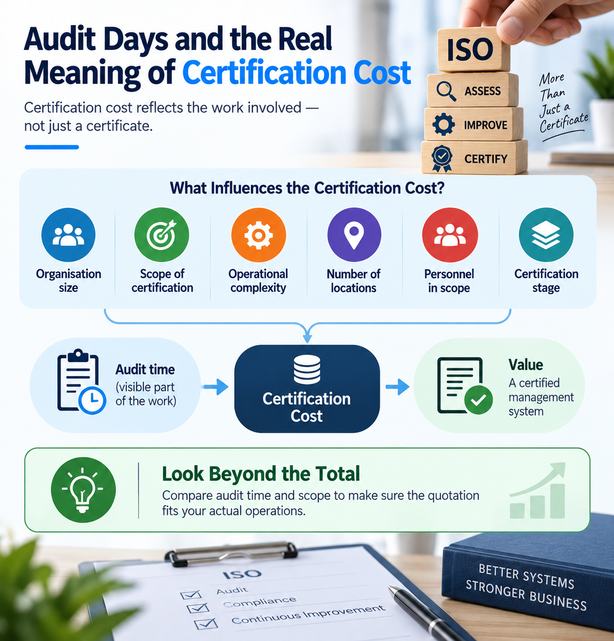
The cost of certification is not simply a fee for receiving a certificate. It reflects the activities required to assess a management system against the applicable requirements.
Audit time is one visible part of that work. The organisation’s size, scope, complexity, locations, personnel, and certification stage can all influence the assessment effort.
For anyone researching iso certification cost india, this provides an important perspective. Instead of comparing quotations only by their totals, businesses can ask whether the proposed audit time and scope are appropriate for their actual operations.
Conclusion
Audit days matter because they represent the time needed to conduct an effective management-system assessment. They can influence certification quotations and help explain why apparently similar businesses may receive different proposals.
Employee numbers, certification scope, business complexity, locations, audit stages, and previous audit results can all affect the required time. The applicable ISO and accreditation guidance exists to help certification bodies determine audit duration systematically rather than treating every organisation identically.
For businesses evaluating ISO certification fees in India, understanding audit days makes quotation comparisons more meaningful. Instead of focusing only on the final figure, review the scope, audit stages, duration, and included services. A clear understanding of audit time can help businesses see what they are actually being assessed for and why certification requirements can differ from one organisation to another.