
Why Do Two Small Businesses Get Completely Different ISO Certification Quotes?
Two small businesses can have similar employee counts and operate in the same city, yet receive very different ISO certification quotations. Certification work is not determined by employee count alone. The standard selected, certification scope, number of sites, operational complexity, audit time, and services included in a proposal can all affect the work involved.
For anyone researching iso certification cost for small business in india, this distinction is important. A quotation is meaningful only when you understand what activities and deliverables it covers. Two figures cannot be compared fairly if the businesses, scopes, or services are different.
The International Accreditation Forum’s audit-time guidance explains that factors such as effective personnel and risk category can affect audit duration for applicable management-system audits.
The ISO Standard Makes a Difference
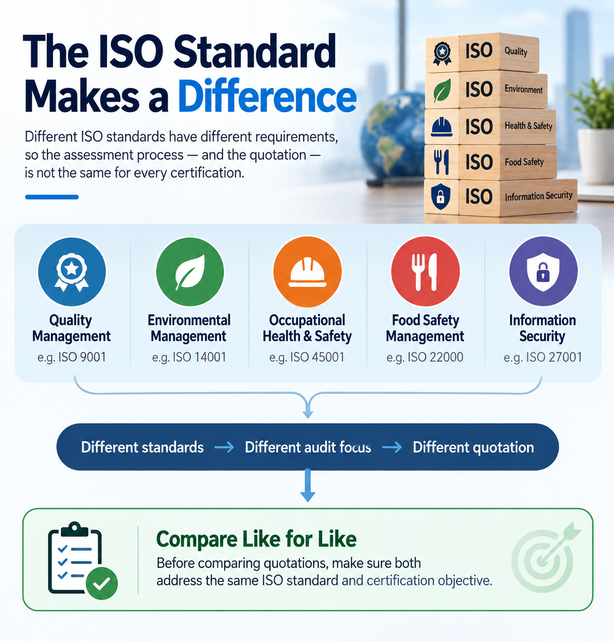
The first reason for different quotations is the standard itself. ISO standards address different management-system requirements, so the assessment process is not identical for every certification.
A business seeking quality management certification may have different audit considerations from an organisation seeking environmental, occupational health and safety, food safety, or information security certification.
This means two small businesses should not expect the same quotation simply because both have fewer employees. Before comparing proposals, identify the exact ISO standard being requested and confirm that both quotations address the same certification objective.
Employee Count Is Important, But It Is Not Everything
The number of people involved in the certification scope can influence audit time. However, employee count does not tell the complete story.
Audit-time guidance refers to an effective number of personnel, which can include permanent, temporary, part-time, and certain other personnel involved within the certification scope.
Two businesses with similar headcounts can therefore have different audit requirements. One may have a straightforward office operation, while another may have several shifts, contractors, production activities, or processes that require greater attention.
When requesting a quotation, businesses should provide accurate information about the people involved in the management system rather than simply describing themselves as small.
Certification Scope Can Change the Comparison
Certification scope defines what the management system covers. This can include particular products, services, activities, departments, or locations.
Imagine two businesses with the same number of employees. One wants certification for a limited service activity at one location. The other wants certification to cover manufacturing, storage, distribution, and additional operational activities. Their employee counts may be identical, but the auditor may need to examine considerably different processes.
A broader scope can require additional audit planning and time. Therefore, ISO certification process discussions should always include a clear definition of scope. Businesses should ensure that the wording in the quotation accurately represents the activities they want certified.
Multiple Locations Can Affect Audit Planning
A business operating from one location may have a simpler certification arrangement than a business with multiple sites.
When several locations are included, the certification body may need to assess how the management system is implemented across those sites. Multi-site certification has specific audit and sampling considerations, so the number and nature of locations can influence audit planning. The IAF maintains specific mandatory guidance for management-system certification of multi-site organisations.
Operational Risk and Complexity Matter
Small does not always mean simple.
A small service business may have relatively straightforward processes. A small manufacturer, laboratory, food operation, construction-related organisation, or other higher-risk activity may involve more controls and operational considerations.
For applicable quality-management audits, IAF guidance groups activities by risk category and notes that higher-risk activities normally require more audit time.
This helps explain why employee count alone cannot determine a quotation. The nature of the work being assessed matters because auditors need enough time to gather evidence and evaluate whether the management system meets applicable requirements.
Audit Time Is a Practical Cost Driver
Audit time is closely connected with the amount of work a certification body must perform. It covers activities such as planning, collecting evidence, reviewing processes, recording findings, and reaching audit conclusions. The IAF guidance states that an audit day is normally based on eight hours, while the required audit time depends on applicable factors.
This explains why two apparently similar businesses can receive different proposals when their scopes or operational characteristics require different assessment effort.
Existing Documentation Can Affect Preparation
Businesses also begin their certification journey from different starting points.
One organisation may already have documented procedures, responsibilities, records, internal controls, and management reviews. Another may have very little formal documentation and may need substantial preparation before an external certification audit.
This difference can affect the amount of consultancy, implementation, training, or preparation support a business may choose to purchase.
That distinction is important when comparing ISO certification fees in India. A proposal that includes extensive implementation support is not directly comparable with one that covers certification activities alone.
Consultancy and Certification Are Different Services
Many quotation differences come from confusion between consultancy and certification.
Consultancy may involve helping an organisation understand requirements, develop documentation, establish processes, train employees, conduct internal audits, prepare for management review, or address identified gaps.
Certification is the independent conformity-assessment activity through which the organisation’s management system is audited against the applicable standard.
These services can appear together in a commercial proposal, but they serve different purposes. A proposal with more preparation support may have a different total from a proposal limited to certification-related activities. The scope of service needs to be examined carefully.
Certification Scheme Requirements Matter
Different management systems can have different certification requirements. IAF materials cover management-system certification across multiple standards and schemes, including quality, environmental, occupational health and safety, food safety, information security, and other areas.
Therefore, a business should not assume that a quotation for one standard can be used as a benchmark for another.
Even when two organisations request the same standard, sector-specific conditions, scope, locations, personnel, and audit requirements can create differences.
What Should Be Checked in an ISO Quotation?
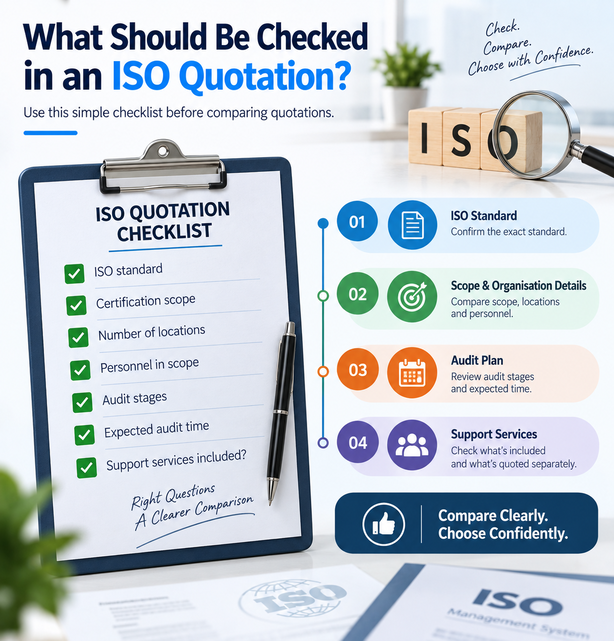
Before comparing quotations, create a simple checklist.
First, confirm the exact ISO standard. Next, compare the certification scope, number of locations, personnel included in the scope, audit stages, and expected audit time.
Then check whether documentation support, employee training, internal audit assistance, management review support, corrective-action guidance, certification activities, and surveillance arrangements are included or quoted separately.
How Small Businesses Can Request More Accurate Quotes
Businesses can make quotation comparisons easier by providing complete information from the beginning.
State the exact standard, business activities, certification scope, employee numbers, shifts, locations, outsourced processes, and current management-system status. If there are multiple sites or unusual operational arrangements, mention them clearly.
Then request an itemised proposal that explains the certification activities and additional services. This helps reduce assumptions and makes different quotations easier to compare.
For businesses researching iso certification cost for small business in india, this approach is more useful than searching for one universal figure. Certification requirements vary because businesses themselves vary.
Conclusion
Two small businesses can receive completely different ISO certification quotations without there being anything unusual about the difference. Employee numbers are only one consideration. The ISO standard, certification scope, locations, effective personnel, operational risk, complexity, audit requirements, existing system, and additional support can all influence the work involved.
The most reliable way to compare quotations is to compare the scope and inclusions line by line. Ask what standard is covered, what activities and locations are included, how the audit is structured, and which preparation or support services are part of the proposal.
Understanding these factors makes ISO certification fees in India easier to evaluate and helps small businesses avoid comparing quotations that are not actually offering the same service.