
HACCP Verification vs Monitoring: What Food Businesses Should Understand
Food safety depends on effective controls and regular checks that those controls continue to work. In a HACCP-based system, monitoring and verification are sometimes confused, although they serve different purposes.
For businesses preparing for haccp certification, understanding this difference is essential. Monitoring checks whether a critical control is maintained during operations, while verification provides confidence that the overall HACCP system is working as intended.
What Is HACCP?
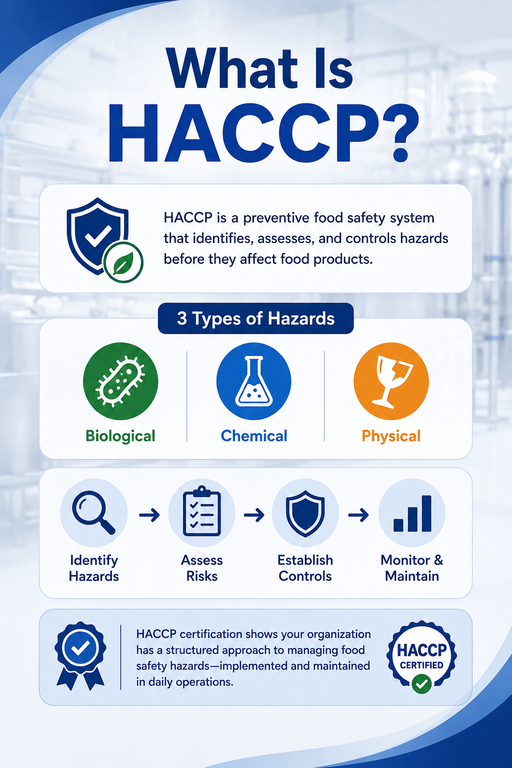
HACCP, or Hazard Analysis and Critical Control Point, is a preventive food safety system designed to identify, assess, and control hazards before they affect food products. It focuses on controlling risks during food production and handling rather than depending only on testing the finished product.
A HACCP system considers three major types of hazards: biological, chemical, and physical. Businesses identify where these hazards could occur and establish suitable controls at important stages of the process. These controls help prevent, eliminate, or reduce food safety risks to acceptable levels.
For businesses working toward haccp certification, understanding these principles is essential. HACCP certification demonstrates that an organization has established a structured approach to managing identified food safety hazards. However, the system must be properly implemented and maintained in everyday operations.
What Is Monitoring?
Monitoring is the planned process of observing or measuring a control at a Critical Control Point (CCP). Its purpose is to confirm that the CCP remains under control and that established critical limits are being achieved.
For example, a cooking process may require food to reach a specific temperature. An employee can measure the temperature at defined intervals and record the results. If the required limit is not achieved, appropriate corrective action can be taken.
Effective monitoring is therefore an important part of haccp certification and helps food businesses identify potential problems quickly.
Why Is Monitoring Important?
Monitoring provides an early warning when a critical control point moves outside its critical limit. This allows the business to take corrective action before unsafe food reaches the next stage of production or, where relevant, the consumer.
Effective monitoring should be practical and reliable. Employees need to understand what must be checked, how and when it should be measured, and what to do when a result is outside the acceptable limit. Records should be completed accurately and promptly.
What Is Verification?
Verification is different from routine monitoring. Verification involves activities used to determine whether the HACCP system is being followed and whether it is effective.
Examples can include reviewing monitoring records, checking measuring equipment, observing employees, reviewing corrective actions, conducting internal audits, and examining test or sampling results where appropriate.
Monitoring and Verification: The Key Difference
The easiest way to understand the difference is to think about their purposes.
Monitoring asks: “Is the control working right now?”
Verification asks: “Is our system working as planned?”
For example, an employee may monitor cooking temperature during production. A supervisor may later verify that temperature records are complete, the equipment is functioning correctly, employees followed the procedure, and corrective actions were taken when necessary.
Both activities are necessary, but they answer different questions.
Who Performs Monitoring?
Monitoring is normally performed by employees involved in the relevant production or food handling activity. The person should have appropriate knowledge and authority to perform the measurement and respond to deviations.
Responsibilities should be clearly defined. Employees should know what information needs to be recorded and who must be informed if a critical limit is not met.
Clear responsibility reduces the possibility of missed checks and helps ensure that problems are addressed quickly.
Who Performs Verification?
Verification responsibilities can be assigned to people who are appropriately qualified and independent enough from the activity being reviewed to provide an objective assessment.
The arrangement depends on the organization’s size, structure, and HACCP system. Verification may involve supervisors, food safety personnel, quality personnel, or other competent individuals.
Examples of Monitoring Activities
Monitoring activities vary according to the food process and identified hazards. They may include measuring cooking temperatures, checking refrigeration temperatures, observing sanitation conditions, measuring processing times, checking product characteristics, or inspecting other defined controls.
The HACCP plan should specify what is monitored, the method, frequency, responsibility, and required records.
Examples of Verification Activities
Verification may include reviewing monitoring records, observing whether procedures are followed, checking calibration or accuracy of measuring equipment, reviewing corrective action records, conducting internal audits, and evaluating relevant testing results.
Verification may also review whether the HACCP plan remains appropriate after changes to ingredients, processes, equipment, products, or facilities.
What Happens When Monitoring Shows a Problem?
If monitoring shows that a critical limit has not been met, the business should follow its established corrective action procedure.
The response may involve stopping or adjusting the process, identifying affected product, evaluating its safety, correcting the cause of the deviation, and recording the action taken.
The response depends on the hazard, process, critical limit, and HACCP plan. Employees should know the required action in advance.
Verification can then help determine whether corrective actions were properly implemented and whether the underlying problem has been addressed.
Why Records Matter
Records connect monitoring and verification. They show what happened during production and provide evidence that the system was reviewed.
Records should be accurate, complete, legible, and available when required. Poor recordkeeping can weaken confidence in the system even when the actual process may have been controlled.
How Monitoring and Verification Support HACCP Certification
Businesses preparing for haccp certification should ensure that monitoring and verification are clearly defined and consistently implemented.
An assessor may expect evidence that critical controls are monitored according to the HACCP plan and that the system is periodically verified.
A written procedure is not enough. Employees need to follow it, records need to provide evidence, and management needs to review results.
Common Mistakes Businesses Should Avoid
One common mistake is treating monitoring and verification as the same activity. Another is recording measurements without defining what happens when a limit is exceeded.
Some businesses also conduct verification only immediately before an assessment. Verification should instead be part of the normal food safety system.
Another problem is assigning monitoring responsibilities without ensuring that employees have suitable knowledge or measuring equipment.
Businesses should also avoid unnecessary checks that increase paperwork without improving food safety. Controls should reflect the organization’s hazards and processes.
How to Strengthen Both Activities
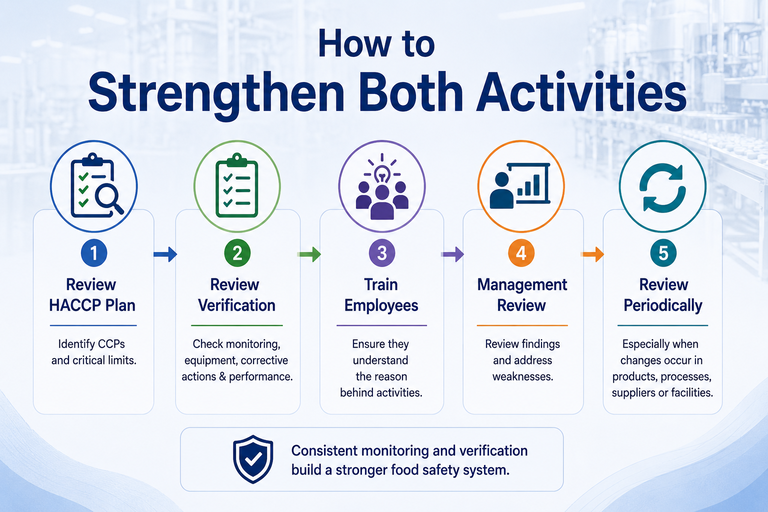
Start by reviewing the HACCP plan and identifying each CCP and its critical limits. Confirm that monitoring methods, frequencies, responsibilities, and records are clearly established.
Then review verification activities. Determine how and when monitoring records, equipment accuracy, corrective actions, procedures, and system performance will be checked.
Employees should receive appropriate instruction and understand the reason behind each activity. Management should review findings and ensure that identified weaknesses are addressed.
Periodic review is particularly important when there are changes to products, ingredients, processes, equipment, suppliers, or facilities.
Conclusion
Monitoring and verification are closely connected but should not be confused. Monitoring provides information about whether a critical control point remains within its established limits during operations. Verification provides additional confidence that the HACCP system is being followed and remains effective.
For food businesses pursuing haccp certification, clearly separating these responsibilities can strengthen the overall food safety system. Monitoring should provide timely information for controlling hazards, while verification should challenge and evaluate whether the controls are genuinely working.
A strong HACCP system is not built around paperwork alone. It depends on trained employees, reliable measurements, accurate records, appropriate corrective actions, and regular review.
When monitoring and verification are properly understood and implemented, food businesses can manage hazards more consistently and demonstrate a stronger commitment to food safety and continual improvement.