
How Can a Delhi Business Maintain Its Management System After Certification?
Achieving ISO certification is an important milestone for a business, but receiving the certificate is not the end of the process. A management system needs to remain active, practical, and relevant to the organization. If employees stop following established processes or records are not maintained, the system can gradually lose its value.
For businesses in Delhi, maintaining certification can become challenging as customers, employees, suppliers, technology, and business activities change. Organizations searching for an ISO certification body Delhi should understand that certification requires continuous attention rather than preparation only before an audit.
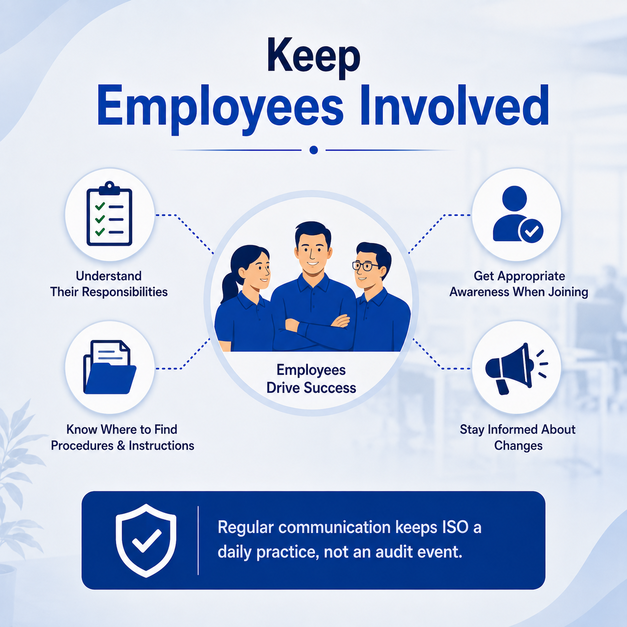
Keep Employees Involved
Employees are central to maintaining a management system. Everyone involved in relevant processes should understand their responsibilities and know where to find current procedures, forms, and instructions.
New employees should receive appropriate awareness when they join. Existing employees should also be informed when important processes or responsibilities change. Regular communication helps prevent ISO requirements from becoming something employees remember only when an auditor visits.
Review Processes Regularly
Business processes can change after certification. A company may introduce a new service, change suppliers, add employees, adopt new software, or modify how customer requirements are handled.
Regular process reviews help determine whether existing procedures are still suitable. If actual working methods have changed, related documented information should also be reviewed and updated.
The goal is not to create extra paperwork. It is to ensure that documented processes and actual business practices remain aligned.
Keep Documentation Updated
Appropriate documented information supports an effective management system. However, businesses should avoid maintaining documents that employees never use.
Relevant policies, procedures, forms, and work instructions should be current and accessible. Obsolete versions should be controlled so employees do not accidentally use outdated information.
A planned document review can help identify information that needs revision. Documentation should describe practical processes that employees can understand and follow.
Monitor Business Performance
Maintaining certification requires more than following procedures. Businesses also need to understand whether their processes are achieving their intended results.
Organizations can monitor indicators relevant to their objectives. Depending on the business, these may include customer complaints, delivery performance, defects, rework, response times, service quality, or supplier performance.
Results should be reviewed regularly. When performance declines, management should investigate the reason and decide whether corrective action or another improvement is necessary.
Conduct Internal Audits
Internal audits should continue after certification. They provide an opportunity to check whether processes are being followed and whether the management system remains effective.
An internal audit should not only confirm that documents exist. Auditors can review records, speak with employees, observe activities, and compare actual practices with applicable requirements.
Findings should be recorded and addressed appropriately. Regular internal audits can identify weaknesses before they become problems during an external assessment.
For organizations working with an ISO certification body Delhi, maintaining a reliable internal audit programme can also make ongoing certification activities easier to manage.
Listen to Customer Feedback
Customer feedback provides useful information about business performance. Complaints, suggestions, satisfaction results, and service issues can reveal areas that need attention.
Businesses should record relevant feedback and look for repeated problems. Where necessary, complaints should be investigated, corrective action should be taken, and the effectiveness of that action should be reviewed.
Customer feedback should not be treated only as a record required for certification. It can provide practical information for improving products, services, and processes.
Manage Suppliers Carefully
Supplier performance can affect an organization’s ability to meet customer and operational requirements. Businesses should establish suitable methods for selecting, evaluating, monitoring, and re-evaluating suppliers.
The level of monitoring can depend on the supplier’s importance and the risks associated with its products or services. Quality, delivery, reliability, responsiveness, and compliance can be useful performance considerations.
When recurring supplier problems are identified, the organization should investigate the issue and take an appropriate response.
Take Corrective Action
Problems can occur in any organization. The important question is how effectively those problems are addressed.
When a significant or recurring issue occurs, the organization should look beyond the immediate correction and consider the underlying cause.
For example, if incorrect information is repeatedly sent to customers, correcting each message may not solve the problem. Management may need to examine responsibilities, checking methods, employee awareness, or outdated information.
Effective corrective action should address the relevant cause and be reviewed to determine whether the problem has been prevented from recurring.
Conduct Management Reviews
Management review keeps leadership connected to the performance of the management system. Reviews can consider audit results, customer feedback, objectives, process performance, nonconformities, corrective actions, supplier performance, risks, opportunities, and resource needs.
Management should use this information to make decisions about priorities and improvements.
A management review should be meaningful rather than a meeting held only to create minutes for an auditor. Leadership involvement helps ensure that the management system remains connected to business objectives.
Manage Organizational Changes
Changes can create new risks or affect established processes. Businesses may change locations, introduce technology, appoint new employees, add services, change suppliers, or enter new markets.
Before significant changes are implemented, organizations should consider their potential effect on the management system. Responsibilities, documentation, training, resources, and controls should be updated when required.
Managing change carefully helps prevent gaps from developing as the business grows.
Prepare for Ongoing Certification Activities
ISO certification normally involves an ongoing assessment cycle. Depending on the certification arrangement, organizations may undergo surveillance or other follow-up assessments.
Businesses should understand their assessment schedule and maintain their systems throughout the year. Preparing only shortly before an external audit can create unnecessary pressure.
If records, internal audits, management reviews, corrective actions, and performance monitoring are maintained consistently, preparation for an external assessment becomes much easier.
Make Continual Improvement Practical
Continual improvement does not always require major projects. Small changes can improve performance over time.
A business might simplify a form, reduce repeated errors, improve customer communication, clarify responsibilities, strengthen supplier monitoring, or introduce a better performance measure.
Improvement activities should be connected to actual business needs. Employees can be encouraged to suggest improvements because they often understand everyday operational difficulties.
Maintain a Simple Review Routine
A regular review routine can prevent important activities from being forgotten. Businesses can periodically review performance indicators, customer complaints, supplier issues, corrective actions, document changes, and significant operational developments.
Internal audits and management reviews should follow the organization’s planned schedule. Responsibilities should also be clearly assigned.
When ownership is unclear, important activities can be delayed or missed. Clear accountability makes the management system easier to maintain.
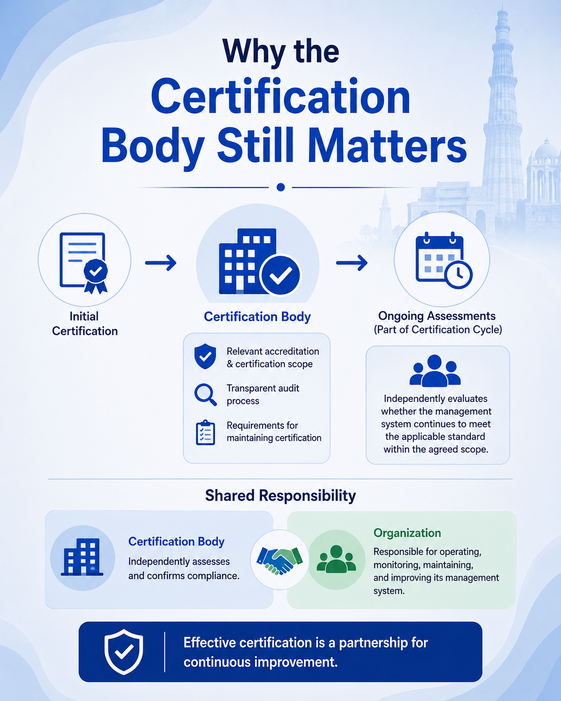
Why the Certification Body Still Matters
The certification body remains relevant after initial certification because ongoing assessments may form part of the certification cycle.
When evaluating an ISO certification body Delhi, organizations should consider the body’s relevant accreditation, certification scope, audit process, and requirements for maintaining certification.
The certification body independently evaluates whether the management system continues to meet the applicable standard within the agreed scope.
However, the organization remains responsible for operating, monitoring, maintaining, and improving its own management system.
Conclusion
Maintaining ISO certification requires continuous involvement from management and employees. It should not become an activity that receives attention only before an external audit.
Delhi businesses can maintain their systems by keeping employees informed, reviewing processes, controlling documentation, monitoring performance, conducting internal audits, managing suppliers, listening to customers, and addressing recurring problems through appropriate corrective action.
Management should also review system performance and consider the effect of significant organizational changes.
For businesses evaluating an ISO certification body Delhi, it is important to understand that successful certification depends on continuing conformity, not simply obtaining an initial certificate.
When ISO practices become part of everyday operations, maintaining certification becomes more manageable. A well-maintained management system can support consistency, accountability, customer satisfaction, process control, and continual improvement.
Ultimately, the management system should provide genuine value to the business.