

Your Business Changes Its Legal Name—Does Your ISO Certificate Need Updating?
Yes, an ISO certificate generally needs updating when a certified business changes its legal name. Organisations working with iso certification companies in india should notify their certification body, provide supporting legal documents and confirm whether the change affects ownership, operations or certification scope. A name change alone does not necessarily require fresh certification.
Why Does Your ISO Certificate Need the Correct Legal Name?
An ISO certificate identifies the organisation whose management system has been assessed. If the legal name changes, the certificate should accurately reflect the identity of the certified business.
Clause 8.2.2 of ISO/IEC 17021-1:2015 requires certification documents to identify the certified client by name and geographical location.
A difference between the registered business name and the certificate may create confusion during customer verification, supplier registration and tender evaluations.
An ISO certificate update helps establish continuity between the previous and current business identities.
When Should You Inform Your Certification Body?
You should inform your certification body without unnecessary delay after a legal name change. Ideally, discuss planned changes before completing the transition.
Clause 8.5.3 of ISO/IEC 17021-1:2015 addresses notification of changes that could affect continued conformity with certification requirements, including changes involving legal status, ownership and organisational structure.
Businesses working with iso certification companies in india should provide accurate information about the nature of the change.
Waiting until the next scheduled surveillance audit could create unnecessary documentation and verification difficulties.

Do You Need a New ISO Audit?
Not necessarily. Whether another audit is required depends on what has changed beyond the registered name.
What If Only Your Business Name Changes?
If ownership, operational activities, employees, locations and management system arrangements remain unchanged, the certification body may complete a documentary review.
Following satisfactory verification, revised certification documents may be issued without conducting another full audit.
What If Ownership Also Changes?
Changes involving ownership, management responsibilities or organisational structure may require additional evaluation.
The certification body must determine whether these developments affect the management system or existing ISO certification scope.
A legal name change associated with a merger or acquisition may require more extensive assessment than a straightforward renaming exercise.
Which Documents Should You Submit?
The documents required depend on your business structure and the circumstances surrounding the legal name change.
Indian businesses may need to provide:
- Revised certificate of incorporation, where applicable.
- Official evidence confirming the legal name change.
- Updated GST registration details, where relevant.
- Existing ISO certification documents.
- Information about ownership or management changes.
- Confirmation of current operational activities and locations.
The certification body may request further evidence before approving an ISO certificate name change.
Providing consistent information across relevant documents can reduce verification difficulties and help distinguish administrative changes from significant organisational developments.
Will Your Certification Scope Change?
A legal name change does not automatically alter the activities covered by certification.
If manufacturing processes, services, locations and management system boundaries remain unchanged, the existing scope may continue to apply.
However, businesses sometimes introduce new products, facilities or operational activities while undergoing rebranding or restructuring.
These developments must be communicated separately because they may affect the ISO certification scope.
For example, adding a manufacturing facility during a name change does not automatically bring that facility under existing certification. Appropriate evaluation and approval may be necessary before the additional location receives coverage.
Will Your Certificate Expiry Date Change?
A revised certificate does not necessarily establish a new certification cycle.
When a legal name change involves only administrative details, the certification body may retain the existing expiry date and surveillance schedule.
Organisations should not assume that receiving revised certification documents extends their certification validity.
An ISO certificate update should clearly distinguish revised documents from obsolete versions while maintaining accurate certification information.
Confirm the applicable validity dates and upcoming audit arrangements before distributing the revised certificate to customers or business partners.
What Happens in a Real Business?
Consider an engineering business in Ahmedabad that changes its registered legal name following a rebranding initiative.
Its manufacturing facility, ownership, employees and quality management procedures remain unchanged. However, its ISO 9001 certificate continues displaying the previous business name.
During supplier registration, a prospective customer notices that the certificate and incorporation documents contain different names.
The business contacts its certification body, submits revised legal documents and confirms that operational activities remain unchanged.
After reviewing the information, the certification body approves revised certification documents without requiring another full certification audit.
This hypothetical example demonstrates how a timely ISO certificate name change can prevent avoidable confusion during commercial transactions.
Which Other Business Documents Need Updating?
Changing the certificate alone may not address every documentation requirement. Businesses should review management system documents and external communications containing the previous legal name.
Relevant documents may include quality policies, internal audit reports, standard operating procedures, supplier agreements, customer communications and website certification statements.
Historical records should remain identifiable rather than being altered indiscriminately. Businesses can maintain appropriate references connecting previous records with the current legal identity.
Organisations consulting iso certification companies in india should also confirm how revised certification information will appear in applicable verification directories.
For further assistance, businesses can explore ISO certification services and discuss their specific organisational changes.
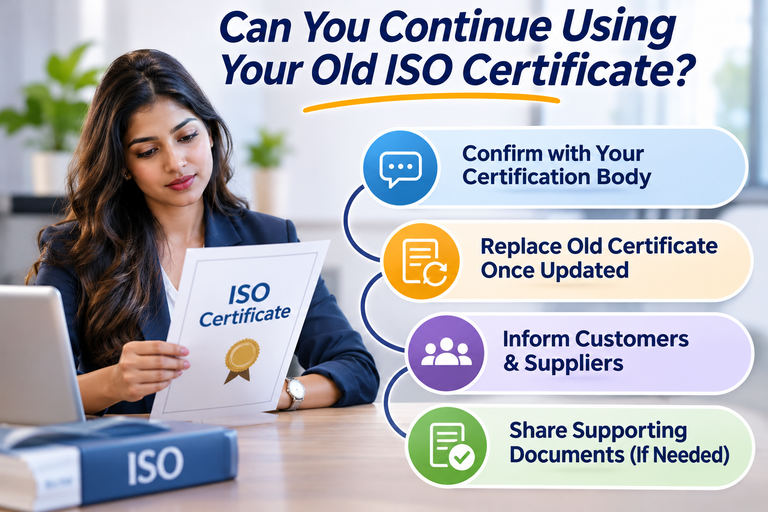
Can You Continue Using Your Old ISO Certificate?
Businesses should seek confirmation from their certification body regarding certificate usage during the transition.
An outdated certificate may create misunderstandings when presented alongside documents displaying the new legal name.
Once revised certification documents are issued, replace outdated copies wherever they are publicly displayed or shared for commercial purposes.
Inform relevant customers, suppliers and tender authorities about the change. Where necessary, provide supporting documentation explaining the relationship between both legal names.
Conclusion
Changing your business’s legal name requires more than updating commercial documents and branding materials. Certification information should also accurately represent the organisation responsible for maintaining the certified management system.
Businesses working with iso certification companies in india should communicate changes promptly, provide supporting legal evidence and clarify whether additional assessment is necessary.
A timely ISO certificate update helps maintain accurate business identification, prevents verification difficulties and supports certification continuity. The most important consideration is whether the legal name change represents an administrative adjustment or a deeper organisational transformation affecting existing certification arrangements.