
What Are the Prerequisites for Advanced Food Hygiene Certification?
Food safety has become one of the most critical priorities across the food industry. Whether an organization is involved in food manufacturing, processing, packaging, storage, catering, or distribution, maintaining high hygiene standards is essential for protecting consumers and complying with food safety regulations. One of the most effective ways to strengthen food safety knowledge is through haccp training, which prepares professionals to identify, control, and prevent food safety hazards.
However, many professionals wonder whether they are ready for advanced food hygiene certification. While advanced certification offers greater expertise and career opportunities, it also requires participants to have a solid understanding of fundamental food safety concepts. Before enrolling, it is important to understand the prerequisites that create the foundation for successful learning.
This guide explains the essential requirements, skills, and knowledge needed before pursuing advanced food hygiene certification and why proper preparation leads to better implementation of food safety systems.
Understanding Advanced Food Hygiene Certification
Advanced food hygiene certification focuses on developing the knowledge required to establish, manage, monitor, and improve food safety management systems. It goes beyond basic hygiene practices by emphasizing risk assessment, hazard control, documentation, internal auditing, verification, and continuous improvement.
Professionals completing haccp training gain a deeper understanding of identifying food safety hazards and implementing preventive controls throughout the food production process. Advanced certification also helps organizations improve compliance while reducing food contamination risks. HACCP-based systems rely on strong prerequisite hygiene programs before hazard analysis can be effectively implemented.
Why Prerequisites Matter
Advanced certification is designed for individuals who already understand the basics of food hygiene. Without foundational knowledge, learners may struggle with complex concepts such as Critical Control Points (CCPs), hazard analysis, validation, verification, corrective actions, and food safety documentation.
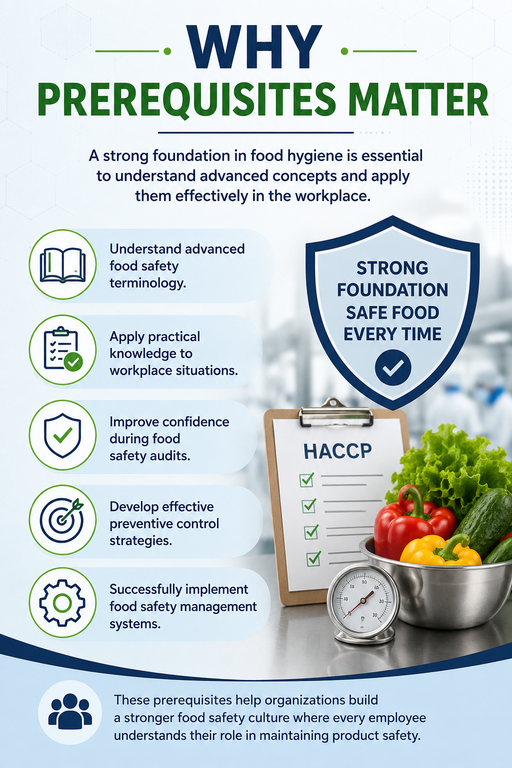
Building a strong foundation before enrolling in haccp training allows participants to:
- Understand advanced food safety terminology.
- Apply practical knowledge to workplace situations.
- Improve confidence during food safety audits.
- Develop effective preventive control strategies.
- Successfully implement food safety management systems.
These prerequisites also help organizations build a stronger food safety culture where every employee understands their role in maintaining product safety.
1. Basic Knowledge of Food Hygiene
The first prerequisite is understanding basic food hygiene principles.
Participants should already know:
- Personal hygiene requirements
- Safe food handling practices
- Cross-contamination prevention
- Cleaning and sanitation procedures
- Temperature control
- Pest management
- Safe storage practices
These topics form the backbone of food safety and support advanced learning. Basic hygiene measures are considered prerequisite programs that should be in place before conducting a HACCP study.
2. Understanding Good Manufacturing Practices (GMP)
Good Manufacturing Practices provide the operational foundation for food safety.
Before beginning haccp training, participants should understand:
- Facility cleanliness
- Equipment maintenance
- Employee hygiene
- Process controls
- Raw material handling
- Waste management
- Preventive maintenance
Since HACCP focuses on controlling hazards rather than correcting poor manufacturing practices, GMP knowledge is considered essential for advanced certification. Advanced HACCP courses commonly expect a working knowledge of prerequisite programs and GMPs.
3. Familiarity with HACCP Principles
One of the most important prerequisites is understanding the seven HACCP principles.
Participants should already know how to:
- Conduct hazard analysis
- Identify Critical Control Points
- Establish critical limits
- Monitor control measures
- Take corrective actions
- Verify system effectiveness
- Maintain documentation
Advanced haccp training expands these concepts by teaching verification, validation, continuous improvement, and practical implementation across food operations.
4. Knowledge of Food Safety Hazards
Professionals pursuing advanced certification should understand different types of food safety hazards.
These include:
Biological Hazards
- Bacteria
- Viruses
- Parasites
- Molds
Chemical Hazards
- Cleaning chemicals
- Allergens
- Food additives
- Agricultural residues
Physical Hazards
- Glass fragments
- Metal pieces
- Plastic contamination
- Stones
Understanding these hazards enables learners to apply hazard analysis more effectively during haccp training.
5. Experience in Food Industry Operations
Although advanced certification may not always require years of experience, practical exposure to food operations is highly beneficial.
Experience in areas such as:
- Food production
- Packaging
- Warehousing
- Distribution
- Catering
- Retail food handling
- Quality assurance
helps participants relate theoretical concepts to real workplace situations.
Many advanced HACCP programs recommend prior HACCP knowledge or equivalent practical experience before enrollment.
6. Documentation Skills
Food safety systems rely heavily on proper documentation.
Before enrolling in haccp training, participants should understand how to maintain:
- Inspection records
- Cleaning logs
- Temperature records
- Corrective action reports
- Calibration records
- Supplier approvals
- Monitoring checklists
Accurate documentation supports traceability and demonstrates compliance during audits.
7. Understanding Risk Assessment
Advanced food hygiene certification introduces more detailed risk evaluation techniques.
Participants should understand:
- Hazard identification
- Risk likelihood
- Risk severity
- Preventive controls
- Monitoring methods
Risk-based thinking helps organizations focus resources where food safety risks are greatest.
8. Communication Skills
Food safety depends on teamwork.
Professionals taking haccp training should be able to:
- Communicate procedures clearly
- Train colleagues
- Report food safety issues
- Participate in food safety meetings
- Explain corrective actions
Strong communication ensures food safety procedures are consistently followed across departments.
9. Commitment to Continuous Improvement
Food safety standards continue to evolve.
Advanced certification requires individuals who are willing to:
- Learn updated regulations
- Improve existing procedures
- Participate in internal audits
- Review food safety performance
- Implement corrective actions
Continuous improvement strengthens long-term food safety performance and reduces operational risks.
10. Awareness of Food Safety Management Systems
Participants should have a basic understanding of Food Safety Management Systems (FSMS).
This includes:
- Food safety objectives
- Management responsibility
- Operational controls
- Internal audits
- Corrective actions
- Performance monitoring
Advanced haccp training integrates these management concepts with hazard analysis to build a complete food safety framework. Quality HACCP training typically covers hazard analysis, CCP management, documentation, audits, and prerequisite programs together.
Common Mistakes Before Advanced Certification
Many learners enter advanced certification without sufficient preparation.
Common mistakes include:
- Ignoring basic hygiene knowledge
- Limited understanding of HACCP principles
- Poor documentation practices
- Lack of workplace experience
- Weak knowledge of GMP
- Insufficient understanding of food hazards
Avoiding these mistakes improves learning outcomes and helps professionals apply food safety principles more effectively.
Benefits of Meeting the Prerequisites
Preparing properly before haccp training offers several advantages.
These include:
Better Learning Experience
Participants understand advanced concepts more easily.
Improved Food Safety Compliance
Organizations implement stronger food safety controls.
Stronger Audit Performance
Prepared professionals perform confidently during internal and external audits.
Better Risk Management
Hazards are identified and controlled more effectively.
Career Growth
Advanced food hygiene certification demonstrates professional competence and supports career development in food safety and quality management.
Who Should Consider Advanced Food Hygiene Certification?
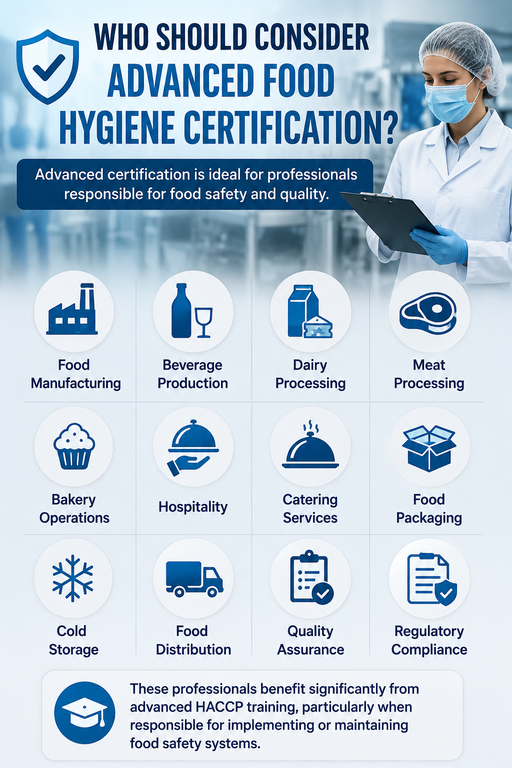
Advanced certification is suitable for professionals working in:
- Food manufacturing
- Beverage production
- Dairy processing
- Meat processing
- Bakery operations
- Hospitality
- Catering services
- Food packaging
- Cold storage
- Food distribution
- Quality assurance
- Regulatory compliance
These professionals benefit significantly from advanced haccp training, particularly when responsible for implementing or maintaining food safety systems.
Final Thoughts
Advanced food hygiene certification is far more than a professional qualification—it is a commitment to protecting consumers and strengthening food safety across the entire supply chain. Success in advanced certification depends on having the right foundation before beginning the learning journey.
Understanding basic food hygiene, Good Manufacturing Practices, food safety hazards, documentation, risk assessment, and the seven HACCP principles creates the knowledge required to benefit fully from haccp training. These prerequisites enable professionals to apply advanced food safety concepts confidently, improve compliance, support successful audits, and contribute to safer food production.
Organizations that invest in well-prepared professionals not only improve regulatory compliance but also build stronger food safety cultures, reduce operational risks, and enhance customer confidence. With the right preparation, advanced food hygiene certification becomes a valuable step toward long-term excellence in food safety management.