
The Science Behind HACCP Certification and Food Hazard Control
Food safety is not a matter of chance—it is the result of systematic planning, scientific analysis, and continuous monitoring. As global food supply chains become more complex, the need for structured food safety systems has never been greater. HACCP certification stands at the center of modern food safety management, offering a science-based approach to identifying, evaluating, and controlling food safety hazards.
Unlike traditional inspection-based methods, HACCP focuses on prevention rather than correction. It applies scientific principles to ensure food is safe at every stage of production, processing, storage, and distribution.
Understanding the Foundation of HACCP Certification
HACCP, which stands for Hazard Analysis and Critical Control Points, is built on scientific risk assessment rather than assumption. HACCP certification requires organizations to systematically identify how biological, chemical, and physical hazards can enter the food chain and determine precise control measures to prevent harm. This scientific approach ensures that food safety decisions are based on evidence, data, and validated processes rather than guesswork.
A key strength of HACCP certification is its proactive nature. Instead of relying only on end-product testing, HACCP certification focuses on controlling critical steps within production, processing, storage, and distribution. By identifying Critical Control Points, organizations can manage risks at the source. This reduces the likelihood of contamination and strengthens overall food safety performance.
The structure of HACCP certification is rooted in internationally accepted scientific principles. Hazard analysis uses microbiological research, chemical safety data, and physical risk assessment to define controls that are measurable and effective. This makes HACCP certification globally recognized and widely accepted by regulators, auditors, and food safety stakeholders. Through its preventive framework, HACCP certification helps organizations maintain consistency, reduce food safety incidents, and build trust across the supply chain.
The Role of Science in Food Hazard Identification
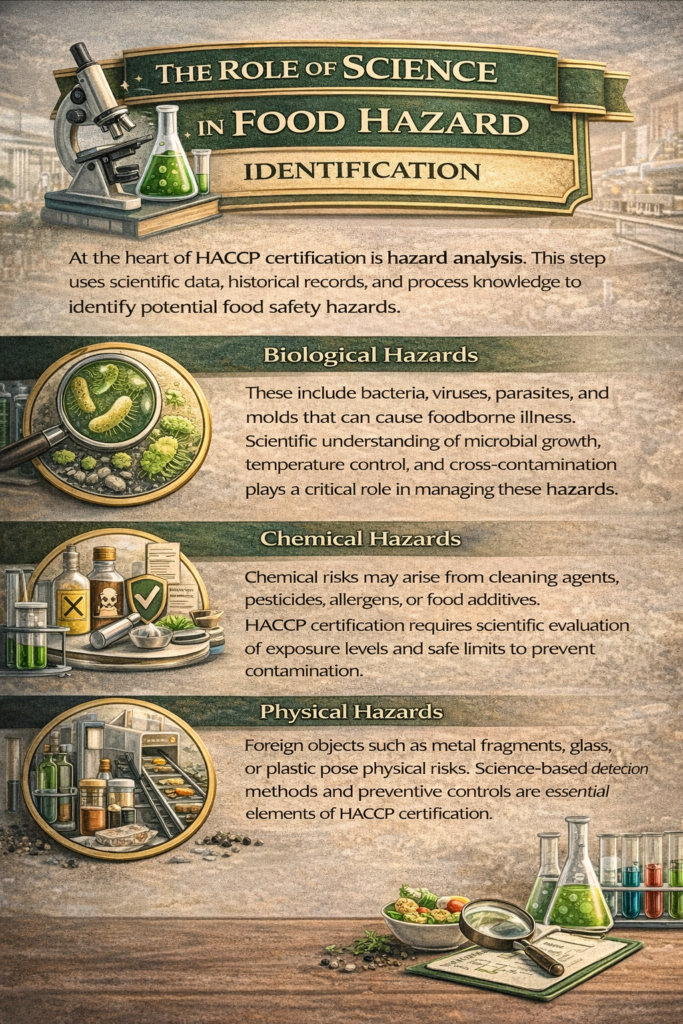
At the heart of HACCP certification is hazard analysis. This step uses scientific data, historical records, and process knowledge to identify potential food safety hazards.
Biological Hazards
These include bacteria, viruses, parasites, and molds that can cause foodborne illness. Scientific understanding of microbial growth, temperature control, and cross-contamination plays a critical role in managing these hazards.
Chemical Hazards
Chemical risks may arise from cleaning agents, pesticides, allergens, or food additives. HACCP certification requires scientific evaluation of exposure levels and safe limits to prevent contamination.
Physical Hazards
Foreign objects such as metal fragments, glass, or plastic pose physical risks. Science-based detection methods and preventive controls are essential elements of HACCP certification.
Critical Control Points: Where Science Meets Control
A defining feature of HACCP certification is the identification of Critical Control Points (CCPs). These are specific stages in the process where control is essential to prevent, eliminate, or reduce food safety hazards to acceptable levels.
Scientific validation is used to determine:
- Why a step is critical
- What control measures are effective
- What limits ensure safety
For example, cooking temperatures are based on microbiological studies that determine how heat destroys pathogens. This scientific precision makes HACCP certification both reliable and measurable.
Establishing Critical Limits Through Scientific Evidence
Critical limits are measurable criteria that separate safe from unsafe conditions. HACCP certification requires these limits to be scientifically justified rather than estimated.
Examples include:
- Minimum cooking temperatures
- Maximum storage times
- Acceptable pH levels
- Safe refrigeration temperatures
By grounding limits in scientific research, HACCP certification ensures consistency, repeatability, and regulatory confidence.
Monitoring Systems Based on Data and Measurement
Monitoring is another science-driven component of HACCP certification. It involves systematic observations and measurements to ensure CCPs remain under control.
Scientific tools such as thermometers, pH meters, metal detectors, and time logs are used to gather objective data. This data-driven approach allows organizations to detect deviations early and take corrective action before food safety is compromised.
Corrective Actions Rooted in Root Cause Analysis
When monitoring reveals a deviation, HACCP certification requires immediate corrective action. These actions are not random fixes—they are based on scientific root cause analysis.
Corrective actions focus on:
- Identifying why the deviation occurred
- Preventing recurrence
- Ensuring affected products do not reach consumers
This systematic approach reinforces the preventive philosophy behind HACCP certification.
Verification: Proving the System Works
Verification activities confirm that the HACCP system is functioning as intended. HACCP certification requires scientific validation and verification methods such as:
- Microbiological testing
- Equipment calibration
- Internal audits
- Process validation studies
These activities provide objective evidence that food safety controls are effective, strengthening trust in the system.
Documentation and Record-Keeping: Evidence of Control
Science relies on evidence, and so does HACCP certification. Accurate documentation supports traceability, accountability, and continuous improvement.
Records demonstrate:
- Hazard analysis decisions
- CCP monitoring results
- Corrective actions taken
- Verification outcomes
This documentation transforms food safety from informal practice into a controlled, auditable system.
How HACCP Certification Supports Regulatory and Global Compliance
The scientific framework of HACCP certification aligns closely with food safety regulations worldwide. Many national and international food laws are based on HACCP principles.
Because HACCP certification uses objective science rather than subjective judgment, it is widely accepted across borders. This makes it especially valuable for organizations involved in export, manufacturing, processing, and large-scale food handling.
Continuous Improvement Through Scientific Review
Food safety risks evolve due to changes in raw materials, technology, consumer behavior, and environmental conditions. HACCP certification requires periodic review and updating of hazard analyses and control measures.
Scientific review ensures the system remains effective over time. New research, incident data, and process changes are evaluated to strengthen food hazard control continuously.
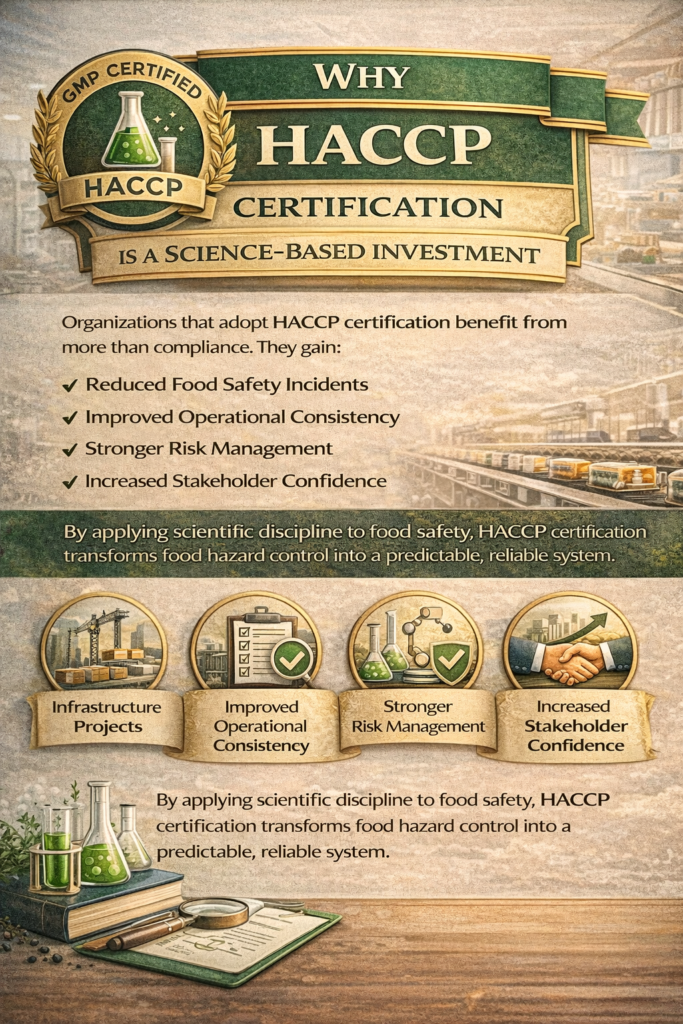
Why HACCP Certification Is a Science-Based Investment
Organizations that adopt HACCP certification benefit from more than compliance. They gain:
- Reduced food safety incidents
- Improved operational consistency
- Stronger risk management
- Increased stakeholder confidence
By applying scientific discipline to food safety, HACCP certification transforms food hazard control into a predictable, reliable system.
Final Thoughts: Science as the Backbone of Food Safety
The strength of HACCP certification lies in its firm scientific foundation, which transforms food safety from a reactive task into a preventive system. By focusing on hazard analysis, HACCP certification enables organizations to identify biological, chemical, and physical risks before they impact consumers. This science-driven approach ensures that food safety decisions are based on evidence, research, and measurable controls rather than assumptions or past experience alone.
One of the greatest advantages of HACCP certification is its emphasis on data-driven controls and continuous monitoring. Critical Control Points are established using scientific thresholds, allowing organizations to detect deviations early and take corrective action immediately. Through regular verification and validation, HACCP certification ensures that food safety systems remain effective, consistent, and aligned with real-world risks across the production and supply chain.
Unlike traditional inspection-based systems, HACCP certification prioritizes prevention over correction. Instead of waiting for contamination to occur, HACCP certification empowers organizations to control processes at every critical stage. This proactive structure reduces food safety incidents, minimizes waste, and strengthens operational reliability while protecting brand credibility.
The long-term value of HACCP certification extends beyond compliance. Its scientific methodology supports sustainability by encouraging continual improvement and adaptation to changing food safety risks. As regulations evolve and consumer expectations rise, HACCP certification provides a flexible yet robust framework that can grow with the organization.Ultimately, HACCP certification serves as a cornerstone of modern food safety management. By integrating science-based decision-making, measurable controls, and preventive strategies, HACCP certification protects consumers, supports public health, and builds trust throughout the food supply chain. When science guides food hazard control, food safety becomes systematic, transparent, and resilient—delivering lasting benefits for businesses and society alike.