

Your Critical Control Point Is Under Control—But What Happens When Monitoring Records Are Missing?
Introduction
Food safety depends on more than following procedures. Businesses also need reliable evidence that essential controls are applied consistently. A team may maintain cooking temperatures, check refrigeration units, and follow sanitation procedures, but missing monitoring records make it difficult to prove that these activities took place.
For food manufacturers, processors, and handlers, accurate documentation is an essential part of a Hazard Analysis and Critical Control Point (HACCP) system.
Missing records do not prove food was unsafe, but they create uncertainty about monitoring and accountability.
Why Critical Control Point Monitoring Matters
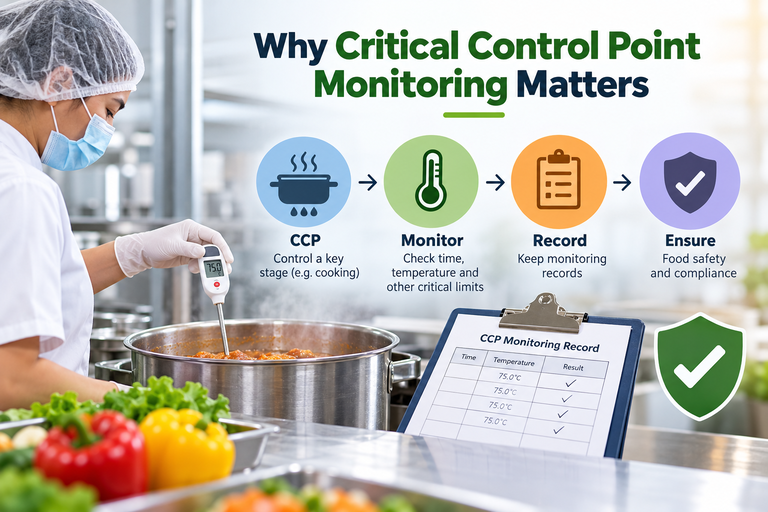
A Critical Control Point (CCP) is a stage where control is essential to prevent a significant food safety hazard, eliminate it, or reduce it to an acceptable level. This may involve cooking, cooling, storage, or other steps identified through hazard analysis.
Each CCP needs critical limits, monitoring procedures, responsibilities, and corrective actions. Monitoring checks whether a process stays within its limits; records preserve the results.
For example, a cooking process may require a specific time and temperature combination to control harmful microorganisms. If an employee completes the cooking cycle but fails to record the measurement, the business cannot readily demonstrate that the required conditions were achieved.
HACCP monitoring records are therefore more than administrative paperwork. They provide evidence that controls were applied and help management determine whether the food safety plan is working as intended.
What Happens When Monitoring Records Are Missing?
Missing documentation creates uncertainty, even when employees believe the process remains under control.
Verification becomes difficult. Supervisors cannot confirm that required checks were completed at the specified frequency. They must investigate whether the omission involved paperwork alone or an actual monitoring failure.
Product assessment becomes harder. Without reliable readings, the business may struggle to identify batches processed during the undocumented period and determine whether they met requirements.
Audit confidence can decline. Repeated gaps may indicate weaknesses in training, supervision, record control, or the wider food safety system.
Recurring problems may go unnoticed. Records can reveal temperature changes, equipment faults, or inconsistent process performance. Missing information can prevent management from identifying these patterns early.
For haccp certification in india, documentation is an operational control, not an afterthought.
Does a Missing Record Mean the CCP Failed?
Not necessarily. A missing entry and a failed critical control point are different situations, although both require investigation.
A CCP failure occurs when the established critical limit is not met. A missing record means expected evidence of monitoring is unavailable. Staff should not assume the process stayed within limits without supporting evidence.
Consider a chilled storage area where employees record temperatures at scheduled intervals. One entry is missing. The refrigeration unit appears to work normally, but the business cannot immediately confirm the conditions during that period.
The team should review reliable automated temperature data, equipment alarms, maintenance information, and production records. Alternative evidence must be reliable and relevant.
Employees must never invent readings, backdate entries, or sign checks they did not perform. These actions undermine the credibility of the system. If available evidence cannot establish that the process remained under control, the business should follow its documented procedures and assess affected products before deciding their disposition.
Immediate Actions When Records Are Missing
1. Identify the gap. Determine which CCP, product, production line, date, shift, or monitoring period is involved. Establish whether one entry or a larger section is missing.
2. Inform the supervisor. Notify the designated food safety representative promptly so the issue can be investigated while relevant information remains available.
3. Assess product impact. Identify batches associated with the undocumented period. Review available process information and decide whether it sufficiently demonstrates compliance with the critical limits. If safety cannot be established, follow procedures for controlling potentially affected products. This may involve holding the product, further evaluation, or another justified decision.
4. Document the investigation. Record when the gap was identified, what was missing, who investigated it, what evidence was reviewed, and what decisions followed. Keep the investigation record separate from the original monitoring entry to preserve transparency.
5. Find the root cause. Possible reasons include unclear duties, lack of training, too much work, missing forms, equipment issues, or poor supervision. The goal is to prevent recurrence, not just complete paperwork.
Building a Reliable CCP Monitoring System
A dependable system makes accurate documentation part of everyday work.
Define responsibilities. Every monitoring activity needs an assigned person, a set frequency, and a clear method. Employees must know what to measure, where to record results, and whom to contact when something goes wrong.
Use practical forms. Monitoring sheets should include the date, time, product or batch identification where relevant, measured result, critical limit, operator identification, and review details. Keep the format clear and suitable for the process.
Train employees. Explain why monitoring matters, how to use equipment, how to record results, and what to do when a reading falls outside the permitted limit. Staff should also know how to report missed checks.
Review logs promptly. Supervisors should examine records at defined intervals. Missing entries, unusual readings, repeated corrections, and unresolved deviations should be investigated rather than ignored.
Use digital tools appropriately. Automated sensors, electronic logs, and alerts may reduce manual errors. However, digital systems still require reliable equipment, controlled access, backup arrangements, and regular review. Technology cannot replace accountability.
Corrective Action and Preventing Repeat Gaps
Corrective action should address the immediate concern and the reason the record was missed. If an employee forgot a check because responsibilities were unclear, a reminder may not be enough. The business may need to improve shift handovers, clarify accountability, or add a supervisory check.
If equipment failure prevented a measurement, maintenance and contingency procedures should be reviewed. If a form causes confusion, simplifying its layout may be more effective than repeating training.
Each investigation should record the action taken, the person responsible, the completion status, and how effectiveness will be checked. Follow-up reviews help determine whether the revised procedure is being followed consistently.
This strengthens food safety compliance and helps prevent repeated gaps.
Preparing for HACCP Certification Audits
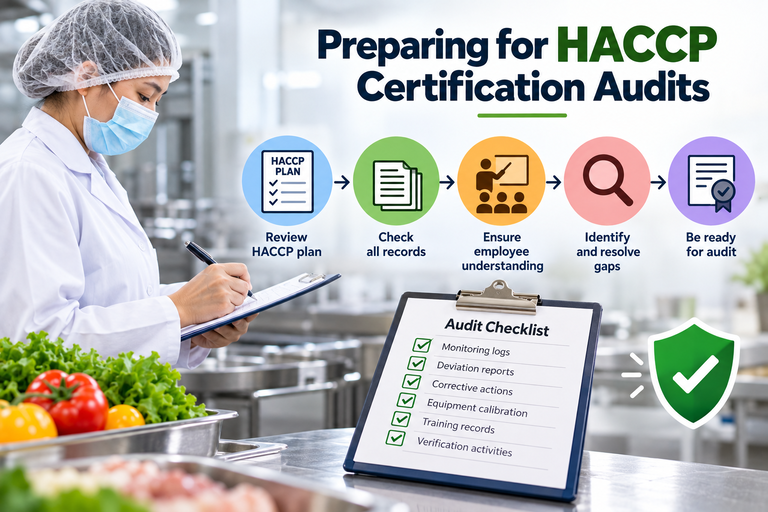
Audit preparation should be part of routine record management. Compare the written HACCP plan with actual practices and ensure records are complete, legible, traceable, and reviewed.
Auditors may examine monitoring logs, deviation reports, corrective action records, equipment calibration information, employee training evidence, and verification activities. Evidence depends on the operation and the scope of the food safety system.
Organisations working towards haccp certification in india should ensure employees understand their monitoring responsibilities and can explain how deviations are handled. A complete record is useful only when it accurately reflects what happened.
Internal reviews can identify omissions, unclear entries, and retention weaknesses. Resolve them before an audit, and continue reviewing controls after certification.
Conclusion
A critical control point may appear to be under control, but missing monitoring records leave an important question unanswered: can the business demonstrate that food safety requirements were consistently met?
Accurate documentation supports verification, traceability, product assessment, and informed corrective action. When gaps occur, businesses should investigate promptly, assess potential risks, preserve reliable evidence, and address underlying causes without fabricating information.
For organisations pursuing haccp certification in india, the strongest approach combines clear responsibilities, practical monitoring procedures, regular record reviews, employee training, and meaningful corrective action. Treating records as an essential part of food safety management strengthens audit readiness and helps protect consumers.