
From Planning to Certification: How Long Does ISO 9001 Really Take?
Quality management has become a strategic necessity for organizations aiming to build credibility, consistency, and customer trust. Among global standards, ISO 9001 certification stands out as one of the most widely recognized frameworks for quality management systems. However, a common question businesses ask before starting the journey is: How long does ISO 9001 really take from planning to certification?
The answer depends on several internal and external factors. Understanding each phase of the process helps organizations set realistic expectations, reduce delays, and achieve certification efficiently without unnecessary stress.
Understanding the Purpose of ISO 9001 Certification
Before examining timelines, it is essential to clearly understand the purpose of ISO 9001 certification. The core objective of ISO 9001 certification is to help organizations establish a structured quality management system that promotes consistency, efficiency, customer satisfaction, and continuous improvement. ISO 9001 certification is not focused only on passing an audit; it is designed to strengthen how an organization functions on a daily basis.
ISO 9001 certification requires organizations to evaluate their internal processes, identify risks, define roles and responsibilities, and ensure that quality objectives align with business goals. Through ISO 9001 certification, organizations learn to monitor performance, measure outcomes, and take corrective actions when gaps are identified. This systematic approach builds reliability and trust among customers and stakeholders.
It is important to recognize that ISO 9001 certification is not a one-time task. Maintaining ISO 9001 certification involves ongoing review, documentation updates, internal audits, and management involvement. Organizations must demonstrate continuous improvement rather than short-term compliance. Because ISO 9001 certification emphasizes long-term process control and improvement, timelines vary depending on organizational size, complexity, and preparedness.
Ultimately, ISO 9001 certification exists to create a strong quality culture. When organizations understand this purpose, they approach ISO 9001 certification with clarity and commitment, making the certification journey more effective, sustainable, and valuable over time.
Key Factors That Influence ISO 9001 Certification Timelines
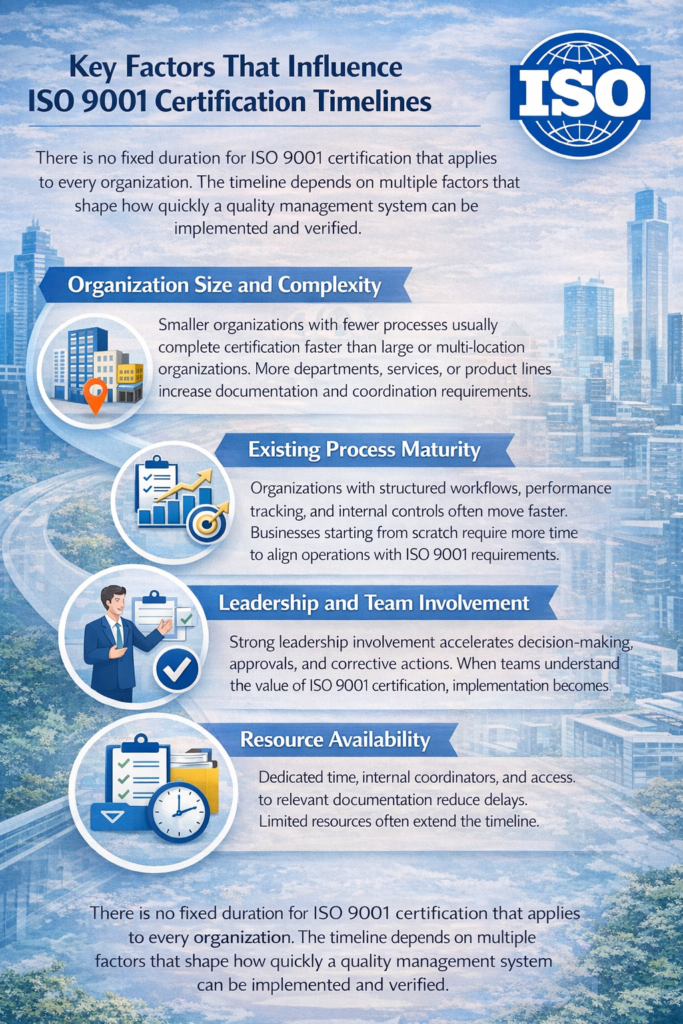
There is no fixed duration for ISO 9001 certification that applies to every organization. The timeline depends on multiple factors that shape how quickly a quality management system can be implemented and verified.
Organization Size and Complexity
Smaller organizations with fewer processes usually complete certification faster than large or multi-location organizations. More departments, services, or product lines increase documentation and coordination requirements.
Existing Process Maturity
Organizations with structured workflows, performance tracking, and internal controls often move faster. Businesses starting from scratch require more time to align operations with ISO 9001 requirements.
Leadership and Team Involvement
Strong leadership involvement accelerates decision-making, approvals, and corrective actions. When teams understand the value of ISO 9001 certification, implementation becomes smoother.
Resource Availability
Dedicated time, internal coordinators, and access to relevant documentation reduce delays. Limited resources often extend the timeline.
Phase 1: Initial Planning and Gap Analysis
The first step toward ISO 9001 certification is planning. This stage focuses on understanding current operations and identifying gaps between existing practices and ISO 9001 requirements.
Activities in this phase include:
- Reviewing current workflows
- Identifying quality objectives
- Understanding customer requirements
- Evaluating documentation gaps
- Defining certification scope
A proper gap analysis prevents confusion later in the process. Organizations that skip this step often face rework and delays during audits.
Phase 2: System Design and Documentation
Documentation is a critical part of ISO 9001 certification, but it does not mean excessive paperwork. The goal is to document processes clearly and practically.
This phase includes:
- Creating quality policies and objectives
- Documenting core and support processes
- Defining roles and responsibilities
- Establishing risk-based thinking
- Setting performance measurement criteria
Organizations with existing documentation move faster, while others may take more time to align procedures with ISO standards.
Phase 3: Implementation of the Quality Management System
Once documentation is ready, the organization begins implementation. This is where ISO 9001 certification becomes a practical, day-to-day reality.
Key activities include:
- Training employees on procedures
- Applying documented processes
- Monitoring process performance
- Collecting records and evidence
- Addressing operational challenges
Implementation is often the longest phase because it requires behavioral change, consistency, and discipline across teams.
Phase 4: Internal Audit and Management Review
Before applying for ISO 9001 certification, organizations must evaluate whether the system is working as intended.
This phase involves:
- Conducting internal audits
- Identifying nonconformities
- Implementing corrective actions
- Reviewing performance at leadership level
- Approving readiness for certification audit
Internal audits help organizations identify weaknesses early and prevent audit failures.
Phase 5: Certification Audit Process
The certification audit is usually conducted in two stages.
Stage 1 Audit: Readiness Review
This audit checks whether documentation and system design meet ISO 9001 requirements. Gaps identified here must be corrected before moving forward.
Stage 2 Audit: Certification Assessment
This is the final evaluation of system implementation. Auditors verify records, employee awareness, and operational consistency.
Successful completion of Stage 2 results in ISO 9001 certification, subject to closure of any minor findings.
Typical Timeline for ISO 9001 Certification
On average, ISO 9001 certification takes:
- Small organizations: 3–4 months
- Medium organizations: 4–6 months
- Large or complex organizations: 6–9 months
Organizations with strong internal systems and leadership commitment may complete the process faster.
Common Reasons for Delays in ISO 9001 Certification
Despite planning, some organizations experience delays. Common causes include:
- Poor documentation quality
- Lack of employee awareness
- Delayed corrective actions
- Limited leadership involvement
- Treating certification as a formality
Understanding these risks early helps organizations stay on schedule.
Can ISO 9001 Certification Be Completed Faster?
Yes, but only with the right approach. Accelerating ISO 9001 certification requires:
- Clear scope definition
- Realistic timelines
- Practical documentation
- Employee training
- Continuous monitoring
Rushing without proper implementation often leads to audit failures and long-term inefficiencies.
Why Time Investment in ISO 9001 Certification Is Worth It
While ISO 9001 certification requires time and effort, the long-term benefits outweigh the initial investment. Organizations experience:
- Improved process consistency
- Higher customer satisfaction
- Better risk management
- Increased market credibility
- Stronger internal accountability
The certification timeline is not a delay—it is a foundation for sustainable quality.

Final Thoughts: Focus on Readiness, Not Speed
When organizations begin the journey toward ISO 9001 certification, the most important focus should be readiness rather than speed. Achieving ISO 9001 certification is not about completing a checklist as quickly as possible, but about building a quality management system that genuinely improves how the organization operates. A rushed approach to ISO 9001 certification often leads to weak implementation, repeated nonconformities, and missed long-term benefits.
Organizations that prepare thoroughly for ISO 9001 certification take time to understand their processes, risks, and customer expectations. This readiness allows ISO 9001 certification to become a natural extension of daily operations rather than an external requirement. When teams are involved, trained, and aligned with quality objectives, ISO 9001 certification is achieved more smoothly and with fewer disruptions.
Focusing on readiness also helps organizations gain real value from ISO 9001 certification. Instead of viewing certification as a deadline-driven task, businesses begin to see improvements in consistency, accountability, and decision-making. A well-implemented system ensures that ISO 9001 certification supports continuous improvement, risk management, and customer satisfaction long after the audit is complete.
By understanding each phase of the process, setting realistic expectations, and allocating the right resources, organizations can move through ISO 9001 certification with confidence. Leadership commitment, employee awareness, and practical documentation all play a key role in successful ISO 9001 certification.Ultimately, ISO 9001 certification is a strategic investment in long-term quality and credibility. Organizations that prioritize readiness over speed not only achieve ISO 9001 certification effectively, but also build a strong foundation for sustainable growth, operational excellence, and lasting trust with customers and stakeholders.