
What Is New in ISO 9001:2026 Compared to ISO 9001:2015?
The quality management landscape is evolving rapidly, and businesses around the world are preparing for the upcoming ISO 9001:2026 revision. Since the release of ISO 9001:2015, industries have experienced major shifts in technology, customer expectations, digital transformation, sustainability practices, and global operational risks. The updated standard is expected to address these modern challenges while improving the effectiveness of quality management systems.
Organizations researching Iso 9001 certification fees in India are also becoming increasingly interested in understanding how the upcoming changes may impact compliance requirements, audits, documentation, and certification processes. While ISO 9001:2015 introduced concepts like risk-based thinking and leadership accountability, ISO 9001:2026 is expected to take these ideas further and align quality systems with the realities of today’s business environment.
Industry discussions indicate that the revision is likely to focus on resilience, sustainability, digital operations, and stronger organizational governance while keeping the overall structure familiar for certified organizations.
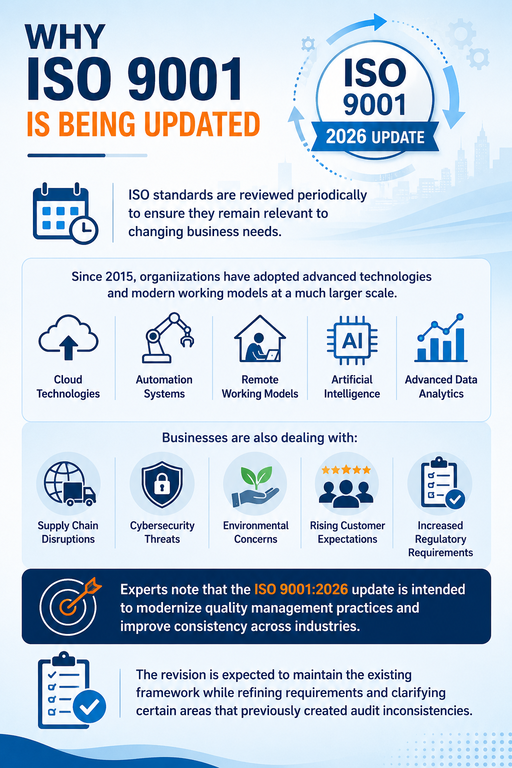
Why ISO 9001 Is Being Updated
ISO standards are reviewed periodically to ensure they remain relevant to changing business needs. Since 2015, organizations have adopted cloud technologies, automation systems, remote working models, artificial intelligence, and advanced data analytics at a much larger scale.
Businesses are also dealing with:
- Supply chain disruptions
- Cybersecurity threats
- Environmental concerns
- Rising customer expectations
- Increased regulatory requirements
Experts note that the ISO 9001:2026 update is intended to modernize quality management practices and improve consistency across industries.
The revision is expected to maintain the existing framework while refining requirements and clarifying certain areas that previously created audit inconsistencies.
Major Expected Changes in ISO 9001:2026
Although the final version is expected later in 2026, several anticipated updates have already been widely discussed across the quality management industry.
Greater Focus on Digital Transformation
One of the most significant expected changes is the stronger integration of digital technologies into quality management systems.
Organizations now rely heavily on:
- Cloud-based platforms
- Digital records
- AI-driven analytics
- Automated workflows
- Remote collaboration tools
ISO 9001:2026 is expected to encourage businesses to adopt more efficient digital systems for process management, data verification, and operational monitoring. Experts believe the updated standard may place more emphasis on digital evidence and electronic documentation practices.
This shift reflects the increasing importance of technology in maintaining operational accuracy and consistency.
Improved Risk Management Requirements
Risk-based thinking was one of the core concepts introduced in ISO 9001:2015. However, the upcoming version is expected to expand and clarify risk management expectations further.
Organizations may need to address risks involving:
- Cybersecurity
- Data protection
- Supply chain instability
- Climate-related disruptions
- Technology dependency
Experts suggest the new revision may separate risk and opportunity management more clearly to encourage proactive planning and organizational resilience.
Businesses implementing strong risk assessment systems may experience improved operational stability and customer trust.
Sustainability and Climate Considerations
Sustainability has become an important part of modern business operations. ISO 9001:2026 is expected to incorporate stronger references to environmental and climate-related considerations within organizational planning.
Potential focus areas include:
- Resource efficiency
- Sustainable business operations
- Climate impact awareness
- Responsible sourcing
- Long-term operational resilience
Recent discussions surrounding the draft revision indicate that climate considerations may become integrated into the organizational context evaluation process.
Organizations pursuing quality management system certification may increasingly need to demonstrate awareness of sustainability-related business risks and stakeholder expectations.
Enhanced Leadership Responsibilities
Leadership involvement became more important under ISO 9001:2015, and the 2026 revision is expected to strengthen these responsibilities further.
Top management may be expected to demonstrate:
- Promotion of quality culture
- Ethical business practices
- Continuous improvement initiatives
- Strategic quality planning
- Employee engagement support
Experts note that the revised standard may introduce more explicit guidance on leadership accountability and organizational culture.
This reflects the growing understanding that leadership plays a central role in maintaining effective quality systems.
Better Supply Chain Oversight
Global disruptions over recent years have highlighted the importance of supply chain management and vendor reliability.
ISO 9001:2026 may place greater emphasis on:
- Supplier performance evaluation
- Third-party risk monitoring
- Vendor communication systems
- Outsourced process control
- Business continuity planning
Organizations are expected to demonstrate stronger oversight of external providers to maintain quality consistency across operations.
This area is particularly important for businesses seeking ISO audit and compliance services to improve supplier management and operational stability.
More Flexible Documentation Practices
Compared to older ISO versions, ISO 9001:2015 already reduced excessive paperwork requirements. The 2026 update is expected to continue supporting flexible documentation systems.
Businesses increasingly use:
- Digital dashboards
- Automated records
- Electronic approvals
- Cloud-based process tracking
- Real-time monitoring systems
The revised standard may further encourage organizations to move away from unnecessary manual documentation while maintaining data integrity and traceability.
Integration With Other ISO Standards
Modern businesses often implement multiple ISO standards together, including quality, environmental, information security, and occupational health systems.
Industry experts suggest ISO 9001:2026 will improve compatibility with other standards through the updated Harmonized Structure.
This may simplify integrated management systems and reduce duplication across organizational processes.
Increased Focus on Organizational Resilience
Business resilience has become a major priority after recent global disruptions. The revised standard is expected to encourage organizations to improve their ability to respond to operational challenges.
Potential focus areas include:
- Crisis preparedness
- Operational continuity
- Flexible process management
- Adaptive decision-making
- Recovery planning
Organizations that plan for unexpected problems are usually better at keeping customer trust and running smoothly.
Employee Awareness and Competence
ISO 9001:2026 may also strengthen requirements related to employee competence and quality awareness.
Organizations may need to demonstrate:
- Ongoing training programs
- Digital skills development
- Employee participation in quality objectives
- Awareness of organizational risks
- Internal communication effectiveness
Experts believe workforce adaptability will become increasingly important as businesses continue integrating advanced technologies into operations.
How Organizations Can Prepare for ISO 9001:2026
Businesses should begin preparing for the transition early instead of waiting for the final release.
Conduct a Gap Analysis
Organizations should review existing quality management systems to identify areas needing improvement.
Strengthen Digital Systems
Digital process management and electronic documentation systems should be evaluated for efficiency and compliance readiness.
Review Risk Management Practices
Businesses should expand risk assessments to include cybersecurity, environmental risks, and supply chain vulnerabilities.
Improve Leadership Involvement
Top management should actively participate in quality planning and organizational improvement strategies.
Focus on Employee Training
Regular training helps employees understand evolving quality expectations and compliance responsibilities.
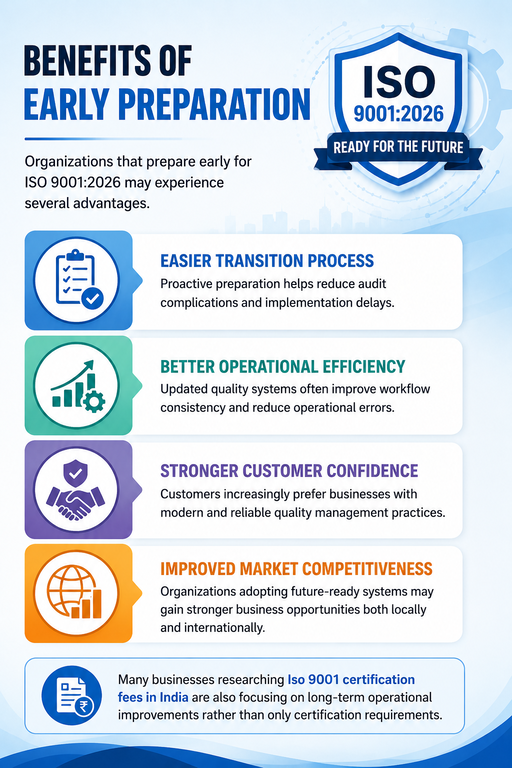
Benefits of Early Preparation
Organizations that prepare early for ISO 9001:2026 may experience several advantages.
Easier Transition Process
Proactive preparation helps reduce audit complications and implementation delays.
Better Operational Efficiency
Updated quality systems often improve workflow consistency and reduce operational errors.
Stronger Customer Confidence
Customers increasingly prefer businesses with modern and reliable quality management practices.
Improved Market Competitiveness
Organizations adopting future-ready systems may gain stronger business opportunities both locally and internationally.
Many businesses researching Iso 9001 certification fees in India are also focusing on long-term operational improvements rather than only certification requirements.
Conclusion
ISO 9001:2026 is expected to introduce important updates that reflect today’s evolving business environment. While the core structure of ISO 9001:2015 will likely remain familiar, the new revision is anticipated to place stronger emphasis on digital transformation, sustainability, organizational resilience, leadership accountability, and advanced risk management.Organizations that begin preparing early can improve compliance readiness while strengthening operational performance and customer trust. Businesses exploring Iso 9001 certification fees in India should also focus on understanding the broader value of modern quality management systems in achieving long-term business growth and operational excellence.