
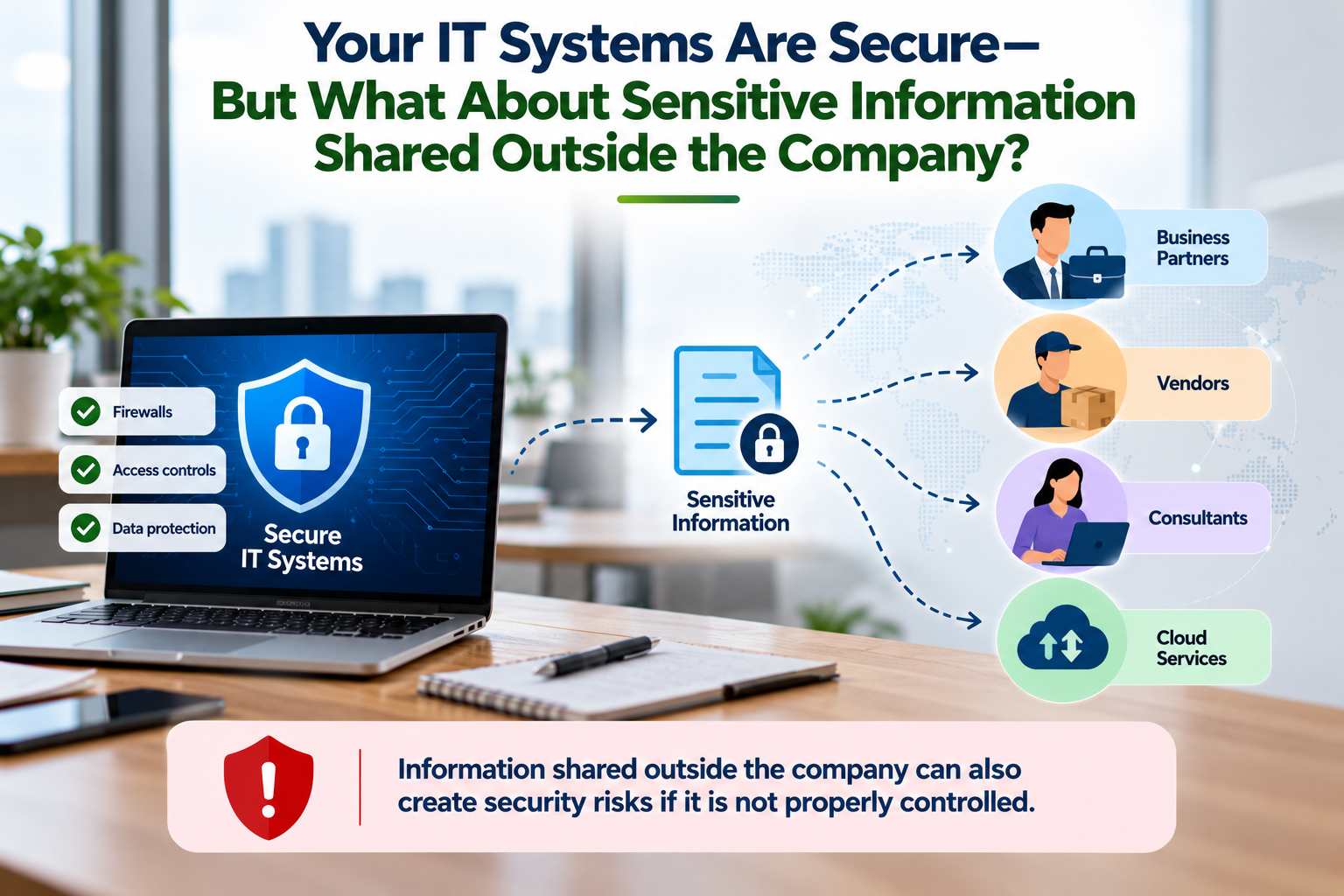
Your IT Systems Are Secure—But What About Sensitive Information Shared Outside the Company?
Firewalls are updated, passwords are protected, and internal networks are monitored. These measures offer reassurance, but they do not answer an important question: what happens when confidential information leaves the organisation? Customer records, employee details, financial reports, and business plans regularly move between external partners, contractors, and service providers.
For businesses exploring an iso 27001 certified company India approach, security must extend beyond office devices and internal servers. An effective information security management system considers who receives sensitive information, why they need it, how they protect it, and what happens when a working relationship ends.
Secure Systems Do Not Guarantee Secure Sharing
An organisation may invest heavily in technical safeguards while employees continue sending confidential files through personal email accounts or unrestricted sharing links. Once information reaches an outside recipient, internal network protections may no longer control its use.
Consider a spreadsheet containing customer contact details. The sender may use a protected computer, but the recipient could download the file onto an unmanaged device or forward it without approval. The original system remains secure while the information becomes exposed.
This is why data protection policies should address information transfers, recipient responsibilities, and approved communication channels. Security needs to follow the information, not stop at the company boundary.
Identify What Information Leaves the Business
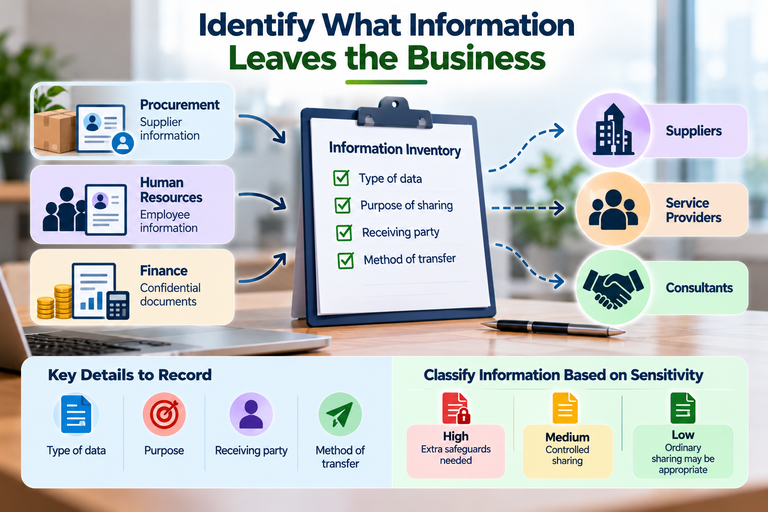
The first step is understanding which records are shared externally. Procurement teams exchange supplier information, human resources departments work with service providers, and finance teams transmit confidential documents. Each activity creates a different level of exposure.
Create an inventory of important information flows. Record the type of data, its purpose, the receiving party, and the method of transfer. Include routine exchanges and occasional requests that employees might otherwise overlook.
An organisation seeking an iso 27001 certified company India standard of practice should classify information according to its sensitivity and business importance. Classification helps determine whether ordinary sharing is appropriate or stronger safeguards are necessary.
Check External Partners Before Sharing
Trusting a supplier because the relationship is longstanding is not the same as evaluating security. External partners may use different access controls, storage arrangements, subcontractors, or incident reporting procedures.
Before sharing sensitive information, assess the risks associated with the recipient and the service being provided. Ask how information is stored, who can access it, whether subcontractors are involved, and how records are deleted when no longer required.
Third party risk management should be proportionate. A contractor receiving public marketing material does not need the same scrutiny as a provider handling employee identity records. The purpose is to apply meaningful checks where exposure could cause harm.
Put Clear Responsibilities Into Agreements
Verbal assurances rarely provide enough clarity when information is mishandled. Written agreements can establish confidentiality expectations, permitted uses, security responsibilities, reporting arrangements, and conditions for returning or deleting records.
The agreement should reflect the relationship and applicable legal obligations. It may also specify whether information can be transferred to additional parties and what approval is required before that happens.
A strong information security management system connects contractual commitments with operational controls. Employees responsible for the relationship should understand the agreement and verify that important requirements are being followed, rather than treating signatures as the final security check.
Control Access After Files Are Shared
Information sharing often continues long after its original purpose has ended. A former contractor might retain access to a shared folder, or an external collaborator may keep permissions that are no longer necessary.
Use approved platforms that support restricted access, authentication, and permission reviews. Where suitable, set expiration dates for sharing links and remove access promptly when projects finish or responsibilities change.
An iso 27001 certified company India mindset also considers the principle of least privilege: recipients should receive only the information and access necessary for their assigned work. Limiting unnecessary exposure reduces the consequences of mistakes and compromised accounts.
Remember That People Make Sharing Decisions
Even carefully configured systems cannot prevent every human error. Employees may select the wrong email recipient, attach an outdated document, or share an entire folder when only one file is required.
Training should use realistic examples from everyday work. Staff need to recognise sensitive information, verify recipients, choose approved transfer methods, and report accidental disclosures quickly.
Simple practices can help: checking addresses before sending, confirming unusual requests through a separate channel, and removing unnecessary personal information from documents.
Effective data protection policies are understandable and practical. If secure methods are difficult to use, employees may develop shortcuts that create new risks.
Monitor External Relationships Over Time
A security assessment completed during supplier onboarding can become outdated. Service arrangements change, subcontractors are introduced, and new technologies alter how information is processed.
Review important external relationships periodically and after significant changes. Confirm whether agreed controls remain suitable, whether incidents have occurred, and whether access permissions still match business needs.
Third party risk management is therefore an ongoing process rather than a one-time questionnaire. Monitoring can identify emerging weaknesses before they develop into serious information security incidents.
Documenting reviews also helps demonstrate that decisions are based on current evidence rather than assumptions about a partner’s reliability.
Prepare for Accidental Disclosure
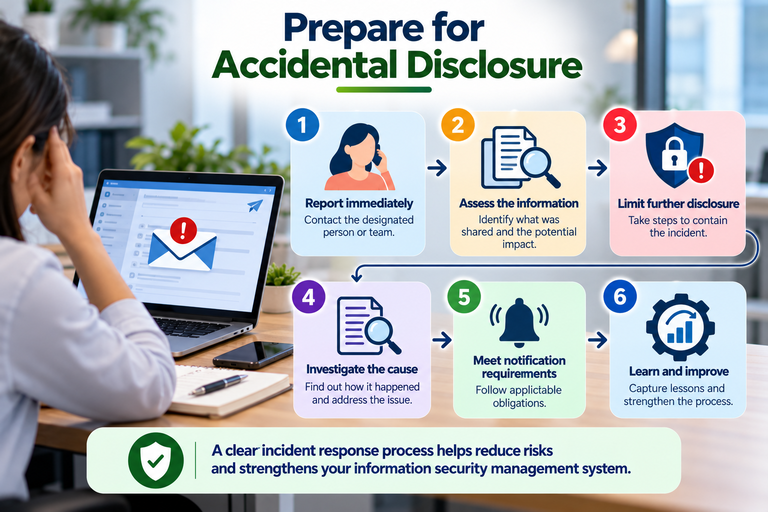
Despite preventive controls, information may reach an unintended recipient. Employees should know whom to contact immediately and what details to preserve. Delayed reporting can make containment more difficult.
An incident response process should define how the organisation assesses the information involved, limits further disclosure, investigates the cause, and determines applicable notification obligations. Actions depend on the nature of the incident and relevant requirements.
An information security management system should also capture lessons from incidents. If employees repeatedly send documents to incorrect addresses, the solution may involve better tools or workflow changes, not simply reminders to be careful.
Audit the Entire Information Journey
Internal reviews should examine information from creation through transfer, external use, retention, and eventual deletion. Auditors can sample sharing records, access permissions, supplier assessments, agreements, and incident reports.
They should also speak with employees to understand how information is actually exchanged. Written procedures may look satisfactory while everyday practices reveal uncontrolled messaging applications or outdated permissions.
For an organisation pursuing an iso 27001 certified company India objective, audits provide evidence of whether selected controls are operating effectively. Certification assesses a defined management system scope; it does not guarantee that every external exchange is risk free.
Conclusion
Protecting internal IT systems is essential, but information security responsibilities continue when confidential data is shared with external parties. Unauthorised access, accidental disclosure, weak supplier controls, and unclear confidentiality agreements can expose sensitive information despite strong cybersecurity measures.
Businesses following an iso 27001 certified company India approach should identify information-sharing risks, evaluate external partners, and establish clear responsibilities for protecting confidential records. Implementing effective data protection policies helps employees understand approved sharing methods, access restrictions, and secure communication practices.
An iso 27001 certified company India framework also encourages regular supplier assessments, access reviews, and incident response planning. Strong third party risk management ensures that external organisations follow appropriate security practices and handle shared information responsibly.
Furthermore, an effective information security management system supports continuous monitoring, employee awareness, and corrective actions when vulnerabilities are identified. Businesses should regularly review information transfers, update security procedures, and verify whether external access remains necessary.
Adopting an iso 27001 certified company India approach helps organisations strengthen accountability, reduce information exposure, and maintain customer confidence. Ultimately, successful information security requires more than protected networks. It demands consistent controls, responsible collaboration, and ongoing improvements that safeguard sensitive information throughout its lifecycle, including beyond organisational boundaries.