
How ISO 14001 and ISO 45001 Protect Your Business in Different Ways
In today’s highly regulated and socially responsible business environment, organizations are expected to prioritize both environmental sustainability and employee safety. Stakeholders, regulators, and customers increasingly demand transparency, accountability, and proactive risk management. To meet these expectations, many companies adopt internationally recognized management standards such as ISO 14001 and ISO 45001.
While these standards share similar management system frameworks, they serve different purposes. ISO 14001 focuses on environmental management, whereas iso 45001 Certification addresses occupational health and safety. Together, they help organizations create safer workplaces, reduce environmental impact, and build resilient business operations.
This article explains how ISO 14001 and ISO 45001 differ, how they complement each other, and how they protect your business in unique yet interconnected ways.
Understanding ISO 14001 and ISO 45001
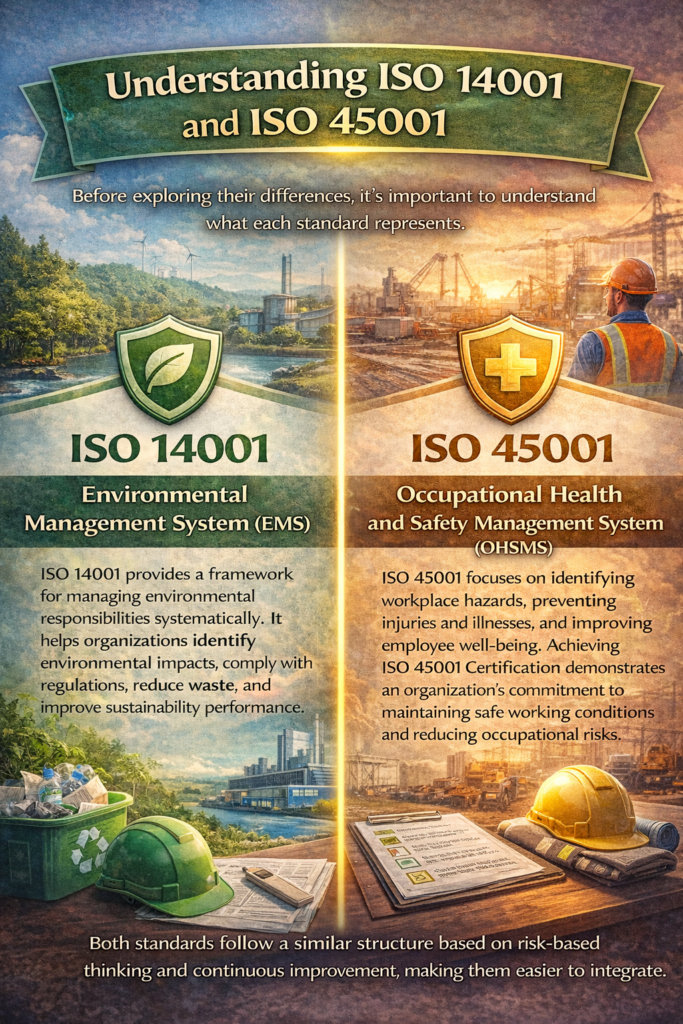
Before exploring their differences, it’s important to understand what each standard represents.
ISO 14001: Environmental Management System (EMS)
ISO 14001 provides a framework for managing environmental responsibilities systematically. It helps organizations identify environmental impacts, comply with regulations, reduce waste, and improve sustainability performance.
ISO 45001: Occupational Health and Safety Management System (OHSMS)
ISO 45001 focuses on identifying workplace hazards, preventing injuries and illnesses, and improving employee well-being. Achieving iso 45001 Certification demonstrates an organization’s commitment to maintaining safe working conditions and reducing occupational risks.
Both standards follow a similar structure based on risk-based thinking and continuous improvement, making them easier to integrate.
Why Businesses Need Both Standards
Modern organizations face a broad spectrum of risks — environmental, operational, and human. Environmental incidents can lead to legal penalties and reputational damage, while workplace accidents can cause productivity losses and employee dissatisfaction.
ISO 14001 and iso 45001 Certification together provide a holistic approach to risk management by addressing:
- Environmental compliance
- Workplace safety
- Operational efficiency
- Stakeholder trust
- Business continuity
While each standard protects businesses in different ways, their combined implementation strengthens organizational resilience.
How ISO 14001 Protects Your Business
1. Reducing Environmental Risks
ISO 14001 helps organizations identify environmental aspects such as emissions, waste generation, and resource consumption. By managing these factors proactively, businesses minimize the risk of environmental incidents.
2. Ensuring Regulatory Compliance
Environmental regulations are becoming increasingly stringent. ISO 14001 supports compliance by establishing processes for monitoring legal requirements and maintaining documentation.
3. Enhancing Reputation and Brand Value
Companies that demonstrate environmental responsibility often gain competitive advantage. ISO 14001 certification signals commitment to sustainability and responsible operations.
4. Improving Resource Efficiency
By optimizing energy usage, reducing waste, and promoting recycling, ISO 14001 contributes to cost savings and operational efficiency.
How ISO 45001 Protects Your Business
1. Preventing Workplace Injuries and Illnesses
The primary goal of iso 45001 Certification is to create safer workplaces. Organizations find possible dangers, evaluate how risky they are, and take steps to stop accidents from happening.
2. Enhancing Employee Well-Being
A safe work environment improves employee morale, engagement, and productivity. Workers feel valued when their health and safety are prioritized.
3. Reducing Legal and Financial Risks
Workplace accidents can lead to compensation claims, regulatory penalties, and operational disruptions. ISO 45001 helps mitigate these risks through proactive safety management.
4. Strengthening Organizational Culture
ISO 45001 encourages employee participation in safety initiatives. This helps create a culture where people take responsibility and keep getting better.
Key Differences Between ISO 14001 and ISO 45001
Although both standards share a common management system structure, they address different areas of risk.
| Aspect | ISO 14001 | ISO 45001 |
| Focus | Environmental impact | Occupational health and safety |
| Primary Goal | Sustainability and compliance | Worker safety and risk prevention |
| Stakeholders | Regulators, communities, customers | Employees, contractors, regulators |
| Risk Types | Pollution, waste, resource usage | Workplace hazards, injuries, illnesses |
Despite these differences, both standards complement each other by addressing critical aspects of responsible business operations.
Integration Benefits: ISO 14001 and ISO 45001 Together
Organizations that implement both standards often adopt an integrated management system. This approach provides several advantages:
Streamlined Processes
Shared documentation, training, and internal audits reduce duplication and administrative effort.
Improved Risk Management
Combining environmental and safety risk assessments provides a comprehensive understanding of operational risks.
Cost Efficiency
Integrated implementation reduces resource requirements and enhances process efficiency.
Stronger Compliance Framework
Organizations benefit from a unified approach to legal and regulatory compliance.
An integrated approach enhances the overall value of iso 45001 Certification by aligning safety with environmental responsibility.
Role of Leadership in Certification Success
Leadership commitment is essential for both ISO 14001 and ISO 45001 implementation. Management must:
- Define policies and objectives
- Allocate resources
- Promote awareness and training
- Monitor performance and improvement
In the context of iso 45001 Certification, leadership involvement is particularly important in fostering a safety-first culture.
Employee Participation and Engagement
Both standards emphasize employee involvement. Workers are encouraged to report hazards, suggest improvements, and participate in environmental initiatives.
Active participation strengthens implementation effectiveness and ensures that policies translate into real-world practices.
Risk-Based Thinking: A Shared Principle
ISO 14001 and ISO 45001 both adopt risk-based thinking as a core principle. Organizations systematically identify potential threats and opportunities, allowing them to implement preventive actions.
Risk-based thinking enhances resilience by enabling proactive decision-making and reducing reactive responses to incidents.
Documentation and Operational Controls
Documentation plays a vital role in both standards. Policies, procedures, and records provide evidence of compliance and support continuous improvement.
For iso 45001 Certification, documentation includes hazard assessments, incident reports, and safety training records. ISO 14001 documentation focuses on environmental aspects, compliance monitoring, and sustainability initiatives.
Effective documentation ensures transparency and audit readiness.
Audit and Continuous Improvement
Both standards require internal audits and management reviews to evaluate performance and identify improvement opportunities. Corrective actions address nonconformities and strengthen system effectiveness.
Continuous improvement ensures that organizations adapt to changing risks, regulations, and stakeholder expectations.
Business Advantages Beyond Compliance
ISO 14001 and iso 45001 Certification offer benefits beyond regulatory compliance.
Competitive Advantage
Certification enhances credibility and supports tender eligibility.
Customer Trust
Clients increasingly prefer partners with demonstrated commitment to sustainability and safety.
Operational Stability
Reduced environmental and safety incidents improve productivity and reduce downtime.
Long-Term Sustainability
Organizations adopting both standards position themselves for sustainable growth.
Challenges in Implementation
Despite their benefits, organizations may encounter challenges such as:
- Resource constraints
- Resistance to change
- Lack of awareness
- Documentation complexity
Addressing these challenges requires strong leadership, employee engagement, and structured planning.
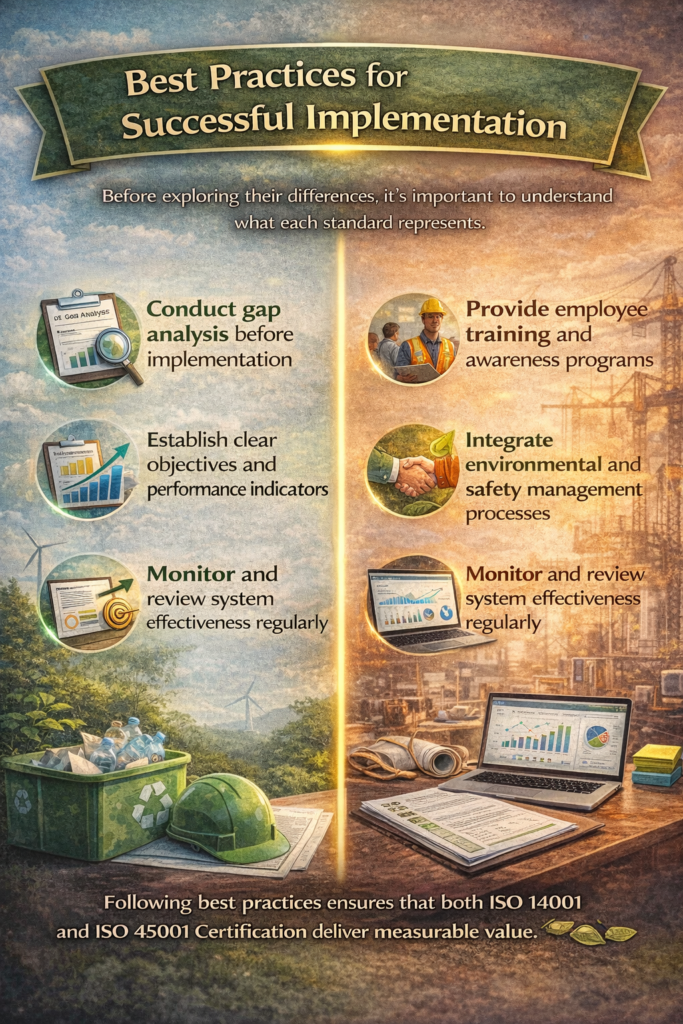
Best Practices for Successful Implementation
- Conduct gap analysis before implementation
- Provide employee training and awareness programs
- Establish clear objectives and performance indicators
- Integrate environmental and safety management processes
- Monitor and review system effectiveness regularly
Following best practices ensures that both ISO 14001 and iso 45001 Certification deliver measurable value.
The Future of Environmental and Safety Management
As sustainability and worker well-being gain global attention, integrated management systems will become increasingly important. Organizations that proactively adopt ISO 14001 and ISO 45001 are better prepared to navigate regulatory changes and stakeholder expectations.
Digital technologies, data analytics, and automation will further enhance environmental and safety management capabilities.
Final Thoughts
ISO 14001 and iso 45001 Certification protect businesses in distinct yet complementary ways. While ISO 14001 focuses on environmental sustainability and regulatory compliance, ISO 45001 prioritizes employee safety and risk prevention.
Together, they create a balanced framework that supports responsible operations, reduces liabilities, and enhances organizational resilience.
Rather than viewing these standards as separate initiatives, organizations should embrace them as interconnected components of a comprehensive management strategy. By integrating environmental and occupational health and safety systems, businesses can safeguard their workforce, protect the environment, and strengthen long-term success in an increasingly competitive and regulated marketplace.