How Different ISO Standards Work Together in an Integrated System
In today’s competitive and highly regulated business landscape, organizations must manage multiple aspects of their operations — quality, environmental impact, employee safety, information security, and energy efficiency. To address these diverse requirements, businesses often adopt various ISO standards. However, managing each standard separately can lead to duplication, inefficiency, and increased administrative workload.
This is where an Integrated Management System (IMS) becomes valuable. Instead of operating in silos, different types of iso standards can be combined into a unified framework that streamlines processes, improves performance, and enhances compliance.
This article explains how different ISO standards work together, the benefits of integration, and how organizations can build an effective integrated management system.
Understanding the Concept of Integrated Management Systems
An Integrated Management System combines multiple management standards into a single cohesive framework. Rather than maintaining separate documentation, audits, and processes for each certification, organizations align their systems to operate efficiently.
The integration is possible because most ISO standards share a common structure known as the Annex SL framework. This structure standardizes key elements such as leadership, risk management, performance evaluation, and continuous improvement.
As a result, organizations implementing multiple types of iso standards can leverage shared processes and reduce duplication.
Common ISO Standards That Can Be Integrated
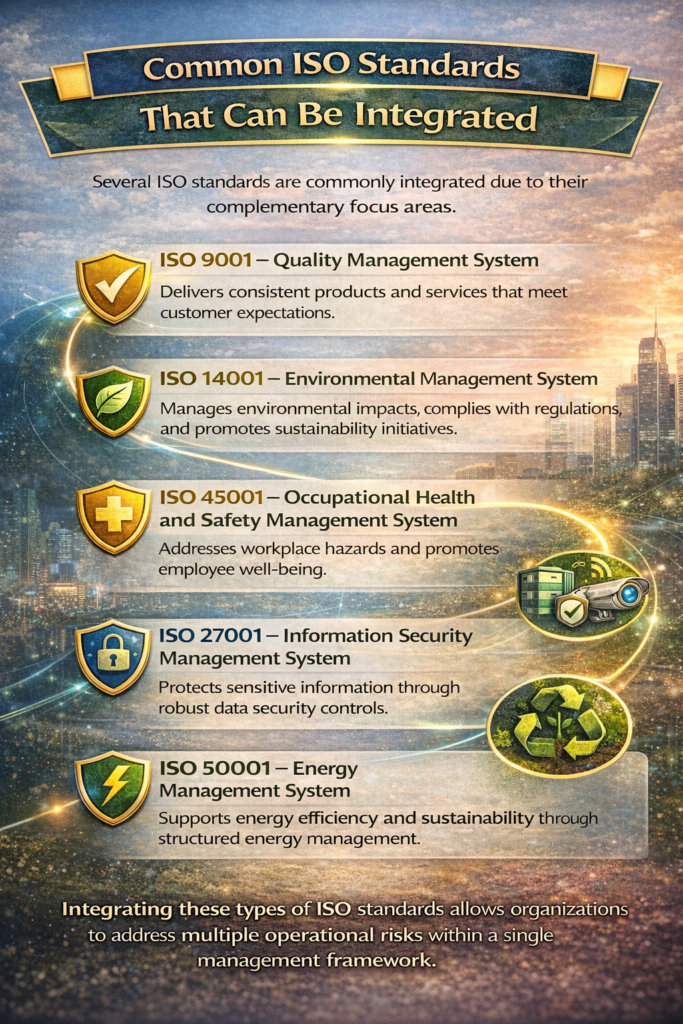
Several ISO standards are commonly integrated due to their complementary focus areas.
ISO 9001 – Quality Management System
ISO 9001 focuses on delivering consistent products and services that meet customer expectations. It focuses on managing processes well, keeping customers happy, and always improving.
ISO 14001 – Environmental Management System
ISO 14001 helps organizations manage environmental impacts, comply with regulations, and promote sustainability initiatives.
ISO 45001 – Occupational Health and Safety Management System
ISO 45001 addresses workplace hazards and promotes employee well-being by reducing occupational risks.
ISO 27001 – Information Security Management System
ISO 27001 protects sensitive information by establishing robust data security controls and risk management practices.
ISO 50001 – Energy Management System
ISO 50001 supports energy efficiency and sustainability through structured energy management processes.
Integrating these types of iso standards allows organizations to address multiple operational risks within a single management framework.
Why Integration Makes Sense
Managing separate systems for each ISO certification can create challenges such as redundant documentation, overlapping audits, and inconsistent processes. Integration addresses these challenges by providing:
- Streamlined documentation
- Unified policies and objectives
- Shared training and awareness programs
- Reduced audit duplication
- Improved operational efficiency
By combining types of iso standards, organizations create a holistic approach to governance and performance management.
The Common Structure That Enables Integration
The Annex SL framework is the key enabler of integration. It ensures that ISO standards share common clauses, including:
- Context of the organization
- Leadership and commitment
- Planning and risk management
- Support and resources
- Operation and control
- Performance evaluation
- Improvement
Because of this structure, organizations can implement integrated policies, risk assessments, and performance monitoring systems across multiple types of iso standards.
How Different ISO Standards Complement Each Other
Quality and Environmental Integration
ISO 9001 focuses on product and service quality, while ISO 14001 addresses environmental sustainability. Together, they help organizations deliver high-quality outputs with minimal environmental impact.
Safety and Environmental Alignment
ISO 45001 and ISO 14001 both emphasize risk identification and mitigation. Integrating these standards ensures that environmental risks and workplace hazards are managed simultaneously.
Information Security and Quality Management
ISO 27001 complements ISO 9001 by protecting data integrity within quality processes. Secure information systems support reliable service delivery.
Energy and Environmental Synergy
ISO 50001 and ISO 14001 both promote sustainability. While ISO 14001 focuses on environmental impact, ISO 50001 targets energy efficiency, creating a comprehensive sustainability strategy.
By aligning these types of iso standards, organizations achieve broader risk coverage and operational synergy.
Key Benefits of an Integrated Management System
Improved Efficiency
Shared processes reduce duplication and streamline workflows, saving time and resources.
Cost Optimization
Integrated audits and documentation lower administrative costs associated with managing multiple certifications.
Enhanced Risk Management
A unified risk assessment approach provides a comprehensive view of organizational threats and opportunities.
Stronger Compliance
Integrated systems simplify regulatory compliance by aligning processes with multiple standards simultaneously.
Improved Employee Engagement
Employees benefit from clear, consistent procedures rather than navigating multiple management systems.
Steps to Build an Integrated Management System
1. Conduct a Gap Analysis
Evaluate existing certifications and identify overlapping requirements among different types of iso standards.
2. Develop Integrated Policies
Create a unified policy that addresses quality, safety, environmental, and information security objectives.
3. Align Risk Assessments
Integrate risk identification processes to cover all relevant operational areas.
4. Standardize Documentation
Develop shared procedures, templates, and records to support multiple standards.
5. Train Employees
Provide awareness and training programs that reflect integrated system requirements.
6. Implement Integrated Audits
Conduct internal audits that assess compliance with multiple standards simultaneously.
Challenges in Integrating ISO Standards
While integration offers significant benefits, organizations may face challenges such as:
- Resistance to change
- Complexity in aligning different processes
- Resource limitations
- Lack of expertise in integrated system design
Addressing these challenges requires strong leadership commitment and effective change management strategies.
Role of Leadership in Integration Success
Leadership plays a critical role in building an effective integrated management system. Top management must:
- Promote a unified vision
- Allocate resources
- Encourage cross-functional collaboration
- Monitor performance and improvement
Strong leadership ensures that integration becomes a strategic initiative rather than a compliance exercise.
Documentation and Process Alignment
Documentation is a cornerstone of integration. Organizations can develop integrated procedures that address requirements across multiple types of iso standards.
For example:
- A single corrective action procedure can satisfy ISO 9001, ISO 14001, and ISO 45001 requirements.
- Integrated training records can demonstrate compliance with safety, quality, and environmental standards.
Efficient documentation reduces complexity and enhances usability.
The Role of Technology in Integrated Systems
Digital platforms support integration by centralizing documentation, automating workflows, and enabling real-time monitoring.
Integrated management software helps organizations:
- Manage multiple certifications in one platform
- Track performance indicators
- Conduct integrated audits
- Improve collaboration
Technology simplifies system management and enhances transparency.
Continuous Improvement in Integrated Systems
Continuous improvement is a shared principle across all ISO standards. Integrated systems allow organizations to implement improvement initiatives that address multiple objectives simultaneously.
For example, energy efficiency projects may reduce environmental impact, improve cost savings, and enhance operational reliability.
By leveraging improvement opportunities, integrated systems deliver long-term value.
Future Trends in Integrated ISO Systems
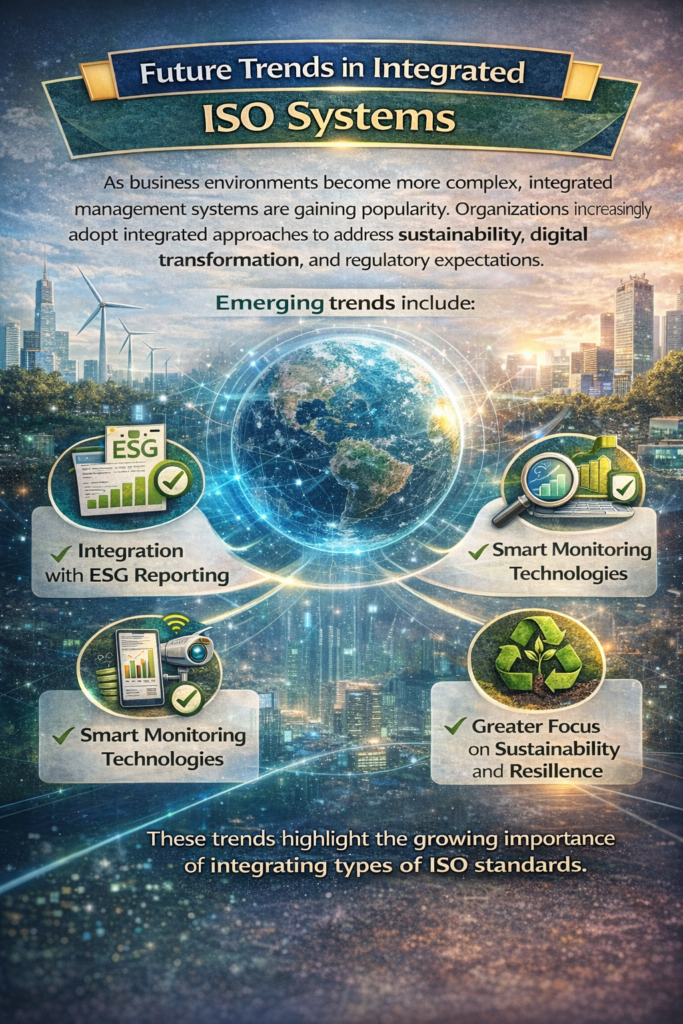
As business environments become more complex, integrated management systems are gaining popularity. Organizations increasingly adopt integrated approaches to address sustainability, digital transformation, and regulatory expectations.
Emerging trends include:
- Integration with ESG reporting
- Data-driven risk management
- Smart monitoring technologies
- Greater focus on sustainability and resilience
These trends highlight the growing importance of integrating types of iso standards.
Final Thoughts
Managing multiple certifications separately can create inefficiencies and operational challenges. Integrating different types of iso standards into a unified management system provides a strategic solution that enhances efficiency, reduces costs, and strengthens risk management.
An integrated system enables organizations to align quality, safety, environmental, energy, and information security objectives within a cohesive framework. By leveraging shared processes, unified documentation, and integrated audits, businesses can achieve greater operational clarity and performance.
Rather than viewing ISO standards as isolated certifications, organizations should embrace integration as a pathway to sustainable growth, improved compliance, and long-term resilience in an increasingly complex business environment.