From Policies to Records: ISO 20000 Documentation Explained
In today’s digital-driven business environment, IT service management plays a critical role in ensuring seamless operations, improved customer satisfaction, and efficient service delivery. Organizations aiming to establish robust IT service processes often pursue ISO 20000, the international standard for IT Service Management Systems (ITSMS). While the benefits of certification are widely recognised, many businesses struggle to understand the documentation aspect of compliance.
Meeting iso 20000 certification requirements involves creating, maintaining, and controlling a structured set of documents that define how IT services are planned, delivered, monitored, and improved. Documentation is not just a compliance formality — it is the backbone of a well-functioning IT service management framework.
This article provides a detailed explanation of ISO 20000 documentation, including policies, procedures, records, and best practices to help organizations successfully align with certification requirements.
Understanding ISO 20000 and Its Documentation Framework
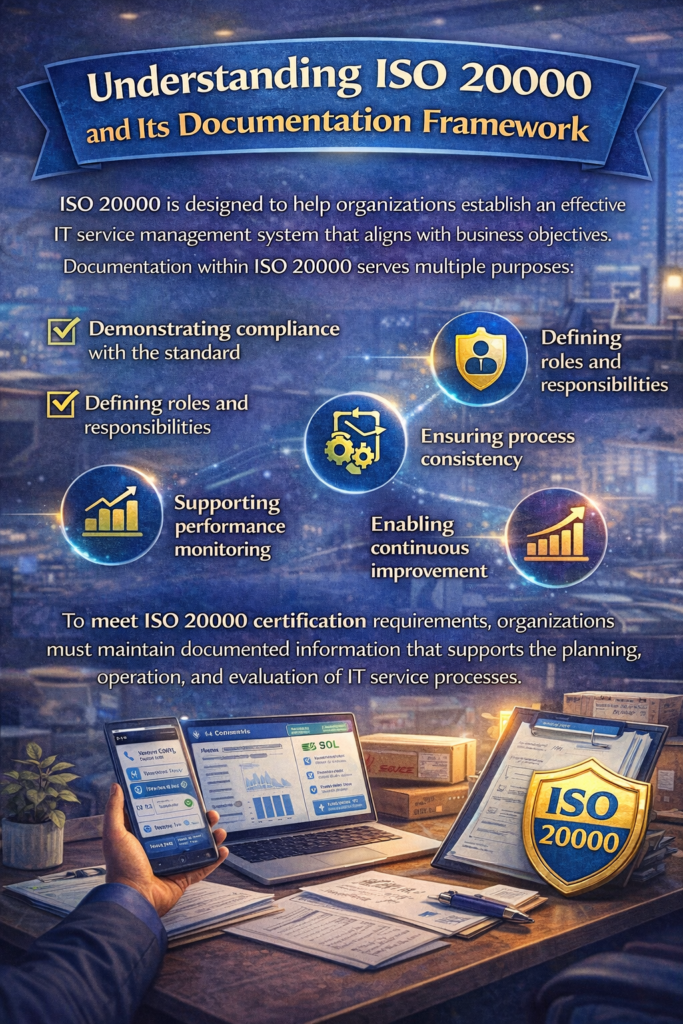
ISO 20000 is designed to help organizations establish an effective IT service management system that aligns with business objectives. The standard focuses on delivering consistent, high-quality IT services through structured processes and continual improvement.
Documentation within ISO 20000 serves multiple purposes:
- Demonstrating compliance with the standard
- Defining roles and responsibilities
- Ensuring process consistency
- Supporting performance monitoring
- Enabling continuous improvement
To meet iso 20000 certification requirements, organizations must maintain documented information that supports the planning, operation, and evaluation of IT service processes.
The Importance of Documentation in ISO 20000
Many organizations underestimate the value of structured documentation. However, ISO 20000 places strong emphasis on documented information because it ensures transparency, accountability, and repeatability of IT service processes.
Proper documentation helps organizations:
- Standardize service delivery
- Improve communication across teams
- Maintain service continuity
- Facilitate audits and reviews
- Preserve organizational knowledge
Without adequate documentation, IT service processes become inconsistent, leading to service disruptions and compliance gaps.
Key Types of ISO 20000 Documentation
ISO 20000 documentation can be broadly categorized into policies, procedures, plans, and records. Each plays a distinct role in supporting the IT service management system.
1. Policies
Policies represent the organization’s intent and commitment to IT service management. They establish the foundation for all processes and activities within the ITSMS.
A typical ISO 20000 policy includes:
- IT service management objectives
- Commitment to customer satisfaction
- Alignment with business strategy
- Continuous improvement approach
The policy acts as a guiding framework for all operational procedures and must be communicated across the organization.
2. Procedures
Procedures define how specific IT service management processes are executed. They provide step-by-step guidance for activities such as incident management, change management, and service level management.
Procedures ensure consistency and help teams perform tasks efficiently. They are essential to meet iso 20000 certification requirements because they demonstrate that processes are structured and controlled.
Common documented procedures include:
- Incident management procedure
- Problem management procedure
- Change management procedure
- Configuration management procedure
- Service continuity procedure
3. Plans
Plans outline how objectives will be achieved and maintained. ISO 20000 requires several planning documents to ensure proactive management of IT services.
Examples include:
- Service management plan
- Capacity management plan
- Availability management plan
- Information security plan
- Service continuity plan
Planning documentation helps organizations anticipate risks, allocate resources effectively, and maintain service performance.
4. Records
Records provide evidence that processes are being followed and objectives are being met. Unlike policies or procedures, records capture actual operational data.
Examples of ISO 20000 records include:
- Incident logs
- Change requests and approvals
- Service level performance reports
- Audit results
- Training records
- Customer feedback
Maintaining accurate records is critical for demonstrating compliance during certification audits.
Mandatory Documentation Under ISO 20000
While ISO 20000 offers flexibility, certain documents are typically required to meet iso 20000 certification requirements.
Service Management Policy
Defines the organization’s commitment and objectives for IT service management.
Scope of ITSMS
Outlines which services, departments, and processes are included in the certification scope.
Service Catalogue
Provides detailed information about the IT services offered, including service descriptions and service level targets.
Risk Management Documentation
Identifies potential risks affecting service delivery and outlines mitigation strategies.
Performance Monitoring Reports
Track service metrics, key performance indicators, and improvement opportunities.
Documentation Control and Management
Creating documentation is only the first step. ISO 20000 also requires organizations to control and maintain documented information effectively.
Documentation control includes:
- Version management
- Approval processes
- Secure storage
- Access control
- Periodic review and updates
Effective document control ensures that teams always refer to the latest and most accurate information, reducing operational errors.
Challenges in ISO 20000 Documentation
Organizations often encounter challenges when preparing documentation for certification.
Over-Documentation
Excessive documentation can create complexity and reduce usability. The focus should be on relevant, practical documentation.
Lack of Ownership
Without clear responsibility, documentation may become outdated or incomplete.
Inconsistent Formats
Using varied document formats can lead to confusion and inefficiency.
Resistance to Change
Employees may view documentation as an administrative burden rather than a strategic tool.
Addressing these challenges requires strong leadership and a culture that values process transparency.
Best Practices for Effective ISO 20000 Documentation
Align Documentation With Business Objectives
Documentation should support organizational goals rather than exist solely for compliance.
Keep Documents Simple and Practical
Clear, concise documentation is easier to understand and implement.
Define Roles and Responsibilities
Assign ownership for each document to ensure accountability.
Use Standard Templates
Templates improve consistency and simplify document creation.
Review and Update Regularly
Periodic reviews ensure documentation remains relevant and effective.
The Role of Documentation in ISO 20000 Audits
During certification audits, auditors assess documented information to verify compliance with iso 20000 certification requirements. Documentation demonstrates that processes are defined, implemented, and monitored.
Auditors typically review:
- Policy statements
- Process documentation
- Operational records
- Performance reports
- Improvement actions
Well-structured documentation simplifies the audit process and increases the likelihood of successful certification.
How Documentation Supports Continuous Improvement
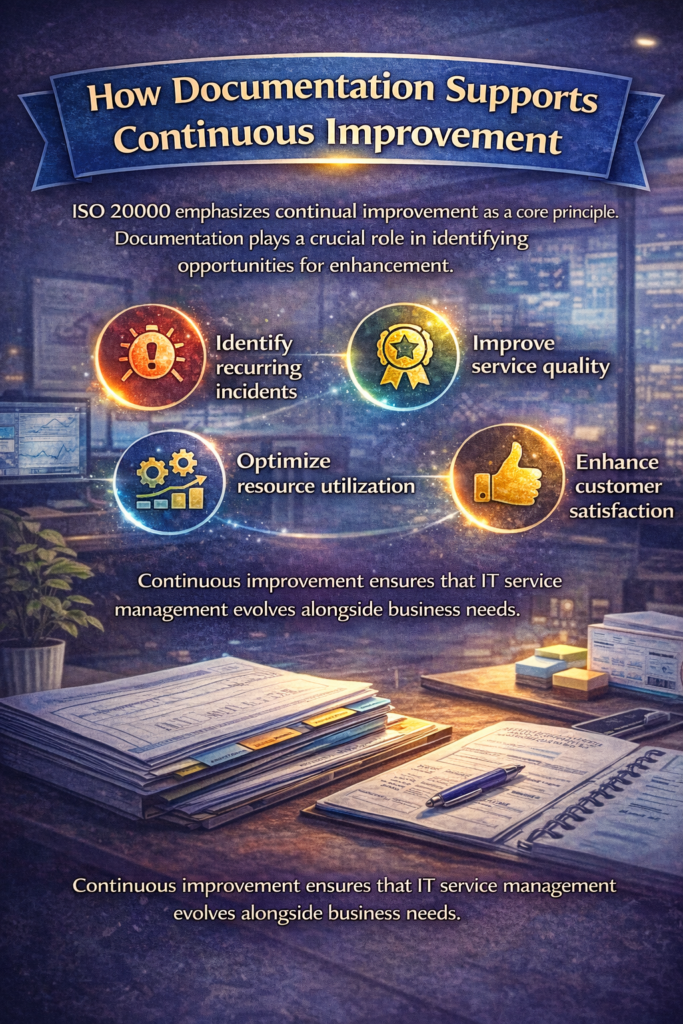
ISO 20000 emphasizes continual improvement as a core principle. Documentation plays a crucial role in identifying opportunities for enhancement.
Through documented records and performance analysis, organizations can:
- Identify recurring incidents
- Improve service quality
- Optimize resource utilization
- Enhance customer satisfaction
Continuous improvement ensures that IT service management evolves alongside business needs.
Digital Tools for Managing ISO 20000 Documentation
Digital transformation has significantly simplified how organizations manage documentation related to iso 20000 certification requirements. Modern document management systems allow businesses to store, organize, and retrieve policies, procedures, and records in a centralized environment, ensuring that information remains accurate and accessible.
By adopting digital platforms aligned with iso 20000 certification requirements, organizations can automate version control, reducing the risk of outdated documents being used during audits or daily operations.
Workflow automation tools further support iso 20000 certification requirements by streamlining approval processes and ensuring that every document undergoes proper review before implementation. IT service management software also integrates documentation with operational workflows, enabling teams to link incident records, change logs, and performance reports directly to iso 20000 certification requirements.
Additionally, digital collaboration features allow multiple stakeholders to contribute to documentation updates in real time, improving accuracy and efficiency. Secure access controls ensure that sensitive documents related to iso 20000 certification requirements are protected while remaining available to authorized personnel.
Overall, leveraging digital tools enhances compliance readiness, simplifies audits, and supports continuous improvement within the IT service management framework.
Final Thoughts
Understanding and implementing documentation is a fundamental aspect of meeting iso 20000 certification requirements. From policies that define organizational commitment to records that provide operational evidence, each document contributes to a structured and effective IT service management system.
Rather than viewing documentation as a compliance exercise, organizations should treat it as a strategic resource that supports service consistency, transparency, and improvement. Well-designed documentation not only facilitates certification but also strengthens operational efficiency and customer trust.
By adopting best practices, maintaining document control, and aligning documentation with business objectives, organizations can build a robust ITSMS that delivers measurable value and supports long-term success.