
ISO 22000 vs ISO 22002: Key Differences Every Food Business Must Know
Food safety is a critical concern for every organization involved in the food supply chain. From production and processing to packaging and distribution, maintaining high safety standards is essential to protect consumers and ensure regulatory compliance. For businesses aiming to strengthen their food safety systems, understanding the difference between ISO 22000 and ISO 22002 is crucial—especially when considering iso 22000 certification.
While both standards are closely related, they serve different purposes within a food safety management system. This guide will help you understand their roles, differences, and how they work together.
What is ISO 22000 Certification?
ISO 22000 is a global standard for managing food safety systems (FSMS). It provides a comprehensive framework that helps organizations identify, control, and manage food safety hazards.
The goal of iso 22000 certification is to ensure that food products are safe for consumption at every stage of the supply chain. It combines key elements such as:
- Hazard Analysis and Critical Control Points (HACCP)
- Prerequisite programs (PRPs)
- Risk-based thinking
- Continuous improvement
Businesses that achieve iso 22000 certification demonstrate their commitment to food safety, quality, and compliance with international standards.
What is ISO 22002?
ISO 22002 is not a standalone certification but a supporting standard that provides detailed guidelines for prerequisite programs (PRPs). These programs establish the basic environmental and operational conditions required for safe food production.
ISO 22002 focuses on specific areas such as:
- Hygiene practices
- Facility design
- Equipment maintenance
- Cleaning and sanitation
- Pest control
While ISO 22000 defines what needs to be achieved, ISO 22002 explains how to implement those foundational practices.
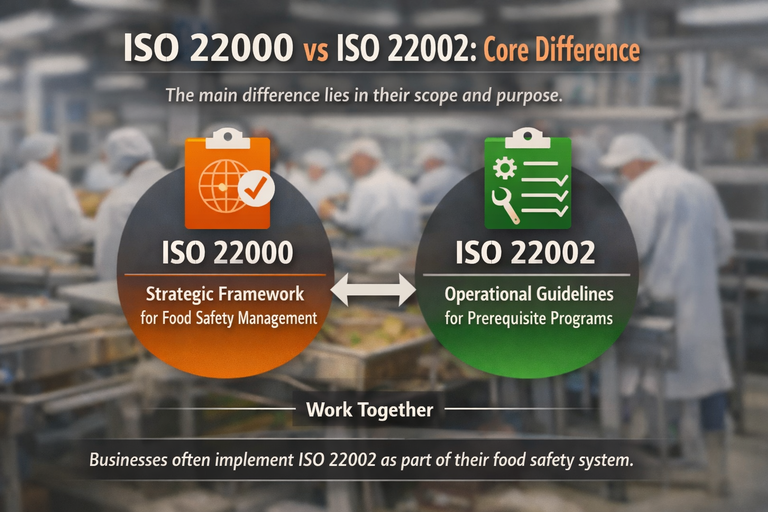
ISO 22000 vs ISO 22002: Core Difference
The main difference between ISO 22000 and ISO 22002 lies in their scope and purpose.
- ISO 22000 is a comprehensive standard for food safety management systems.
- ISO 22002 provides detailed guidelines for prerequisite programs that support ISO 22000.
In simple terms:
- ISO 22000 = Strategic framework
- ISO 22002 = Operational guidelines
Businesses seeking iso 22000 certification must often implement ISO 22002 as part of their food safety system.
Key Differences Between ISO 22000 and ISO 22002
1. Scope
- ISO 22000: Covers the entire food safety management system
- ISO 22002: Focuses on prerequisite programs only
2. Certification
- ISO 22000: Can be certified independently
- ISO 22002: Cannot be certified alone
3. Purpose
- ISO 22000: Ensures overall food safety
- ISO 22002: Supports hygiene and operational conditions
4. Application
- ISO 22000: Applies to every organization in the food chain.
- ISO 22002: Industry-specific guidelines
5. Approach
- ISO 22000: Risk-based and management-focused
- ISO 22002: Process-based and operational
Understanding these differences is essential for businesses planning to achieve iso 22000 certification.
How ISO 22000 and ISO 22002 Work Together
ISO 22000 and ISO 22002 are designed to complement each other rather than compete.
Integration Benefits:
- ISO 22002 establishes a clean and controlled environment
- ISO 22000 builds on that environment to manage risks
For example:
- ISO 22002 ensures proper sanitation
- ISO 22000 identifies and controls hazards
Together, they create a strong and effective food safety system, which is essential for successful iso 22000 certification.
Why ISO 22000 Certification is Important
Food safety incidents can damage a company’s reputation and lead to serious consequences. iso 22000 certification helps businesses:
- Ensure product safety
- Meet regulatory requirements
- Build customer trust
- Improve operational efficiency
- Reduce risks
It is especially important for businesses that operate in international markets.
Role of ISO 22002 in Food Safety
ISO 22002 plays a crucial supporting role in maintaining hygiene and operational control.
Key Contributions:
- Provides detailed implementation guidelines
- Ensures consistency in hygiene practices
- Supports compliance with ISO 22000
Without ISO 22002, achieving iso 22000 certification becomes more challenging because the foundational requirements may not be fully addressed.
Industries That Benefit from ISO 22000 and ISO 22002
These standards can be used in different sectors, including:
- Food manufacturing
- Dairy and meat processing
- Beverage production
- Packaging industries
- Catering and hospitality
Organizations in these industries rely on iso 22000 certification to ensure food safety and maintain market credibility.
Common Challenges in Implementation
While implementing ISO 22000 and ISO 22002 offers significant benefits, businesses may face challenges such as:
1. Complex Documentation
Maintaining detailed records can be time-consuming.
2. Lack of Awareness
Employees may not fully understand requirements.
3. Resource Constraints
Small businesses may struggle with limited resources.
4. Resistance to Change
Adopting new systems may face internal resistance.
Overcoming these challenges is essential for achieving iso 22000 certification successfully.
Steps to Implement ISO 22000 Certification
To achieve iso 22000 certification, businesses should follow a structured approach:
- Conduct a gap analysis
- Implement prerequisite programs (ISO 22002)
- Develop a food safety management system
- Train employees
- Conduct internal audits
- Apply for certification audit
Following these steps makes the implementation process smooth and effective.
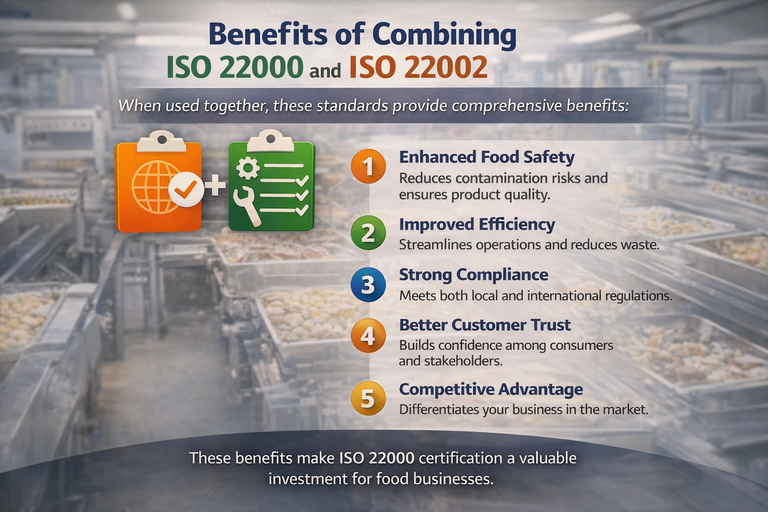
Benefits of Combining ISO 22000 and ISO 22002
When used together, these standards provide comprehensive benefits:
1. Enhanced Food Safety
Reduces contamination risks and ensures product quality.
2. Improved Efficiency
Streamlines operations and reduces waste.
3. Strong Compliance
Meets both local and international regulations.
4. Better Customer Trust
Builds confidence among consumers and stakeholders.
5. Competitive Advantage
Differentiates your business in the market.
These benefits make iso 22000 certification a valuable investment for food businesses.
Future Trends in Food Safety Standards
The food industry is evolving rapidly, and safety standards are becoming more advanced to address new challenges and consumer expectations. As global supply chains expand and technology continues to grow, businesses must adopt modern approaches to ensure food safety and compliance. One of the most effective ways to stay aligned with these changes is through iso 22000 certification, which provides a structured and adaptable framework for managing food safety risks.
Digital monitoring systems are becoming increasingly important, allowing businesses to track processes in real time and identify potential hazards quickly. Organizations implementing iso 22000 certification can integrate these technologies to enhance accuracy and improve decision-making. Additionally, regulatory requirements are becoming stricter, making iso 22000 certification essential for maintaining compliance and avoiding operational disruptions.
Sustainability is another key trend, with businesses focusing on reducing waste and improving resource efficiency. By adopting iso 22000 certification, organizations can align their food safety practices with sustainable goals. Furthermore, the integration of artificial intelligence is transforming food safety by enabling predictive analysis and automated monitoring.
Overall, companies that invest in iso 22000 certification are better prepared to adapt to these emerging trends, ensuring long-term growth, improved efficiency, and a strong competitive position in the evolving food industry.
Final Thoughts
Understanding the difference between ISO 22000 and ISO 22002 is essential for any food business that aims to maintain high standards of safety, hygiene, and quality. ISO 22000 provides a complete framework for managing food safety risks, while ISO 22002 focuses on the operational and environmental conditions required to support those systems. Together, they form a strong foundation that ensures food products are safe at every stage of the supply chain.
For organizations planning to achieve iso 22000 certification, implementing both standards is the most effective and practical approach. ISO 22002 helps establish essential prerequisite programs such as sanitation, hygiene, and facility management, while ISO 22000 builds on this foundation by identifying hazards and implementing control measures. By integrating these standards, businesses pursuing iso 22000 certification can create a well-structured and reliable food safety management system.
Moreover, adopting iso 22000 certification allows organizations to improve operational efficiency and reduce the risk of contamination or product failure. It also enhances customer confidence by demonstrating a commitment to international food safety standards. Companies that invest in iso 22000 certification are better positioned to meet regulatory requirements and expand into global markets.In today’s competitive food industry, maintaining consistent quality is critical for long-term success. By focusing on iso 22000 certification, businesses can build a proactive approach to food safety, ensuring continuous improvement and risk management. Ultimately, organizations that prioritize iso 22000 certification can strengthen their brand reputation, protect consumers, and achieve sustainable growth in an increasingly demanding market.