
ISO 9001 Clause Structure: How Many Clauses and What They Mean
Understanding the structure of ISO 9001 is essential for any organization aiming to build a strong quality management system. One of the most common questions businesses ask is how many clauses ISO 9001 contains and what each clause represents. The clause structure of ISO 9001 is not random—it follows a logical framework designed to improve consistency, accountability, and continuous improvement across organizations of all sizes and industries.
This blog explains the ISO 9001 clause structure in a clear, practical way, helping readers understand not just what the clauses are, but why they matter.
What Is ISO 9001 and Why Clause Structure Matters
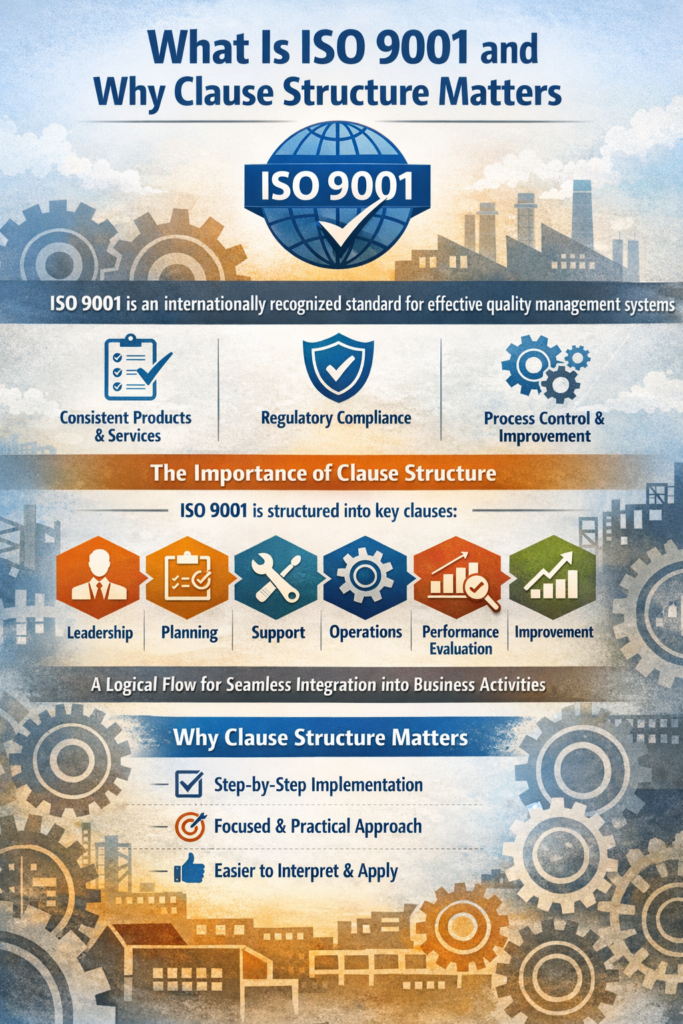
ISO 9001 is an internationally recognized standard that defines the requirements for an effective quality management system. The primary purpose of ISO 9001 is to help organizations deliver consistent products and services that meet customer expectations and regulatory requirements. By following ISO 9001, organizations improve process control, reduce errors, and strengthen customer confidence.
The clause structure of ISO 9001 plays a critical role in successful implementation. ISO 9001 is organized into clearly defined clauses that follow a logical flow, covering leadership, planning, support, operations, performance evaluation, and improvement. This structured approach ensures that ISO 9001 is integrated into everyday business activities rather than treated as a separate compliance task.
Understanding the clause structure of ISO 9001 makes the standard easier to interpret and apply. Each clause builds on the previous one, helping organizations implement ISO 9001 in a step-by-step manner. With a clear understanding of ISO 9001 clauses, implementation becomes more practical, focused, and less overwhelming.
How Many Clauses Are There in ISO 9001?
The ISO 9001 standard follows the High-Level Structure (HLS), also known as Annex SL, which is used across many ISO management system standards. ISO 9001 contains 10 main clauses, but only clauses 4 to 10 are mandatory for implementation.
Here is a breakdown of the 10 clauses in ISO 9001:
- Scope
- Normative References
- Terms and Definitions
- Context of the Organization
- Leadership
- Planning
- Support
- Operation
- Performance Evaluation
- Improvement
Clauses 1 to 3 provide background information, while clauses 4 to 10 define actionable requirements.
Clause 4: Context of the Organization
Clause 4 of ISO 9001 focuses on understanding the internal and external factors that affect an organization’s ability to achieve quality objectives. This includes identifying stakeholders, customer expectations, regulatory requirements, and business risks.
Organizations must also define the scope of their quality management system and understand how different processes interact. Clause 4 ensures that ISO 9001 is aligned with real business conditions rather than generic documentation.
Clause 5: Leadership
Leadership commitment is central to ISO 9001. Clause 5 requires top management to actively support and promote the quality management system. This includes setting quality policies, assigning responsibilities, and ensuring that quality objectives align with strategic goals.
ISO 9001 emphasizes leadership accountability rather than delegation. When leadership is engaged, the quality system becomes embedded in organizational culture instead of operating as a separate function.
Clause 6: Planning
Clause 6 of ISO 9001 addresses risk-based thinking and planning. Organizations are required to identify risks and opportunities that could affect product or service quality and take actions to address them.
This clause also focuses on setting measurable quality objectives and planning changes in a controlled manner. ISO 9001 uses planning as a proactive tool to prevent problems rather than reacting after failures occur.
Clause 7: Support
Clause 7 ensures that organizations have the necessary resources to maintain an effective quality management system. This includes people, infrastructure, work environment, monitoring tools, and organizational knowledge.
ISO 9001 also places strong emphasis on competence, awareness, communication, and documented information. Proper support systems allow processes to function consistently and reliably.
Clause 8: Operation
Clause 8 is the operational core of ISO 9001. It focuses on how products and services are planned, designed, delivered, and controlled. This clause covers customer requirements, process controls, supplier management, and service delivery.
ISO 9001 requires organizations to manage outsourced processes and ensure quality is maintained throughout the supply chain. Clause 8 ensures that customer expectations are met consistently.
Clause 9: Performance Evaluation
Clause 9 of ISO 9001 focuses on measuring and evaluating system performance. Organizations must monitor processes, analyze data, conduct internal audits, and perform management reviews.
The goal of this clause is to ensure that the quality management system remains effective, relevant, and aligned with business goals. ISO 9001 emphasizes evidence-based decision-making rather than assumptions.
Clause 10: Improvement
Continuous improvement is a core principle of ISO 9001, and Clause 10 formalizes this requirement. Organizations must address nonconformities, implement corrective actions, and identify opportunities for improvement.
ISO 9001 does not expect perfection, but it does require organizations to learn from mistakes and improve over time. Clause 10 ensures that quality evolves with changing business conditions.
Why the ISO 9001 Clause Structure Is Effective
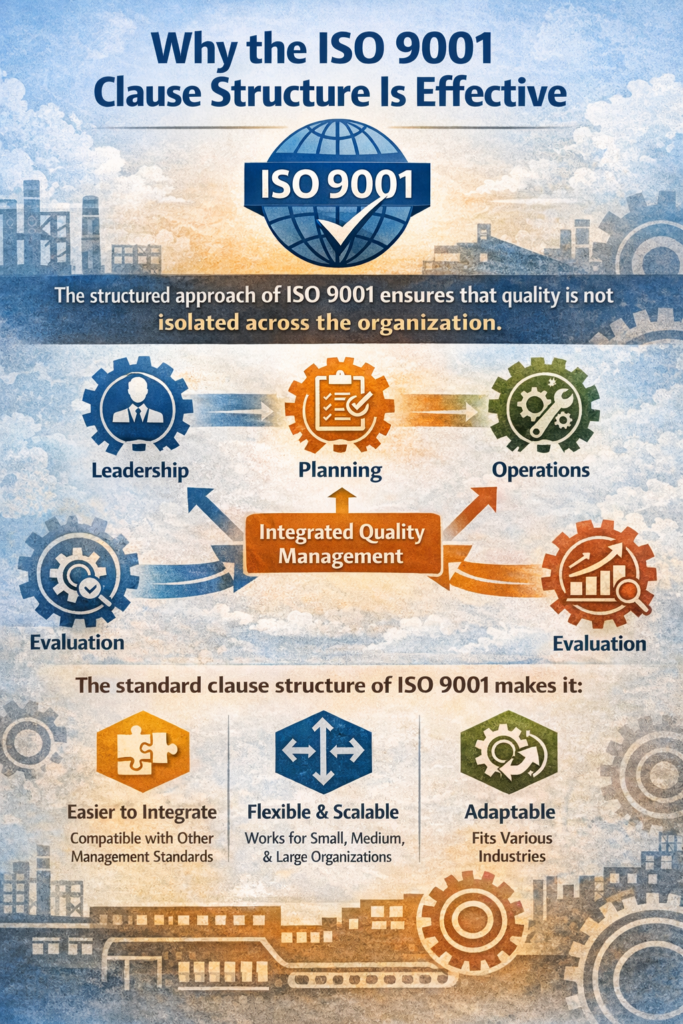
The structured approach of ISO 9001 ensures that quality is not isolated within one department. Instead, it integrates leadership, planning, operations, and evaluation into a single framework.
Because ISO 9001 follows a standardized clause structure, it is easier to integrate with other management system standards. This makes ISO 9001 flexible, scalable, and adaptable across industries.
Common Misunderstandings About ISO 9001 Clauses
One of the most common misunderstandings about ISO 9001 is the belief that its clauses are rigid, overly complex, or heavily focused on documentation. Many organizations assume that ISO 9001 requires excessive paperwork and fixed procedures that restrict flexibility. In reality, ISO 9001 is designed to be outcome-focused rather than prescriptive. The clauses define what needs to be achieved, not how it must be done. This allows organizations to design processes that suit their size, structure, and operational needs while still meeting ISO 9001 requirements.
Another frequent misconception is that ISO 9001 is suitable only for large organizations with dedicated quality departments. The clause structure of ISO 9001 is intentionally scalable. Small and medium-sized organizations can implement ISO 9001 using simpler systems, fewer documents, and leaner processes. ISO 9001 adapts to the organization, not the other way around. Whether an organization has ten employees or thousands, ISO 9001 focuses on consistency, customer satisfaction, and continual improvement.
Some also believe that ISO 9001 is a one-time certification activity. In truth, ISO 9001 emphasizes ongoing performance evaluation, internal audits, and improvement. The clauses encourage organizations to regularly review risks, measure results, and refine processes. This makes ISO 9001 a living management system rather than a static compliance exercise.
Final Thoughts
Understanding the clause structure of ISO 9001 removes uncertainty and builds confidence during implementation. Each clause in ISO 9001 has a clear purpose, guiding organizations toward structured planning, strong leadership involvement, controlled operations, and continuous improvement. When organizations understand how the clauses connect, ISO 9001 becomes easier to implement and maintain.
Rather than viewing ISO 9001 as a compliance burden, organizations that understand its clause structure recognize it as a practical and strategic business tool. ISO 9001 helps improve operational control, clarify responsibilities, and strengthen decision-making. Over time, ISO 9001 supports consistent quality, improved customer trust, and sustainable growth.
By approaching ISO 9001 with the right understanding, organizations unlock its real value. The clause structure of ISO 9001 provides a roadmap for long-term performance, resilience, and credibility. When implemented thoughtfully, ISO 9001 becomes an integral part of how an organization operates, improves, and succeeds in a competitive environment.