
The Smart Way to Get ISO 22000 Certification
Food safety is no longer just a regulatory requirement—it is a critical factor that influences customer trust, brand reputation, and global market access. Organizations involved in food production, processing, storage, transportation, or distribution must demonstrate that food safety risks are effectively controlled. This is where ISO 22000 certification plays a vital role.
However, achieving certification is not just about passing an audit. The smart way to approach ISO 22000 certification is by understanding its purpose, planning strategically, and embedding food safety into everyday operations. When implemented thoughtfully, the certification becomes a powerful business tool rather than an administrative burden.
Understanding the Purpose of ISO 22000 Certification
At its core, ISO 22000 certification is designed to help organizations establish a robust food safety management system. The standard integrates hazard analysis, risk-based thinking, and continuous improvement into a structured framework that applies across the entire food supply chain.
Unlike basic compliance standards, ISO 22000 certification focuses on prevention rather than reaction. It encourages organizations to identify potential food safety hazards early, control them effectively, and monitor performance consistently. This proactive approach reduces the likelihood of food safety incidents while improving operational discipline.
A smart certification journey begins with recognizing that ISO 22000 certification is not about documentation alone, but about building a culture where food safety is a shared responsibility.
Why a Strategic Approach Matters
Many organizations fail to gain long-term value from ISO 22000 certification because they rush implementation or treat it as a checklist exercise. A smart approach focuses on readiness rather than speed.
Strategic planning allows organizations to align food safety objectives with business goals. This includes defining roles, allocating resources, and integrating food safety controls into existing workflows. When ISO 22000 certification is aligned with daily operations, implementation becomes smoother and more sustainable.
By adopting a structured and realistic roadmap, organizations reduce audit stress and ensure that certification delivers real operational improvements.
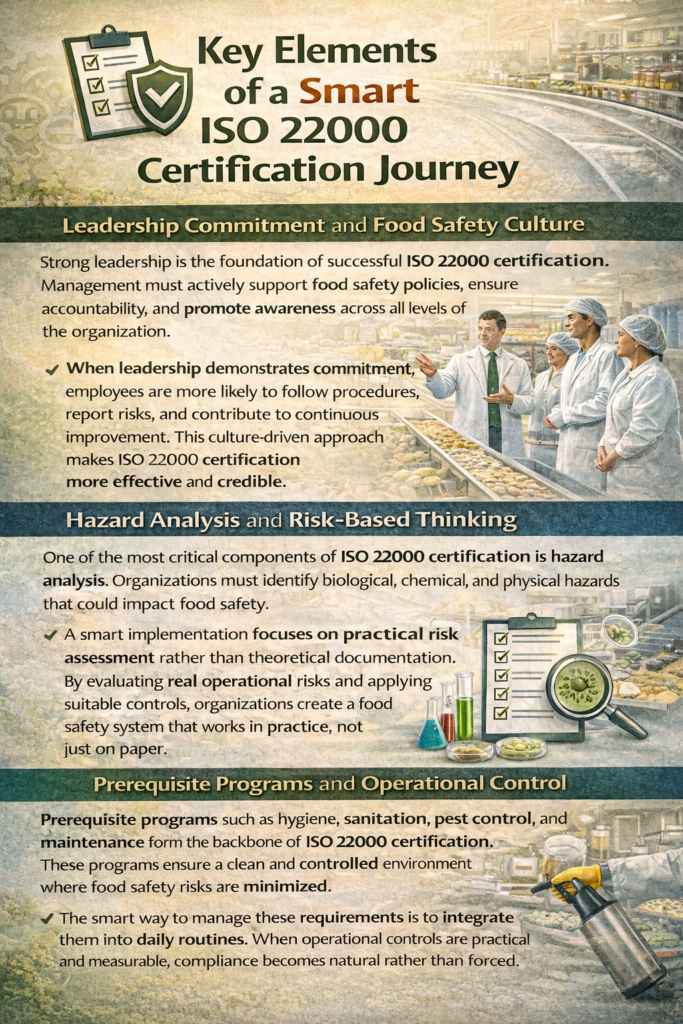
Key Elements of a Smart ISO 22000 Certification Journey
Leadership Commitment and Food Safety Culture
Strong leadership is the foundation of successful ISO 22000 certification. Management must actively support food safety policies, ensure accountability, and promote awareness across all levels of the organization.
When leadership demonstrates commitment, employees are more likely to follow procedures, report risks, and contribute to continuous improvement. This culture-driven approach makes ISO 22000 certification more effective and credible.
Hazard Analysis and Risk-Based Thinking
One of the most critical components of ISO 22000 certification is hazard analysis. Organizations must identify biological, chemical, and physical hazards that could impact food safety.
A smart implementation focuses on practical risk assessment rather than theoretical documentation. By evaluating real operational risks and applying suitable controls, organizations create a food safety system that works in practice, not just on paper.
Prerequisite Programs and Operational Control
Prerequisite programs such as hygiene, sanitation, pest control, and maintenance form the backbone of ISO 22000 certification. These programs ensure a clean and controlled environment where food safety risks are minimized.
The smart way to manage these requirements is to integrate them into daily routines. When operational controls are practical and measurable, compliance becomes natural rather than forced.
Documentation Without Complexity
A common misconception is that ISO 22000 certification requires excessive documentation. In reality, the standard emphasizes effectiveness over volume.
Smart organizations create clear, concise, and relevant documents that reflect actual processes. Procedures, records, and policies should support operations, not slow them down. Well-structured documentation simplifies audits and helps employees understand their responsibilities.
Training and Employee Involvement
Employee awareness plays a critical role in achieving and maintaining ISO 22000 certification. Training should focus on practical food safety responsibilities rather than generic theory.
When employees understand how their actions impact food safety, compliance improves naturally. Ongoing training also supports adaptability, helping organizations respond to changing risks and regulatory expectations.
Internal Audits and Performance Evaluation
Internal audits are not just a requirement of ISO 22000 certification—they are a powerful improvement tool. A smart audit process identifies weaknesses before they become major issues.
By analyzing audit results, monitoring performance indicators, and reviewing corrective actions, organizations strengthen their food safety management system over time. This proactive evaluation ensures long-term compliance and continuous improvement.
Certification Audit Readiness
Preparing for the certification audit is a critical step in the ISO 22000 certification journey. Smart organizations treat audits as opportunities to validate their system rather than events to fear.
Audit readiness involves ensuring that processes are followed consistently, records are complete, and employees understand their roles. When systems are embedded into daily operations, audits become straightforward and confidence-driven.
Long-Term Benefits of ISO 22000 Certification
The true value of ISO 22000 certification lies in its long-term impact. Certified organizations benefit from improved food safety performance, reduced risk of recalls, and stronger customer confidence.
Additionally, ISO 22000 certification enhances market credibility, supports regulatory compliance, and opens doors to new business opportunities. It demonstrates that food safety is managed systematically and responsibly.
Over time, organizations also experience improved efficiency, better communication, and greater operational control.

Maintaining Certification Through Continuous Improvement
Achieving ISO 22000 certification is only the beginning of a long-term commitment to food safety excellence. To remain effective, ISO 22000 certification requires organizations to continuously monitor processes, review performance data, and evaluate food safety risks on an ongoing basis. Regular internal audits and management reviews help ensure that the food safety management system stays aligned with operational realities and regulatory expectations.
A smart maintenance approach to ISO 22000 certification focuses on learning from real-world performance rather than relying only on documented procedures. Nonconformities, customer feedback, and audit findings should be treated as opportunities for improvement. By addressing root causes and strengthening preventive controls, organizations reinforce the value of ISO 22000 certification year after year.
Continuous improvement also involves adapting to changes such as new raw materials, process modifications, or evolving food safety regulations. When these changes are proactively managed, ISO 22000 certification remains relevant and robust. Organizations that embed improvement into daily operations not only maintain ISO 22000 certification, but also build stronger food safety culture, resilience, and long-term stakeholder trust.
Final Thoughts: The Smart Way Forward
The smart way to achieve ISO 22000 certification is by focusing on building a strong, practical, and sustainable food safety management system rather than treating certification as a short-term goal. Organizations that rush toward audits often struggle with long-term compliance, while those that prioritize system effectiveness gain lasting value. ISO 22000 certification works best when food safety controls are embedded into daily operations and decision-making processes.
A key factor in successful ISO 22000 certification is employee involvement. Food safety cannot be managed by documentation alone; it requires awareness, accountability, and consistent practices at every level. When employees understand their role in maintaining food safety, ISO 22000 certification becomes a shared responsibility rather than a management-driven task. This collaborative approach strengthens compliance and reduces operational risks.
Viewing ISO 22000 certification as a strategic investment also changes how organizations approach implementation. Instead of focusing only on audit readiness, businesses begin to see improvements in process control, risk prevention, and customer confidence. ISO 22000 certification helps organizations identify hazards early, establish preventive controls, and respond effectively to changing food safety challenges.
Long-term success with ISO 22000 certification depends on continuous improvement. Regular internal audits, performance reviews, and corrective actions ensure that the food safety management system remains effective and relevant. Organizations that use ISO 22000 certification as a framework for ongoing improvement are better prepared to adapt to regulatory changes, market expectations, and supply chain risks.Ultimately, ISO 22000 certification provides more than compliance—it delivers trust, resilience, and credibility. Customers, partners, and stakeholders gain confidence knowing that food safety is managed systematically and responsibly. With the right mindset, careful planning, and strong leadership commitment, ISO 22000 certification becomes a powerful foundation for sustainable food safety excellence and long-term business growth.