
Why Do Companies Want to Be ISO Certified?
In today’s competitive business environment, organizations are constantly looking for ways to improve quality, strengthen customer confidence, and stand out in the marketplace. Getting ISO certification is one of the most effective ways to reach these goals. Across industries such as manufacturing, healthcare, construction, logistics, education, food processing, and information technology, businesses are recognizing the value of implementing internationally accepted management standards.
The growing demand for iso certification companies in india reflects this trend, as organizations seek guidance to implement globally recognized management systems that improve operational performance and compliance. However, achieving ISO certification is about much more than earning a certificate. It is a strategic investment that helps businesses improve processes, reduce risks, and create long-term value.
In this article, we’ll explore why companies choose to become ISO certified, the benefits they gain, and how certification contributes to sustainable business growth.
What Is ISO Certification?
ISO certification is a formal recognition that an organization has implemented a management system that meets the requirements of a specific International Organization for Standardization (ISO) standard. These standards provide frameworks for managing quality, environmental responsibility, occupational health and safety, information security, food safety, energy management, and other important business functions.
Organizations work with iso certification companies in india to establish documented processes, improve operational controls, conduct internal audits, and undergo independent assessments to demonstrate conformity with the selected ISO standard.
The ultimate objective is not simply compliance but continual improvement and consistent delivery of products and services that meet customer and regulatory expectations.
Why Is ISO Certification Becoming More Important?
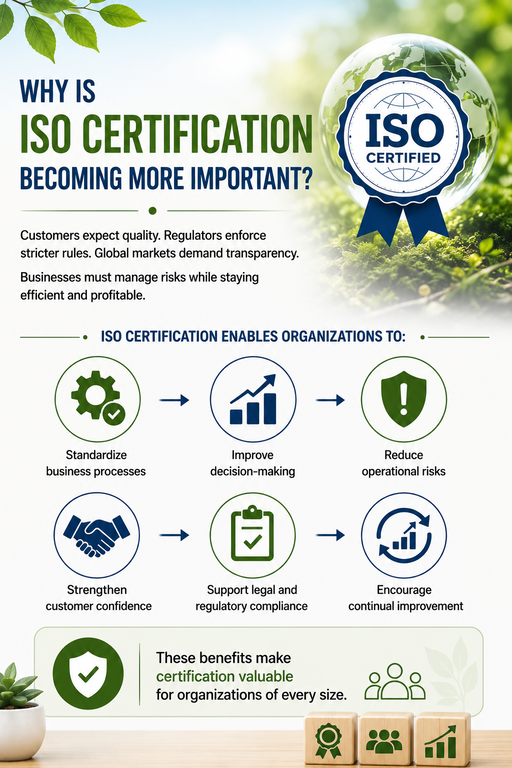
Businesses today operate in an environment where customers expect consistent quality, regulators enforce stricter compliance requirements, and global markets demand greater transparency. Companies must also manage operational risks while maintaining efficiency and profitability.
ISO certification provides a structured management approach that enables organizations to:
- Standardize business processes
- Improve decision-making
- Reduce operational risks
- Strengthen customer confidence
- Support legal and regulatory compliance
- Encourage continual improvement
These benefits make certification valuable for organizations of every size.
Top Reasons Companies Want to Be ISO Certified
1. Builds Customer Trust
Customer confidence is one of the strongest reasons organizations pursue ISO certification.
When customers know a company follows internationally recognized standards, they gain greater confidence in the quality, consistency, and reliability of its products or services.
Many organizations seeking support from iso certification companies in india do so because certification helps strengthen customer relationships and enhance brand credibility.
2. Improves Product and Service Quality
ISO standards encourage organizations to establish consistent procedures that reduce variation and improve quality.
Rather than relying on individual experience alone, businesses develop standardized processes for:
- Planning
- Production
- Service delivery
- Monitoring
- Corrective actions
- Performance evaluation
This structured approach results in more consistent products and better customer experiences.
3. Enhances Operational Efficiency
Inefficient processes often lead to delays, errors, rework, and unnecessary costs.
ISO certification helps organizations identify process weaknesses and implement improvements that increase efficiency.
Benefits include:
- Reduced waste
- Improved workflow
- Better resource utilization
- Faster decision-making
- More effective communication
These improvements contribute to stronger organizational performance.
4. Supports Regulatory Compliance
Every industry operates under specific legal and regulatory requirements.
Implementing an ISO management system helps organizations establish processes for identifying applicable regulations and ensuring ongoing compliance.
This proactive approach reduces the likelihood of:
- Regulatory violations
- Legal penalties
- Compliance failures
- Operational disruptions
Maintaining compliance also improves confidence among customers and stakeholders.
5. Strengthens Risk Management
Modern businesses face a wide range of operational risks, including quality failures, workplace incidents, environmental challenges, cybersecurity threats, and supply chain disruptions.
ISO standards encourage organizations to think about risks by helping them to:
- Identify potential risks
- Evaluate their impact
- Implement preventive controls
- Monitor effectiveness
- Continuously improve processes
Many organizations consult iso certification companies in india to build stronger risk management systems that support long-term business resilience.
6. Increases Employee Engagement
Employees perform better when responsibilities are clearly defined and processes are well organized.
ISO implementation promotes:
- Employee training
- Clear communication
- Defined responsibilities
- Continuous learning
- Performance evaluation
Involving employees in quality and improvement initiatives creates a stronger organizational culture while increasing motivation and accountability.
7. Improves Market Opportunities
Many customers, government agencies, and multinational organizations prefer working with ISO-certified businesses.
Certification can improve opportunities by helping organizations:
- Participate in competitive tenders
- Expand into international markets
- Meet supplier qualification requirements
- Strengthen business partnerships
For many companies, certification becomes an important factor in business growth strategies.
8. Encourages Continual Improvement
A key part of ISO standards is the focus on continuous improvement.
Organizations regularly evaluate:
- Business objectives
- Customer feedback
- Operational performance
- Audit findings
- Risk assessments
- Corrective actions
This ongoing review helps businesses adapt to changing customer expectations while maintaining high performance.
9. Reduces Operational Costs
Although certification requires planning and implementation, the long-term savings can be significant.
Improved process control helps reduce:
- Product defects
- Customer complaints
- Rework
- Production delays
- Resource waste
- Equipment downtime
Greater efficiency often translates into lower operating costs and improved profitability.
10. Enhances Business Reputation
A positive reputation is essential for attracting customers, investors, employees, and business partners.
Organizations that achieve certification demonstrate their commitment to internationally accepted management practices.
Working with experienced iso certification companies in india enables businesses to implement robust systems that strengthen their credibility in competitive markets.
Industries That Benefit from ISO Certification
ISO standards are designed to be flexible and applicable across diverse sectors.
Industries that commonly pursue certification include:
- Manufacturing
- Construction
- Healthcare
- Education
- Food processing
- Pharmaceuticals
- Information technology
- Logistics and transportation
- Hospitality
- Retail
- Engineering
- Automotive
- Energy
- Agriculture
- Professional services
Regardless of industry, organizations benefit from improved management systems and greater operational consistency.
Common ISO Standards Businesses Choose
Depending on their objectives, organizations may implement different ISO standards.
Some of the most widely adopted include:
- ISO 9001 for quality management
- ISO 14001 for environmental management
- ISO 45001 for occupational health and safety
- ISO 22000 for food safety management
- ISO/IEC 27001 for information security management
- ISO 50001 for energy management
Each standard focuses on a specific area while following a similar management system approach.
How Companies Achieve ISO Certification
Organizations typically follow several key stages when pursuing certification.
Understand the Standard
Management studies the applicable ISO standard and identifies its requirements.
Conduct a Gap Analysis
Current processes are evaluated to determine areas requiring improvement.
Develop the Management System
Policies, procedures, objectives, and operational controls are established.
Train Employees
Staff members receive training to understand their responsibilities within the management system.
Implement the System
The documented processes become part of daily operations.
Conduct Internal Audits
Organizations verify that the management system functions effectively.
Management Review
Leadership evaluates performance and identifies improvement opportunities.
Certification Audit
An independent assessment confirms conformity with the applicable ISO standard.
Continuous Improvement
Organizations regularly monitor, review, and improve their management systems to maintain certification and enhance performance.
Long-Term Value of ISO Certification
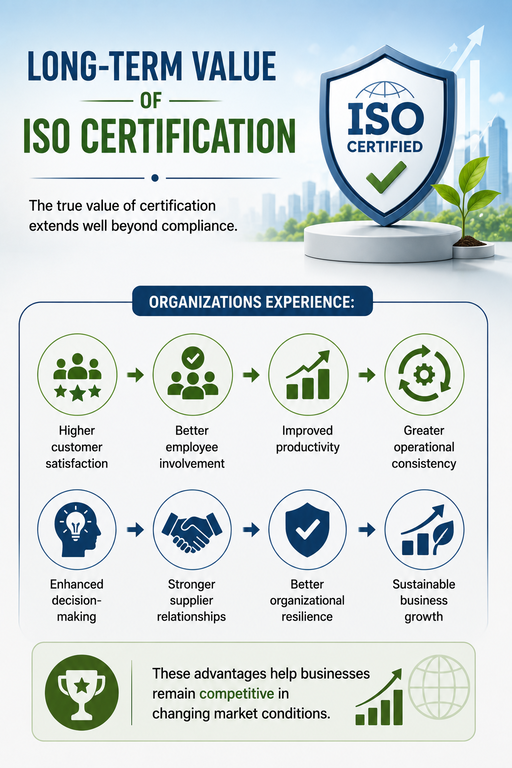
The true value of certification extends well beyond compliance.
Organizations that successfully implement ISO management systems often experience:
- Higher customer satisfaction
- Better employee involvement
- Improved productivity
- Greater operational consistency
- Enhanced decision-making
- Stronger supplier relationships
- Better organizational resilience
- Sustainable business growth
These advantages help businesses remain competitive in changing market conditions.
Conclusion
Companies pursue ISO certification because it provides a structured framework for improving quality, managing risks, enhancing efficiency, and building customer trust. Rather than serving as a one-time achievement, certification promotes a culture of continual improvement that supports long-term organizational success.
The increasing demand for iso certification companies in india highlights the growing recognition that internationally accepted management standards help businesses strengthen operations, improve compliance, and compete more effectively in domestic and global markets.
Whether an organization seeks to improve quality, environmental performance, workplace safety, food safety, or information security, implementing a robust ISO management system offers measurable benefits that extend throughout every level of the business.