
ISO 45001 vs OSHA: Key Differences You Must Know
Workplace safety is no longer just a regulatory requirement, it’s a strategic priority for modern organizations. Businesses across industries are actively adopting structured safety systems to reduce risks, improve employee well-being, and enhance operational efficiency. Two of the most discussed frameworks in this space are OSHA regulations and iso 45001 Certification.
While both focus on occupational health and safety, they are fundamentally different in purpose, structure, and implementation. Understanding these differences is essential for organizations aiming to build a strong safety culture while staying compliant with legal obligations.
What is ISO 45001 Certification?
ISO 45001 is an international standard designed to help organizations establish a robust Occupational Health and Safety Management System (OHSMS). It provides a structured framework to identify risks, prevent workplace injuries, and continuously improve safety performance.
Unlike traditional compliance-based systems, iso 45001 Certification emphasizes a proactive approach. Organizations are required to anticipate risks and implement preventive measures before incidents occur.
This global standard is applicable to businesses of all sizes and industries, making it a preferred choice for companies operating internationally. By adopting iso 45001 Certification, organizations demonstrate their commitment to employee safety and continuous improvement.
What is OSHA?
OSHA (Occupational Safety and Health Administration) is a regulatory body in the United States responsible for enforcing workplace safety laws. OSHA sets mandatory standards that organizations must follow to ensure safe working conditions.
Unlike ISO 45001, OSHA is not a certification but a legal requirement. It establishes rules, conducts inspections, and imposes penalties for non-compliance.
The primary goal of OSHA is to ensure that employers provide a workplace free from recognized hazards. While it offers guidelines and training, its focus is on enforcement rather than continuous improvement.
ISO 45001 vs OSHA: Core Differences
Understanding how iso 45001 Certification differs from OSHA is crucial for making informed decisions.
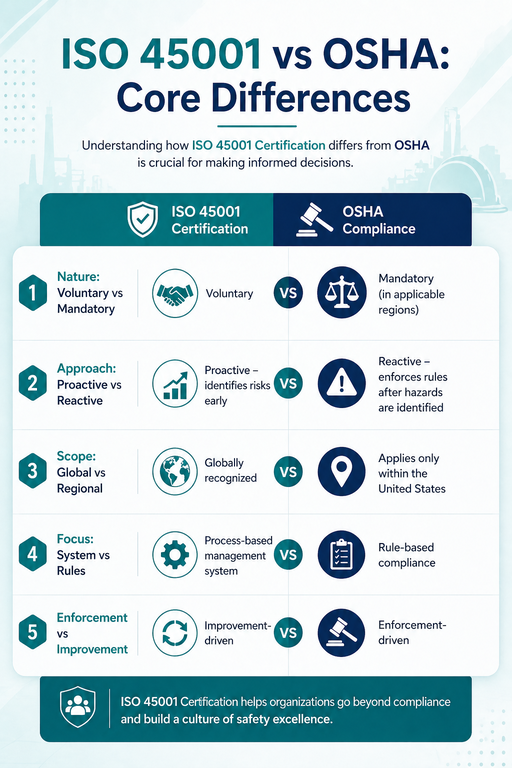
1. Nature: Voluntary vs Mandatory
One of the biggest differences lies in their nature:
- ISO 45001 Certification is voluntary
- OSHA compliance is mandatory (in applicable regions)
Organizations choose iso 45001 Certification to improve their safety systems and gain a competitive advantage. On the other hand, OSHA compliance is legally required and enforced through inspections and penalties.
2. Approach: Proactive vs Reactive
ISO 45001 follows a proactive approach by identifying risks before they lead to accidents. OSHA, however, is more reactive, focusing on enforcing rules after hazards are identified.
Research shows that ISO 45001 requires organizations to evaluate risks and implement preventive measures early.
This makes iso 45001 Certification a forward-thinking framework compared to OSHA’s compliance-based model.
3. Scope: Global vs Regional
- ISO 45001 Certification is globally recognized
- OSHA regulations apply only within the United States
For businesses operating internationally, ISO 45001 offers a standardized approach across multiple regions. OSHA, however, is limited to U.S. jurisdiction.
4. Focus: System vs Rules
ISO 45001 focuses on building a comprehensive management system, while OSHA emphasizes adherence to specific safety rules.
- ISO 45001 Certification: Process-based system
- OSHA: Rule-based compliance
This means ISO 45001 integrates safety into everyday operations, whereas OSHA ensures minimum safety standards are met.
5. Enforcement vs Improvement
OSHA enforces compliance through inspections and penalties. ISO 45001 promotes continuous improvement without legal enforcement.
- OSHA: Enforcement-driven
- ISO 45001 Certification: Improvement-driven
Organizations adopting ISO 45001 aim to go beyond compliance and create a culture of safety excellence.
Can ISO 45001 Replace OSHA?
A common misconception is that iso 45001 Certification can replace OSHA compliance. This is not true.
ISO 45001 complements OSHA but does not replace it. Organizations must still comply with OSHA regulations where applicable.
In fact, many businesses use both frameworks together:
- OSHA ensures legal compliance
- ISO 45001 enhances safety performance
Combining both creates a stronger and more effective safety system.
Benefits of ISO 45001 Certification Over OSHA Alone
While OSHA ensures compliance, iso 45001 Certification offers additional benefits:
✔ Improved Risk Management
ISO 45001 focuses on identifying and controlling risks before they occur, reducing workplace incidents.
✔ Enhanced Employee Engagement
Employees play an active role in safety processes, improving awareness and accountability.
✔ Global Recognition
ISO 45001 is recognized worldwide, making it ideal for multinational organizations.
✔ Continuous Improvement
The standard encourages ongoing evaluation and improvement of safety systems.
✔ Competitive Advantage
Organizations with iso 45001 Certification gain credibility and trust among clients and stakeholders.
When Should Businesses Choose ISO 45001?
ISO 45001 is ideal for organizations that:
- Want to go beyond basic compliance
- Operate in multiple countries
- Aim to reduce workplace risks proactively
- Seek long-term operational excellence
For such businesses, iso 45001 Certification provides a structured and scalable solution.
Challenges in Implementing ISO 45001
Despite its benefits, achieving iso 45001 Certification comes with challenges:
- Extensive documentation requirements
- Need for employee training
- Integration with existing systems
- Time and resource investment
However, the long-term benefits are usually greater than these challenges.
ISO 45001 and OSHA: A Strategic Combination
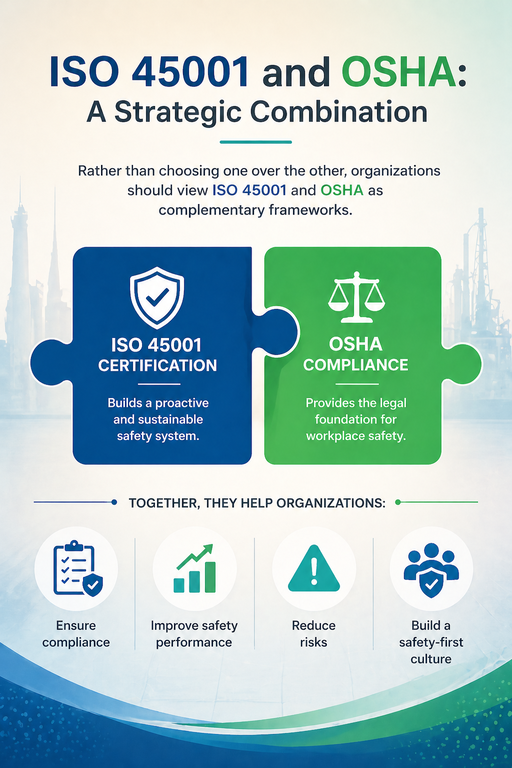
Rather than choosing one over the other, organizations should view ISO 45001 and OSHA as complementary frameworks.
OSHA provides the legal foundation for workplace safety, while iso 45001 Certification builds a proactive and sustainable safety system.
Together, they help organizations:
- Ensure compliance
- Improve safety performance
- Reduce risks
- Build a safety-first culture
Final Thoughts
When comparing ISO 45001 and OSHA, it becomes clear that both frameworks serve distinct yet complementary purposes in workplace safety. OSHA focuses on enforcing legal compliance and ensuring that organizations meet mandatory safety standards. In contrast, iso 45001 Certification provides a structured and proactive approach that helps businesses go beyond basic compliance and achieve higher levels of occupational health and safety performance.
For modern organizations, relying only on regulatory compliance is no longer sufficient. Workplace risks are constantly evolving due to technological advancements, changing work environments, and increasing operational complexities. This is where iso 45001 Certification plays a crucial role. It enables organizations to identify potential hazards in advance, implement preventive measures, and create a culture of continuous improvement. By adopting iso 45001 Certification, businesses can shift from a reactive approach to a proactive safety strategy.
Another important aspect to consider is the integration of both frameworks. Organizations that combine OSHA compliance with iso 45001 Certification can build a more comprehensive safety management system. OSHA ensures that legal requirements are met, while iso 45001 Certification enhances internal processes, risk management, and employee involvement. This integrated approach not only minimizes workplace incidents but also improves overall operational efficiency.
Employee engagement is also significantly improved when organizations implement iso 45001 Certification. Workers become more aware of safety practices and actively participate in maintaining a secure work environment. This leads to fewer accidents, reduced downtime, and increased productivity. In addition, businesses that achieve iso 45001 Certification often gain greater trust from stakeholders, clients, and partners, as it reflects a strong commitment to safety and responsibility.
In today’s competitive business landscape, organizations must prioritize long-term sustainability and resilience. Investing in iso 45001 Certification is not just about meeting international standards; it is about building a safer, smarter, and more efficient workplace. Companies that embrace iso 45001 Certification position themselves as industry leaders who value employee well-being and operational excellence.
Ultimately, the combination of compliance and continuous improvement is the key to success. By integrating OSHA regulations with iso 45001 Certification, organizations can create a balanced safety strategy that protects employees, strengthens reputation, and drives sustainable growth.